
- Joined
- Aug 15, 2023
- Threads
- 3
- Messages
- 71
- Reaction score
- 23
- Location
- southeast michigan
- Vehicle(s)
- Bronco
- Your Bronco Model
- Badlands
- Thread starter
- #76
Ok thanks for the info. It doesn't really apply. But it's interesting
Sponsored
I addressed this earlier, but I don't know specifically which brand. There are dozens on the market and it would be really bad for business if they seized engines. Most do have an EP additive to help protect bearings and cams during the process.Not water related. You stated that your independent shop changed the oil and then flushed it and changed again. What did they flush it with? Is it possible that they washed the bearings of lube? That would kind of explain the seizure after a few miles.
I think what @HoosierDaddy is saying is what if your mud related incident had nothing to do with it at all? Just happened the block cracked because it was one of the defective ones, and picked that time to do it? Sure...long odds, but not impossible. Should be able to pressure test the cooling system...if it wont hold pressure, yet has no external leaks...then there is your answer. Should check if your engine's build date is in the affected range...that would at least give you a fair argument!I dont know about the coolant level, but I don't think that had anything to do with it, since it was driven at least 30 miles before it seized. It didn't hydrolock, it seized well after the 'incident'
This situation is quite puzzling. Certainly leaving the engine running may have avoided all of these issues (other than the alternator).The tailpipe was never in the water. And it never stalled. I left it running for a minute or two and decided maybe it's better to shut it off. But it sat there idling with no hesitation whatsoever. I started it back up to help with the tow and same thing, ran fine. After pulling it out, I got a charging system warning. At first it ran ok then stuttered a little bit, that's when I checked the dipstick and yeah there was water in the oil. Immediately went for filter and oil and changed it. But I didn't run it after that, towed to a indy service station who changed oil, flushed it, and changed it again. Dealer did the TSB on the alternator and let it go back to the indy. It started running bad after it warmed up and he checked oil, found metal sheen in it, changed oil again and it seized up.
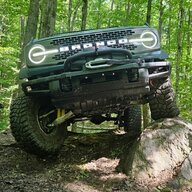
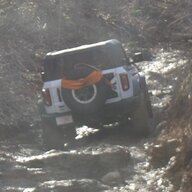
I do have pictures showing the water level below the headlights, a couple inches over the bumper. I need to measure another sasquatch to see if that's less than 33.5".
Thanks for your time and input.
I didn’t drive it anywhere to change the oil. I left it in the parking lot and changed it there. I was thinking about the cracked head and while unlikely I suppose it is possible, with the temp change of the water and water splashing the engine from the cooling fan.This situation is quite puzzling. Certainly leaving the engine running may have avoided all of these issues (other than the alternator).
- Typically water ingested through the intake or exhaust (which includes the intercooler charge pipe) would remain on the top side of the engine and not get a significant amount of water into the crankcase. A large amount of water in the intake would most likely hydrolock it on re-start.
- Shutting off the engine while it is partially submerged would lead to more rapid cooling of the crankcase area. That would likely create a vacuum which could suck water that was on the top side down to the crankcase.
- As soon as you pulled the Bronco out of the mud hole, you checked the dipstick and noticed the water in the oil. Was it a milkshake already or was it distinctly water and oil separated? How far did you have to drive it before you went to get the oil changed?
- It's unlikely that any defect with the 2.3 crankcase would also appear simultaneously to the mud hole incident so that can likely be ruled out unless rapid cooling of the block in the water caused a problem. But that should be noticed by a drop in the coolant level.
I think you should re-post those pics. It was hilarious to see how deep you stuffed the nose of your Bronco into that
Hi FlipI've yet to see one that slugged water and didn't lock or knock almost immediately. It's possible it got enough to bend a rod leading to rod bearing damage later but it would likely have thrown a misfire or crank revolution speed code along with a light knock. If it got water in the intake, there would probably be some evidence of that somewhere in the piping.
The more I think about this the more it makes me feel like the "flush" could've been the contributing factor to the failure. Again, more testing would need to be done to determine the failed causal part to maybe narrow down the cause. Intake smoking, pulling plugs and checking with a borescope for washed piston(s) or cylinder wall damage (bent rod). If this all happened in the bottom end, the cooling system could be pressure tested to verify it was intact which only leaves a couple other possibilities. Those would be water entering through the oil fill, dipstick tube, crank seals (very unlikely) or aliens.
While flushes may be common in the industry, they are absolutely not recommended by Ford. I did a writeup several months ago which included my opinion on so called "flushes" along with Ford's position statements.Hi Flip
Why do you think the flush would have anything to do with it? I wanted to have whatever water and contaminants flushed out and replaced with new oil. Flushes are pretty common and widely used in the industry for engine/trans/power steering/radiator.
I have no idea how it happened but everything appears to me that the dirty water started at the bottom and eventually worked its way through the piston rings after wearing away at them. I have no other way to see it given the way the car acted and fired completely normally until the failure. Except for the charging system fault. The Indy did say as the car started running bad the second time he drove it 15 miles (back from dealer) that it threw a code. I can't remember exactly but it had something to do with the timing I believe. Don't know if that means anything because by then I think the internals were pretty messed up.
I don’t know but thanks for this. I need to get them to explore other explanations, , I think they just went with the simplest.The link I have attached is over a year old however it does describe some issues with 2.7 failures which include an oil pan issue in which an oil tube becomes disconnected and sucks in air. Is it possible that yours sucked in water after being submerged? Link: Ford Bronco 2.7L V6 EcoBoost Engine Failures Explained: Exclusive (fordauthority.com)
I’ve started the process but get this. My insurance wanted to tow it to their facility to look at it. Dealer said if the Bronco leaves the dealer then the power train warranty would automatically be voided. I’m stunned that this could be true.How about filing an insurance claim? Not sure, but you comprehensive might cover it. Kind of like if you ran into a tree or backed into something.