
Sponsored
Raptor Tailgate Hinges installed with Hammerbilt Bracket
Loading



- First Name
- Frank
- Joined
- Jan 16, 2020
- Threads
- 16
- Messages
- 249
- Reaction score
- 664
- Location
- San Mateo, California
- Website
- www.instagram.com
- Vehicle(s)
- 2021 First Edition | 4 Door | Cactus Grey
- Your Bronco Model
- First Edition
You can add another Baja test to the list. Just got back form a 6 day off-roading excursion, and was BLOWN AWAY by the support that just the tailgate reinforcement plate provided comparative to the many trips I've done without it. All of the wobble and shake of the 35" spare (loaded with an American Adventure Lab spare tire platform, Maxtrax, and full Roam 95L Rugged Case) was completely gone. Like.... completely gone. The quality of just that plate alone is incredibly impressive, and I have no doubt that the engineering and build materials used by Tyson to make the hinges is going to just provide even more peace of mind.The original design has been Baja proven with dual 2 gallon rotopax, and a 37" tire. The HD bracket was conceived for the regular bronco owners who want to carry even more weight a 5 gallon jerry can and/or a spare tire platform rack with offroad boxes full of gear... It will also fit the Bronco raptor of course...
I don't (yet) have the Raptor hinges, but I definitely plan to install as soon as I can get them from HammerBuilt. I'll be posting more photos and some videos on my account once I have a chance to edit, but take it from me that this is a no-brainer upgrade for anyone adding weight to their tailgate/spare tire.
- First Name
- Frank
- Joined
- Jan 16, 2020
- Threads
- 16
- Messages
- 249
- Reaction score
- 664
- Location
- San Mateo, California
- Website
- www.instagram.com
- Vehicle(s)
- 2021 First Edition | 4 Door | Cactus Grey
- Your Bronco Model
- First Edition
Granted, that's because the table weight is supported by two thin cables, not some structural hinge that puts stress on the tailgate. So I wouldn't use that as a consideration for what the tailgate should support.My Ford Tailgate table says 25 lbs max…

Rad! Just installed the HB reinforcement and picked up that spare tire platform as well - glad it’s working for ya! Waiting anxiously for the HB hinges myself…You can add another Baja test to the list. Just got back form a 6 day off-roading excursion, and was BLOWN AWAY by the support that just the tailgate reinforcement plate provided comparative to the many trips I've done without it. All of the wobble and shake of the 35" spare (loaded with an American Adventure Lab spare tire platform, Maxtrax, and full Roam 95L Rugged Case) was completely gone. Like.... completely gone. The quality of just that plate alone is incredibly impressive, and I have no doubt that the engineering and build materials used by Tyson to make the hinges is going to just provide even more peace of mind.
I don't (yet) have the Raptor hinges, but I definitely plan to install as soon as I can get them from HammerBuilt. I'll be posting more photos and some videos on my account once I have a chance to edit, but take it from me that this is a no-brainer upgrade for anyone adding weight to their tailgate/spare tire.
I have been perplexed about this tailgate hinge load from the beginning of when the forum started talking about it. As an engineer these things swirl in my mind and I must solve "my concern".
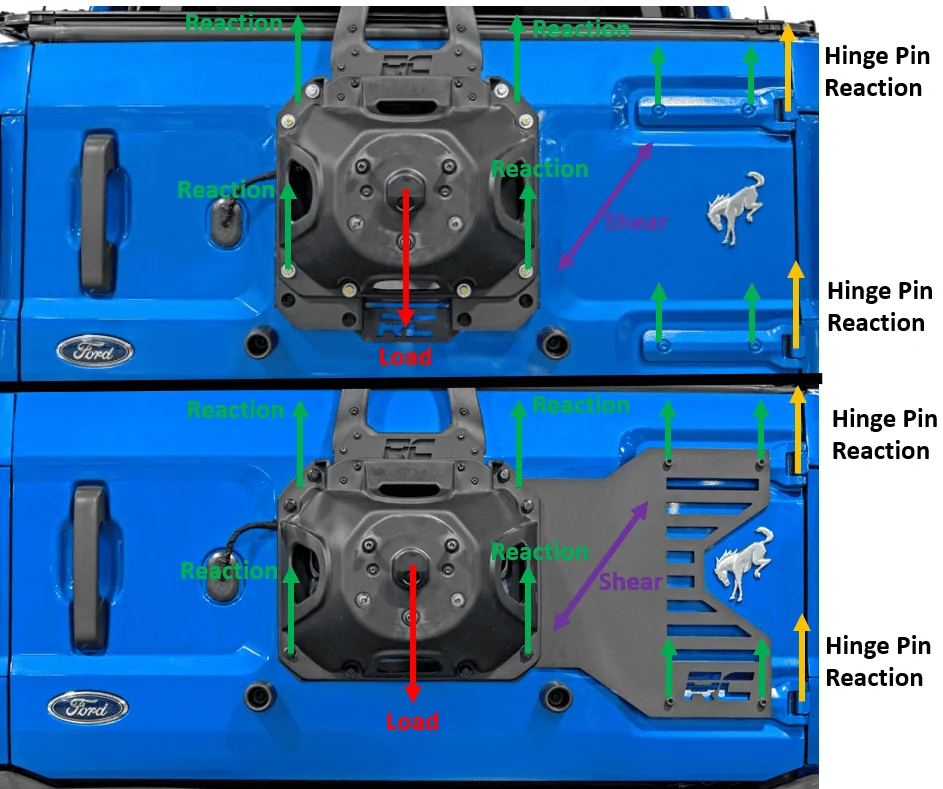
I created this picture to try and demonstrate my thoughts. Upper picture is no reinforcement and lower is with something. The ultimate goal is to be able to apply more LOAD (Red arrow) and have that distribute better on the tailgate. As I see the upper picture puts the shear load thru the tailgate sheet metal and ultimately would buckle if the Reactions we lower than the Load. Conversely the lower picture nicely adds extra metal to help that shear load....GREAT!!!!
....but my perplexion comes about what happens when you OPEN the tailgate with all that LOAD. Now the Hinge Pins must react that load and if you don't upgrade the hinge pins, the OEM load capability does not increase with a reinforcement plate "when the door is OPEN". I get replacing the hinges/pins with RAPTOR helps (assuming they are truly bigger/stronger) but SO many companies are making these reinforcement plates for any Bronco and do NOT require RAPTOR hinge upgrades. I believe the ultimate failure with more and more weight added to the tailgate is failure in the hinges.
Prove me wrong

I created this picture to try and demonstrate my thoughts. Upper picture is no reinforcement and lower is with something. The ultimate goal is to be able to apply more LOAD (Red arrow) and have that distribute better on the tailgate. As I see the upper picture puts the shear load thru the tailgate sheet metal and ultimately would buckle if the Reactions we lower than the Load. Conversely the lower picture nicely adds extra metal to help that shear load....GREAT!!!!
....but my perplexion comes about what happens when you OPEN the tailgate with all that LOAD. Now the Hinge Pins must react that load and if you don't upgrade the hinge pins, the OEM load capability does not increase with a reinforcement plate "when the door is OPEN". I get replacing the hinges/pins with RAPTOR helps (assuming they are truly bigger/stronger) but SO many companies are making these reinforcement plates for any Bronco and do NOT require RAPTOR hinge upgrades. I believe the ultimate failure with more and more weight added to the tailgate is failure in the hinges.
Prove me wrong
Sponsored
- First Name
- Frank
- Joined
- Jan 16, 2020
- Threads
- 16
- Messages
- 249
- Reaction score
- 664
- Location
- San Mateo, California
- Website
- www.instagram.com
- Vehicle(s)
- 2021 First Edition | 4 Door | Cactus Grey
- Your Bronco Model
- First Edition
I don't think there's necessarily anything to prove wrong, IMO. I think this is a pretty solid breakdown of the issue, and from the conversations I've had with Tyson, this is precisely why the Raptor Hinges are being developed. But I would just point out you're solving for two different problems here, and one seems to occur before the other, making the two products useful, but for different reasons.I have been perplexed about this tailgate hinge load from the beginning of when the forum started talking about it. As an engineer these things swirl in my mind and I must solve "my concern".
I created this picture to try and demonstrate my thoughts. Upper picture is no reinforcement and lower is with something. The ultimate goal is to be able to apply more LOAD (Red arrow) and have that distribute better on the tailgate. As I see the upper picture puts the shear load thru the tailgate sheet metal and ultimately would buckle if the Reactions we lower than the Load. Conversely the lower picture nicely adds extra metal to help that shear load....GREAT!!!!
....but my perplexion comes about what happens when you OPEN the tailgate with all that LOAD. Now the Hinge Pins must react that load and if you don't upgrade the hinge pins, the OEM load capability does not increase with a reinforcement plate "when the door is OPEN". I get replacing the hinges/pins with RAPTOR helps (assuming they are truly bigger/stronger) but SO many companies are making these reinforcement plates for any Bronco and do NOT require RAPTOR hinge upgrades. I believe the ultimate failure with more and more weight added to the tailgate is failure in the hinges.
Prove me wrong
The load distribution on the tailgate itself (represented by the shear force?) is poorly distributed from factory. Even my 35" Falken A/T3W on my Fifteen52 wheel is enough to cause creaks and wobbles, and if I mount anything else to the tire it just gets worse. Maybe this weight also creates excessive force on the hinge pins, but in my nearly 2 years of using the truck, it hasn't caused any misalignment. So I'd say up to a certain weight (some weight beyond the OEM rating, lets call it "X lbs"), the reinforcement plate will help distribute the weight better and reduce flex, which ultimately reduces the frequency that all that force is applying against that shear angle.
What I really consider to be "Stage II reinforcement" is reinforcing the hinges, which I think the HammerBuilt raptor hinges are going to do well, following in the same design as Ford's engineers. I admin I'm not sure if the pins are the actual part that need the added strength, though, so much as the hinge pieces themselves connected by the pin. But yeah, addressing the hinge components in some capacity is necessary for any payload > X, described above.
So both items serve a purpose, but the plate is better for Stock and lighter extra load, while the hinges plus plate help for beyond that.


- Joined
- Jul 24, 2020
- Threads
- 70
- Messages
- 5,017
- Reaction score
- 18,612
- Location
- Up Doug's ass
- Vehicle(s)
- d
- Your Bronco Model
- Raptor
Roll pins, yes, even the OEM roll pins are made of hardened steel and should have a shear strength of about 27,000 lbs. You should be able to lift three Broncos before one of the roll pins fail. The hinges and tailgate itself will fail much sooner than the roll pin.I have been perplexed about this tailgate hinge load from the beginning of when the forum started talking about it. As an engineer these things swirl in my mind and I must solve "my concern".
I created this picture to try and demonstrate my thoughts. Upper picture is no reinforcement and lower is with something. The ultimate goal is to be able to apply more LOAD (Red arrow) and have that distribute better on the tailgate. As I see the upper picture puts the shear load thru the tailgate sheet metal and ultimately would buckle if the Reactions we lower than the Load. Conversely the lower picture nicely adds extra metal to help that shear load....GREAT!!!!
....but my perplexion comes about what happens when you OPEN the tailgate with all that LOAD. Now the Hinge Pins must react that load and if you don't upgrade the hinge pins, the OEM load capability does not increase with a reinforcement plate "when the door is OPEN". I get replacing the hinges/pins with RAPTOR helps (assuming they are truly bigger/stronger) but SO many companies are making these reinforcement plates for any Bronco and do NOT require RAPTOR hinge upgrades. I believe the ultimate failure with more and more weight added to the tailgate is failure in the hinges.
Prove me wrong
Having a steel hinge shouldn't be a problem. Im very interested in what grade of steel HB will be using. Where things get absolutely stupid is if you try to do something full-retard such as use cast aluminum for a tailgate reinforcement. Cast aluminum is so ductile it will simply bend and flex under load, the roll pins wallering out the incredibky soft material around it. Thankfully nobody is trying to make a cast aluminum tailgate brace!!!!! **cough, cough, A different vendor is trying to use cast aluminum, OMFG! **cough, cough**
BTW, what kind of engineering do you practice in? It's a fairly vague term with a vast area of specialty and education.
Good solid points. I’d like to know more about the pin material on the Raptor vs non. Is HB designing a new hinge or just using Raptor?Roll pins, yes, even the OEM roll pins are made of hardened steel and should have a shear strength of about 27,000 lbs. You should be able to lift three Broncos before one of the roll pins fail. The hinges and tailgate itself will fail much sooner than the roll pin.
Having a steel hinge shouldn't be a problem. Im very interested in what grade of steel HB will be using. Where things get absolutely stupid is if you try to do something full-retard such as use cast aluminum for a tailgate reinforcement. Cast aluminum is so ductile it will simply bend and flex under load, the roll pins wallering out the incredibky soft material around it. Thankfully nobody is trying to make a cast aluminum tailgate brace!!!!! **cough, cough, A different vendor is trying to use cast aluminum, OMFG! **cough, cough**
BTW, what kind of engineering do you practice in? It's a fairly vague term with a vast area of specialty and education.
I’m recently retired but spent 35yrs designing aircraft for Boeing, much of that in door and wing structure/mechanisms.
I will point out on my diagram I forgot to show the Reaction contribution at the latch but a closed tailgate is not my concern. It’s OPEN with a high weight load that bothers me most.
Are they Raptor hinges or Raptor like hinges built by HB? Do we know the pins are different?I don't think there's necessarily anything to prove wrong, IMO. I think this is a pretty solid breakdown of the issue, and from the conversations I've had with Tyson, this is precisely why the Raptor Hinges are being developed. But I would just point out you're solving for two different problems here, and one seems to occur before the other, making the two products useful, but for different reasons.
The load distribution on the tailgate itself (represented by the shear force?) is poorly distributed from factory. Even my 35" Falken A/T3W on my Fifteen52 wheel is enough to cause creaks and wobbles, and if I mount anything else to the tire it just gets worse. Maybe this weight also creates excessive force on the hinge pins, but in my nearly 2 years of using the truck, it hasn't caused any misalignment. So I'd say up to a certain weight (some weight beyond the OEM rating, lets call it "X lbs"), the reinforcement plate will help distribute the weight better and reduce flex, which ultimately reduces the frequency that all that force is applying against that shear angle.
What I really consider to be "Stage II reinforcement" is reinforcing the hinges, which I think the HammerBuilt raptor hinges are going to do well, following in the same design as Ford's engineers. I admin I'm not sure if the pins are the actual part that need the added strength, though, so much as the hinge pieces themselves connected by the pin. But yeah, addressing the hinge components in some capacity is necessary for any payload > X, described above.
So both items serve a purpose, but the plate is better for Stock and lighter extra load, while the hinges plus plate help for beyond that.
- Joined
- Jul 24, 2020
- Threads
- 70
- Messages
- 5,017
- Reaction score
- 18,612
- Location
- Up Doug's ass
- Vehicle(s)
- d
- Your Bronco Model
- Raptor
Interesting, I have a buddy who fit fuel tanks in wings up in Everett. Got himself blackballed for failing to follow just about every safety reg they have. Sometimes people will be sandwich engineers or whatever and pull out the "I'm an engineer!" card.Good solid points. I’d like to know more about the pin material on the Raptor vs non. Is HB designing a new hinge or just using Raptor?
I’m recently retired but spent 35yrs designing aircraft for Boeing, much of that in door and wing structure/mechanisms.
I will point out on my diagram I forgot to show the Reaction contribution at the latch but a closed tailgate is not my concern. It’s OPEN with a high weight load that bothers me most.
Anyway, on topic: as far as I know it, hardened steel is the defacto roll pin material for automotive hinges going back many decades. Personally I can trace this back to pre-war automobiles of the 40's but will ask a buddy with a T-bucket what was used for door hinges in his 30's cars.
At least the period of time with the tailgate open is minimal, plus the vehicle should not be in motion, so the load will be more predictable. My accountants mind would feel the greatest loads will still be with weight the vehicle in operation as opposed to at a state of rest.
Sponsored
OP
OP

- Thread starter
- #131
I am not an engineer but as a mechanic I have been on the failure end of botched assemblies/parts/abuse, and I can share that simply comparing the OEM hinge and that Raptor hinge is like night and day. I can't fathom that the hinges pins themselves would have ever failed in either hinge, but it is feasible that the OEM hinges at some point may fail.Interesting, I have a buddy who fit fuel tanks in wings up in Everett. Got himself blackballed for failing to follow just about every safety reg they have. Sometimes people will be sandwich engineers or whatever and pull out the "I'm an engineer!" card.
Anyway, on topic: as far as I know it, hardened steel is the defacto roll pin material for automotive hinges going back many decades. Personally I can trace this back to pre-war automobiles of the 40's but will ask a buddy with a T-bucket what was used for door hinges in his 30's cars.
At least the period of time with the tailgate open is minimal, plus the vehicle should not be in motion, so the load will be more predictable. My accountants mind would feel the greatest loads will still be with weight the vehicle in operation as opposed to at a state of rest.
What I found beneficial with the Raptor hinges, equally to their robustness (non-engineering term?) is that they do not share their tailgate mounting holes with the plate mounting holes. The other "solutions" out there do...and that design sucks. First and foremost, trying to juggle whatever reinforcement you have and lining up the holes with the tailgate and the plates that can easily pop off the clips inside the tailgate is a circus in and of itself. Second, trying to use four M8 bolts with tapered heads and then a plate and then some kind of a washer or spacer to compensate for the curvature of the OEM hinges is not a long-term viable mounting solution. Some manufacturers without naming names have decided the solution is to simply mount their plate directly to the OEM hinge, and then elongate the mounting holes to compensate for alignment. Any of these designs can't adequately provide enough clamping force to keep the plate from shuffling about. The Raptor hinge provides a flat mounting surface with threaded holes into steel which I imagine is the best possible solution for mounting a flat plate.
I am definitely in the camp of not believing in aluminum for hinges for our particular application. As I shared in several other forum entries I purchased the RTR setup, and almost immediately noticed that using a steel bolt in an aluminum hinge, no matter how overbuilt appearing, was not a good combination because there was excessive play even with the bolt being snug...and the bolt would surely outlast the hinge itself when it came to excessive force being placed upon it. I had to over adjust my tailgate in order to compensate for the play in the hinges which was an exercise in and of itself. The reason Hammer built is coming up with a hinge of their own is not because they don't think the Raptor hinges are strong enough but instead to offer a potentially more affordable hinge that also includes the benefits of the Raptor hinge with the addition of a built-in swing stop that will keep your tailgate from opening past 90° and smashing into the tail light if you choose to have any accessories hanging off your plate. Currently, my solution is a specific strut that limits my tailgate swing to 90°. The downside is no one currently produces an actual damper that performs that task... So I had to settle for a 46 PSI strut that does not keep my door from swinging open too fast. I just need to be careful when I open it so that it doesn't swing with too much force and stress the strut mounts. Hammer built makes great stuff, and I just chose the Raptor hinges because they were available at that time. The hinges can be had for just under $400 even though they list for over 600... Or you can probably get the hinges from Hammer built for even less than that when they are released. I'm perplexed about all the excitement from that one vendor that has the aluminum reinforcement because I will wager that someone will almost immediately either knock their nut plates into the tailgate or that they will soon strip the limited accessory mounting holes that are in that aluminum.
As an added bonus for the hammer built setup, there's an accessory arm on which you can mount all kinds of cool things including rotopax or an MFC carrier or a shovel or max tracks and antenna or a whip.
I was definitely going to dish out for the RTR tire carrier because cost is not a big factor, and I prefer something free of branding on the tailgate. I don't plan on adding any accessories, really just need the extra load capacity for a 37" tire. The RTR carrier checks all the boxes for me, but my hold up now is that Raptor hinges and the HD reinforcement system seems like a better thought out design.
OP
OP
- Thread starter
- #133
The RTR set up weighs over 50 lb...in addition to having those aluminum hinges with all the play in them the weight itself seems kind of counterproductive. It is also somewhat on the bulky side and makes your tire stick out even farther, which of course then puts even more stress on things. The Hammer Built is sleek and tight to the tailgate, lighter, and even with the Raptor hinges it is still a far less expensive setup.I was definitely going to dish out for the RTR tire carrier because cost is not a big factor, and I prefer something free of branding on the tailgate. I don't plan on adding any accessories, really just need the extra load capacity for a 37" tire. The RTR carrier checks all the boxes for me, but my hold up now is that Raptor hinges and the HD reinforcement system seems like a better thought out design.

- First Name
- Michael
- Joined
- Jun 19, 2021
- Threads
- 9
- Messages
- 92
- Reaction score
- 66
- Location
- Phoenix, AZ
- Vehicle(s)
- 2022 Subaru Outback Wilderness
- Your Bronco Model
- Wildtrak
Maybe I missed it but is the 800 the upper and the 900 the lower for the raptor hinges??

I have another wrinkle to ponder, lets assume you park at an incline, or off camber and open the tailgate. How would the load be applied? (Assuming you don't just let it swing open with and get momentum involved)I have been perplexed about this tailgate hinge load from the beginning of when the forum started talking about it. As an engineer these things swirl in my mind and I must solve "my concern".
I created this picture to try and demonstrate my thoughts. Upper picture is no reinforcement and lower is with something. The ultimate goal is to be able to apply more LOAD (Red arrow) and have that distribute better on the tailgate. As I see the upper picture puts the shear load thru the tailgate sheet metal and ultimately would buckle if the Reactions we lower than the Load. Conversely the lower picture nicely adds extra metal to help that shear load....GREAT!!!!
....but my perplexion comes about what happens when you OPEN the tailgate with all that LOAD. Now the Hinge Pins must react that load and if you don't upgrade the hinge pins, the OEM load capability does not increase with a reinforcement plate "when the door is OPEN". I get replacing the hinges/pins with RAPTOR helps (assuming they are truly bigger/stronger) but SO many companies are making these reinforcement plates for any Bronco and do NOT require RAPTOR hinge upgrades. I believe the ultimate failure with more and more weight added to the tailgate is failure in the hinges.
Prove me wrong
I had my had my tailgate fail at a United by Bronco event while opening it at an incline with about a 30lb load on top of the stock 35's while on trail. It now needs to be lifted to reach the latch. No external indications of bent sheet metal or hinges. Currently at the dealership..
Sounds like a reinforcement won't fix that next time, and need to be more mindful of only opening on the level...
Sponsored


