
- First Name
- josh
- Joined
- Mar 13, 2026
- Threads
- 2
- Messages
- 19
- Reaction score
- 17
- Location
- South Carolina
- Vehicle(s)
- 2022 Bronco 4door
- Your Bronco Model
- Black Diamond
- Thread starter
- #1
50k miles. I'm a firm believer in 50k transmission services, 25k if towing.
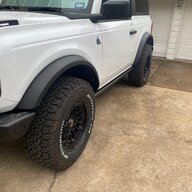
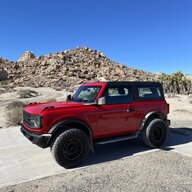
Dropping the pan isn't difficult on a non sas model with 4 inches of lift and 35s. No lift or jacking needed, plenty of room on a creeper.
Drop the front non quick disconnecting sway bar. Pull the four bolts/nuts 18mm and let it dangle.
Pull the 10mm head bolt holding the support for cooler lines at the front of the transmission.
Pull the 3 plastic tabs with a flat pry bar or any small forked pry from the pan.
The transmission dipstick cap is retained by a 19mm or 3/4 chrome head tall acorn looking nut on the driver side by the cross member "y" support.
Pull up and tilt towards rear to remove the dip stick then pull dip stick from chrome nut for checking fluid. The dip stick slides in where you cannot see the first block of the top portion of the stick. I used a long curved nose set of needle nose for feeding the dipstick in/out, unfortunately tig welding gloves don't cover to much elbow so I wanted to reach up as little as possible.
You'll need a 13mm deep well socket and an 8mm or 5/16 for the pan bolts. The two rear corners can be accessed with a small 5/16 or 8mm wrench.
If replacing the pan you can drill a hole to drain, I didn't because I wanted a spare. I used a pneumatic pump to suck out from the dip stick hole.
I sucked out 5 liters. She holds more than 5 liters in the pan after sitting a few hours so if you only get 5 liters push the hose in deeper or be prepared to make a mess.
I didn't realize there was maybe two more quarts in the pan, the extractor was pulling air. I got soaked with transmission fluid. Not ideal. Co worked don't listen when you state your shirt size so be prepared to wear a moomoo at the shop for the rest of the day. An extra 20 dollar expense yet avoidable mistake on my part.
The front transmission lines need to be gently pushed forward and to the passenger side to clear the pan for removal and installation. Take pics of the bolts holding the pan for orientation before removal.
The oil pan gasket, I opted for a new one, has two small alignment dowels that align on the transmission mating surface. Be sure the mating surfaces are clean before install. Don't use any sealer for this gasket m. It is reusable but I opted for a new one. You can use fishing string to hold the corners of gasket to the pan if you'd like then remove before tightening down.
I opted for an OEM filter. This filter doesn't come with a new seal, yours is likely reusable but why risk it on an 8 dollar part. Two 8mm or 5/16 head bolts hold the filter in. She'll be holding lots of fluids so be clear and have a catch. The screws are different lengths so note where they go.
At 50k there was not much on the magnet, as suspected.
I added back almost 7 quarts of fluid via a hand pump.
FSM says to fill between 3-4 on the dip stick at 205-210 degrees, I cannot get my transmission past about 185 on an 85 degree day on a 40 minute work commute on 35x12.50x20s.
If allowed to idle long enough she'll get to about 170 but still needs to run through the gears to cycle oil after the initial fill. I initially added 6 quarts and after a drive home and back had to add another quart, I was on about 5 on the stick . I'm now at the 3 mark at 185 degrees. I was aiming for the 3.5 mark. I'll have some towing to do soon, a few mowers on a 16 ft trailer, if shell spike to 200 plus I'll recheck and drain a bit if it gets over 3 but I'm not sure how much more expansion I'll get with only 25 more degrees.
Draining out a pint with a drain screw or extractor is not a difficult task so long as you are spry enough to roll under your rig.
I don't recall the torque settings for the pan bolts, it's very small hardware in an aluminum casing so it's just a few inch pounds. I used a cross pattern torque sequence and hand snugged them evenly with a 3/8 ratchet minus the two rear corners I had to access with a small wrench. I'd recommend a torque wrench unless you're like me and spent the last two plus decades hand tightening 4 and 5 mm hardware into outdoor power equipment.
Not a hard job but due to the heating process required to properly check the oil level it's time consuming. No special tools required aside from torque wrenche.
I hope this helps someone.
Dropping the pan isn't difficult on a non sas model with 4 inches of lift and 35s. No lift or jacking needed, plenty of room on a creeper.
Drop the front non quick disconnecting sway bar. Pull the four bolts/nuts 18mm and let it dangle.
Pull the 10mm head bolt holding the support for cooler lines at the front of the transmission.
Pull the 3 plastic tabs with a flat pry bar or any small forked pry from the pan.
The transmission dipstick cap is retained by a 19mm or 3/4 chrome head tall acorn looking nut on the driver side by the cross member "y" support.
Pull up and tilt towards rear to remove the dip stick then pull dip stick from chrome nut for checking fluid. The dip stick slides in where you cannot see the first block of the top portion of the stick. I used a long curved nose set of needle nose for feeding the dipstick in/out, unfortunately tig welding gloves don't cover to much elbow so I wanted to reach up as little as possible.
You'll need a 13mm deep well socket and an 8mm or 5/16 for the pan bolts. The two rear corners can be accessed with a small 5/16 or 8mm wrench.
If replacing the pan you can drill a hole to drain, I didn't because I wanted a spare. I used a pneumatic pump to suck out from the dip stick hole.
I sucked out 5 liters. She holds more than 5 liters in the pan after sitting a few hours so if you only get 5 liters push the hose in deeper or be prepared to make a mess.
I didn't realize there was maybe two more quarts in the pan, the extractor was pulling air. I got soaked with transmission fluid. Not ideal. Co worked don't listen when you state your shirt size so be prepared to wear a moomoo at the shop for the rest of the day. An extra 20 dollar expense yet avoidable mistake on my part.
The front transmission lines need to be gently pushed forward and to the passenger side to clear the pan for removal and installation. Take pics of the bolts holding the pan for orientation before removal.
The oil pan gasket, I opted for a new one, has two small alignment dowels that align on the transmission mating surface. Be sure the mating surfaces are clean before install. Don't use any sealer for this gasket m. It is reusable but I opted for a new one. You can use fishing string to hold the corners of gasket to the pan if you'd like then remove before tightening down.
I opted for an OEM filter. This filter doesn't come with a new seal, yours is likely reusable but why risk it on an 8 dollar part. Two 8mm or 5/16 head bolts hold the filter in. She'll be holding lots of fluids so be clear and have a catch. The screws are different lengths so note where they go.
At 50k there was not much on the magnet, as suspected.
I added back almost 7 quarts of fluid via a hand pump.
FSM says to fill between 3-4 on the dip stick at 205-210 degrees, I cannot get my transmission past about 185 on an 85 degree day on a 40 minute work commute on 35x12.50x20s.
If allowed to idle long enough she'll get to about 170 but still needs to run through the gears to cycle oil after the initial fill. I initially added 6 quarts and after a drive home and back had to add another quart, I was on about 5 on the stick . I'm now at the 3 mark at 185 degrees. I was aiming for the 3.5 mark. I'll have some towing to do soon, a few mowers on a 16 ft trailer, if shell spike to 200 plus I'll recheck and drain a bit if it gets over 3 but I'm not sure how much more expansion I'll get with only 25 more degrees.
Draining out a pint with a drain screw or extractor is not a difficult task so long as you are spry enough to roll under your rig.
I don't recall the torque settings for the pan bolts, it's very small hardware in an aluminum casing so it's just a few inch pounds. I used a cross pattern torque sequence and hand snugged them evenly with a 3/8 ratchet minus the two rear corners I had to access with a small wrench. I'd recommend a torque wrench unless you're like me and spent the last two plus decades hand tightening 4 and 5 mm hardware into outdoor power equipment.
Not a hard job but due to the heating process required to properly check the oil level it's time consuming. No special tools required aside from torque wrenche.
I hope this helps someone.
Sponsored
Last edited: