Sponsored

Adding a distribution block to positive side - Pics and Part links appreciated

OP
OP
Shrek27

Shrek27

Black Diamond
Well-Known Member
Joined
Apr 14, 2023
Threads
1
Messages
382
Reaction score
475
Location
Fullerton CA
Vehicle(s)
Bronco
Your Bronco Model
Black Diamond
Clubs
 
Have to admit I did not. If you know the timestamp I can go take a look.

That location where they install the bus bars is a great one, I've seen a lot of folks here do very similar things. Mine is wadded up with in-line fuses and zip-tied wire bundles and looks like a cat's butt hole.
2:24 and at the end they cut a nice notch to make room for the wire with the lid back on.

I’m trying to avoid the whole Tiger King’s butthole scenario…one of my fears is always that point where bad shit happens and eveyone goes “yup, never woulda saw that comin’…yuk yuk yuk”
Sponsored


 

Gluestick

Badlands
Well-Known Member
First Name
Josh
Joined
Mar 23, 2023
Threads
17
Messages
668
Reaction score
741
Location
Nashville
Website
instagram.com
Vehicle(s)
Explorer ST, Bronco Badsquatch
Your Bronco Model
Badlands
Clubs
 

SierraBronco

Wildtrak
Well-Known Member
Joined
Mar 27, 2024
Threads
41
Messages
5,190
Reaction score
14,022
Location
USA
Vehicle(s)
2022 Wildtrak, 2024 Wildtrak, 2024 Wildtrak
Your Bronco Model
Wildtrak
I DONT HATE IT
Let the record show that Gluestick does not, in fact, hate it. 😉

As far as dual winches and the compressor all running off of the same block, I rationalized it by thinking I’ll probably never be in a situation where all three will be running simultaneously. That said we will be running rear only going forward.
 

Gluestick

Badlands
Well-Known Member
First Name
Josh
Joined
Mar 23, 2023
Threads
17
Messages
668
Reaction score
741
Location
Nashville
Website
instagram.com
Vehicle(s)
Explorer ST, Bronco Badsquatch
Your Bronco Model
Badlands
Clubs
 
I mean I’m in. It isn’t the first nor last time I regret something but I feel COMPELLED
 

Brian_B

Big Bend
Well-Known Member
First Name
Brian
Joined
Sep 14, 2023
Threads
62
Messages
8,339
Reaction score
14,788
Location
Central CA
Vehicle(s)
'23 BB 4dr 7MT, '22 BSport OBX, '87 B-II XL
Your Bronco Model
Big Bend
Clubs
 
Let the record show that Gluestick does not, in fact, hate it. 😉

As far as dual winches and the compressor all running off of the same block, I rationalized it by thinking I’ll probably never be in a situation where all three will be running simultaneously. That said we will be running rear only going forward.
As long as the feeder fuse is sized correctly - you are absolutely correct. You can have 4 600A loads coming off a single 600A bus bar. So long as the feeder for that bus bar is fused at … 600A
 

Sponsored

centja1

Wildtrak
Member
Joined
Feb 12, 2025
Threads
2
Messages
22
Reaction score
36
Location
LA
Vehicle(s)
2024
Your Bronco Model
Wildtrak
I do really like that location for a couple bus bars. Now that I'm repairing the OEM block and leaving the winch direct to that, something like this looks really convenient for adding devices down the road. Even better if I can fit one of those MIDI fused style blocks like @centja1 used over there to tailor the amps per device! Thanks for posting.
The biggest thing that gives me pause is that I didn't see a single fuse in that video. I'm sure the accessories they connected at the end had inline fuses, but none were shown.

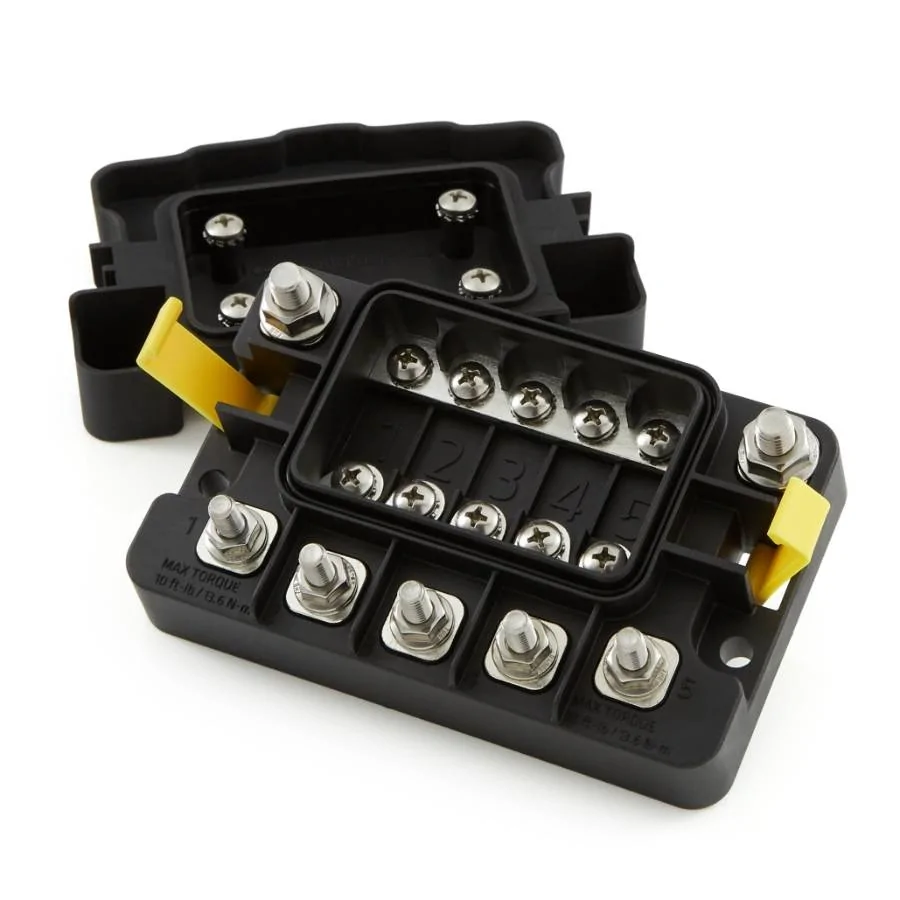
I would put something like this block from Waytek rather than high-current unfused wire. It's the same physical size as the one from Borne and 1/3 of the price

Ford Bronco Adding a distribution block to positive side - Pics and Part links appreciated be8ae23da5265cd_lg
 
Last edited:

CalvinT

Badlands
Well-Known Member
First Name
Calvin
Joined
Mar 15, 2022
Threads
16
Messages
2,542
Reaction score
3,185
Location
Phoenix, AZ
Vehicle(s)
2002 Subaru WRX Wagon, 2023 Badlands (nonSAS)
Your Bronco Model
Badlands
Clubs
 
Our battery terminals are precision-machined from high-grade 6061 aluminum, which is a commonly used material in electrical busbars due to its balance of conductivity, strength, and corrosion resistance. For context, the electrical conductivity of 6061 aluminum is approximately 44% of that of pure copper. In comparison:
6061 aluminum isn’t used in electrical busbars. The industry standard for electrical busbars is EC-grade aluminum (1350) alloy or copper.

1350 aluminum has 60% the conductivity of copper. 6061 has 40% the conductivity of copper. 1350 aluminum is only used in dry, clean, controlled environments such as electrical panels.

Aluminum is corrosion resistant because of it's oxide layer. Aluminum forms a passive oxide layer which is electrically insulating. Even if the terminals are initially clean and tight, oxidation at the contact interface increases in resistance over time leading to voltage drop and heat.

A aluminum/lead connection would be subject to galvanic corrosion in the presence of moisture. Aluminum would be the sacraficial element in such a case which would lead to a poor connection, heating and more corrosion. Slight humidity is enough to trigger the reaction.

(In the presence of an electrolyte a lead/aluminum will act like a battery producing 0.5 - 0.6 volts. (electrochemical series) This will drive the corrosion.) You test this yourself by making a battery using a saline solution for electrolyte and aluminum and lead for electrodes.

This is the same reason zinc is used for galvanizing and as a sacraficial element on the bottom of ocean going ships. Zinc and magnesium are the only common metals that are more electrochemically reactive than aluminum.

Electrical terminals are usually copper or tinned copper. The same thing will happen when they’re connected to aluminum. Copper will erode the aluminum faster than lead, tin a little slower than lead. I’ll leave out the numbers unless someone wants them.

SDHQ uses stainless steel hardware. The high nickel content of stainless steel can worsen galvanic reaction. All you need is stainless steel touching the aluminum in the presence of moisture.

Anti-sieze compounds don’t help. They just help prevent thread galling and are electrically insulating. Improperly used they can trap moisture and accelerate corrosion of dissimilar metals. (between the aluminum and stainless steel)

6061 aluminum is rigid. Exactly what you do not want in a battery terminal. That’s why lead is preferred and the Japanese use tinned steel straps for battery terminals. Either will deform enough around the lead battery post to give a good connection.

Aluminum has a lower modulus of elasticity. That means it bends and stretches easily but doesn't recover it's shape very well. So connections that are subject to heat will get looser and looser. This was a cause of many residential fires before aluminum wiring was banned.

I can’t think of a worse material for a battery terminal other than zinc or magnesium.

edit... The voltage for lead and aluminum in the presence of an electrolyte should read 1.5-1.6V not 0.5-0.6V.
 
Last edited:

SierraBronco

Wildtrak
Well-Known Member
Joined
Mar 27, 2024
Threads
41
Messages
5,190
Reaction score
14,022
Location
USA
Vehicle(s)
2022 Wildtrak, 2024 Wildtrak, 2024 Wildtrak
Your Bronco Model
Wildtrak
6061 aluminum isn’t used in electrical busbars. The industry standard for electrical busbars is EC-grade aluminum (1350) alloy or copper.

1350 aluminum has 60% the conductivity of copper. 6061 has 40% the conductivity of copper. 1350 aluminum is only used in dry, clean, controlled environments such as electrical panels.

Aluminum is corrosion resistant because of it's oxide layer. Aluminum forms a passive oxide layer which is electrically insulating. Even if the terminals are initially clean and tight, oxidation at the contact interface increases in resistance over time leading to voltage drop and heat.

A aluminum/lead connection would be subject to galvanic corrosion in the presence of moisture. Aluminum would be the sacraficial element in such a case which would lead to a poor connection, heating and more corrosion. Slight humidity is enough to trigger the reaction.

(In the presence of an electrolyte a lead/aluminum will act like a battery producing 0.5 - 0.6 volts. (electrochemical series) This will drive the corrosion.) You test this yourself by making a battery using a saline solution for electrolyte and aluminum and lead for electrodes.

This is the same reason zinc is used for galvanizing and as a sacraficial element on the bottom of ocean going ships. Zinc and magnesium are the only common metals that are more electrochemically reactive than aluminum.

Electrical terminals are usually copper or tinned copper. The same thing will happen when they’re connected to aluminum. Copper will erode the aluminum faster than lead, tin a little slower than lead. I’ll leave out the numbers unless someone wants them.

SDHQ uses stainless steel hardware. The high nickel content of stainless steel can worsen galvanic reaction. All you need is stainless steel touching the aluminum in the presence of moisture.

Anti-sieze compounds don’t help. They just help prevent thread galling and are electrically insulating. Improperly used they can trap moisture and accelerate corrosion of dissimilar metals. (between the aluminum and stainless steel)

6061 aluminum is rigid. Exactly what you do not want in a battery terminal. That’s why lead is preferred and the Japanese use tinned steel straps for battery terminals. Either will deform enough around the lead battery post to give a good connection.

Aluminum has a lower modulus of elasticity. That means it bends and stretches easily but doesn't recover it's shape very well. So connections that are subject to heat will get looser and looser. This was a cause of many residential fires before aluminum wiring was banned.

I can’t think of a worse material for a battery terminal other than zinc or magnesium.
I heart this so much. Thanks for your input.


“well that’s just not true. We’ve sold hundreds of and NEVER had an issue”
-manufacturer, probably

One of the things I didn’t like about the Adventure Labs bracket originally meant for use with a kill switch-it comes with little aluminum “jumper” links meant to connect the fuse to the disconnect. Links, plural, because you stack to of them together. Sure it looks all custom, but sorry duderrinos-can’t say I like that idea. Bracket works well for holding a thing though.
 
OP
OP
Shrek27

Shrek27

Black Diamond
Well-Known Member
Joined
Apr 14, 2023
Threads
1
Messages
382
Reaction score
475
Location
Fullerton CA
Vehicle(s)
Bronco
Your Bronco Model
Black Diamond
Clubs
 
@CalvinT Thanks for that explanation. Sounds like the corrosion would vary by user and region, almost like SAS shock reservoirs.

@SierraBronco @CalvinT While we're reviewing products and sound practices, did you guys see where the Borne block is connected to in their install vid? 2:24 time stamp. I'm curious what the max amps would be to run through that terminal.
 

Sponsored

mvilla

Badlands
Well-Known Member
First Name
Mike
Joined
Sep 19, 2023
Threads
23
Messages
237
Reaction score
317
Location
San Francisco
Vehicle(s)
4-door Badlands Bronco w/ Sasquatch package
Your Bronco Model
Badlands
I heart this so much. Thanks for your input.


“well that’s just not true. We’ve sold hundreds of and NEVER had an issue”
-manufacturer, probably

One of the things I didn’t like about the Adventure Labs bracket originally meant for use with a kill switch-it comes with little aluminum “jumper” links meant to connect the fuse to the disconnect. Links, plural, because you stack to of them together. Sure it looks all custom, but sorry duderrinos-can’t say I like that idea. Bracket works well for holding a thing though.
I was surprised that it’s literally 2 pieces of the same sheet metal used for the mount, just shrink wrapped together. And for me it didn’t come close reaching my mega fuse holder. I didn’t buy one from AAL, but how different can these holders really be dimension wise?
 

SierraBronco

Wildtrak
Well-Known Member
Joined
Mar 27, 2024
Threads
41
Messages
5,190
Reaction score
14,022
Location
USA
Vehicle(s)
2022 Wildtrak, 2024 Wildtrak, 2024 Wildtrak
Your Bronco Model
Wildtrak
I was surprised that it’s literally 2 pieces of the same sheet metal used for the mount, just shrink wrapped together. And for me it didn’t come close reaching my mega fuse holder. I didn’t buy one from AAL, but how different can these holders really be dimension wise?
All I know is the 500 amp Class T fuse is yuuuuuuge
 

CalvinT

Badlands
Well-Known Member
First Name
Calvin
Joined
Mar 15, 2022
Threads
16
Messages
2,542
Reaction score
3,185
Location
Phoenix, AZ
Vehicle(s)
2002 Subaru WRX Wagon, 2023 Badlands (nonSAS)
Your Bronco Model
Badlands
Clubs
 
@SierraBronco @CalvinT While we're reviewing products and sound practices, did you guys see where the Borne block is connected to in their install vid? 2:24 time stamp. I'm curious what the max amps would be to run through that terminal.
That's a nice looking product! But it's impossible to give an exact answer because they don't tell you what the bus bar is made of. It looks like it's plated, so it's not aluminum or stainless which is good.

They say the studs are M4x0.7. That limits each circuit to about 10 amps. The connecting cables look to be about that diameter which is around 10-12 AWG which would go with four circuits each carrying 10 amps.

The bus bar is either brass or steel, probably steel and the plating is probably nickel which is good for low currents and corrosion protection. I think the bus bar is steel because the studs look like they PEM style press-in studs which are made for steel, stainless and aluminum. Again I'm sure the bar isn't stainless or aluminum because it's plated. Brass isn't strong enough for press-in studs.

If you own one of these use a magnet on the bus bar. I think one will stick.

I really like how they've mounted it. I may steal their idea if I need to fabricate a bus bar for extra connections, or just buy theirs.

I'd make the ground connection differently. At 2:50 they put their ground lug under the factory ground lug. I'd reverse the order and leave the factory ground lug against the chassis with the Borne lug next to the bolt head. The factory ground is probably carrying more current.

From what I see I think it's a nice product if you want to wire accessories that draw less than 10 amps each.
 

SierraBronco

Wildtrak
Well-Known Member
Joined
Mar 27, 2024
Threads
41
Messages
5,190
Reaction score
14,022
Location
USA
Vehicle(s)
2022 Wildtrak, 2024 Wildtrak, 2024 Wildtrak
Your Bronco Model
Wildtrak
That's a nice looking product! But it's impossible to give an exact answer because they don't tell you what the bus bar is made of. It looks like it's plated, so it's not aluminum or stainless which is good.

They say the studs are M4x0.7. That limits each circuit to about 10 amps. The connecting cables look to be about that diameter which is around 10-12 AWG which would go with four circuits each carrying 10 amps.

The bus bar is either brass or steel, probably steel and the plating is probably nickel which is good for low currents and corrosion protection. I think the bus bar is steel because the studs look like they PEM style press-in studs which are made for steel, stainless and aluminum. Again I'm sure the bar isn't stainless or aluminum because it's plated. Brass isn't strong enough for press-in studs.

If you own one of these use a magnet on the bus bar. I think one will stick.

I really like how they've mounted it. I may steal their idea if I need to fabricate a bus bar for extra connections, or just buy theirs.

I'd make the ground connection differently. At 2:50 they put their ground lug under the factory ground lug. I'd reverse the order and leave the factory ground lug against the chassis with the Borne lug next to the bolt head. The factory ground is probably carrying more current.

From what I see I think it's a nice product if you want to wire accessories that draw less than 10 amps each.
Yeah it doesn't look like it's meant to be used for much load. And you know someone is going to hook a winch up to the thing.

Just watched the 2:24 timestamp. @Shrek27 Personally I'd be hesitant to hook up to the connection at the fuse box. There are three fused wires coming off of the battery for the fuse box. It seems Ford has planned out a specific amount of work to be done for that circuit. Yeah, probably not going to be an issue to use a fusetap to trigger a relay, but I don't know that it would be the best idea to throw a distribution block on the thing given the nature of wanting to power several devices from it.

Also on grounding I forget where I posted it...maybe the "let's start a fight" thread...but when redoing the wiring harness after the fire we learned that all the grounding for the vehicle goes back through what seem to be two 4g wires. That's it. Fine for the stock vehicle but seeing that I was no longer thinking a chassis ground for the rear winch was the best idea, so we ran a dedicated 1/0 ground for the rear winch back to a 600A block and tied that right on to the battery. I'll still use the factory grounds for small things but like Calvin suggested, I put them on top of the factory ground. Not under it. I'd much rather make certain anything factory has the grounding it needs as designed by Ford rather than risk compromising it for the sake of an accessory.
 

CalvinT

Badlands
Well-Known Member
First Name
Calvin
Joined
Mar 15, 2022
Threads
16
Messages
2,542
Reaction score
3,185
Location
Phoenix, AZ
Vehicle(s)
2002 Subaru WRX Wagon, 2023 Badlands (nonSAS)
Your Bronco Model
Badlands
Clubs
 
The biggest thing that gives me pause is that I didn't see a single fuse in that video. I'm sure the accessories they connected at the end had inline fuses, but none were shown.

I would put something like this block from Waytek rather than high-current unfused wire. It's the same physical size as the one from Borne and 1/3 of the price

be8ae23da5265cd_lg.jpg
You're right about the fusing. You'd need to put an inline fuse into each circuit, 4 in all, to give good protection.

You'd only need one of these blocks. You could use a simple copper bus bar for the grounds.
Sponsored


Top