Sponsored

SierraBronco

Wildtrak
Well-Known Member
Joined
Mar 27, 2024
Threads
43
Messages
5,358
Reaction score
14,537
Location
USA
Vehicle(s)
2022 Wildtrak, 2024 Wildtrak, 2024 Wildtrak
Your Bronco Model
Wildtrak
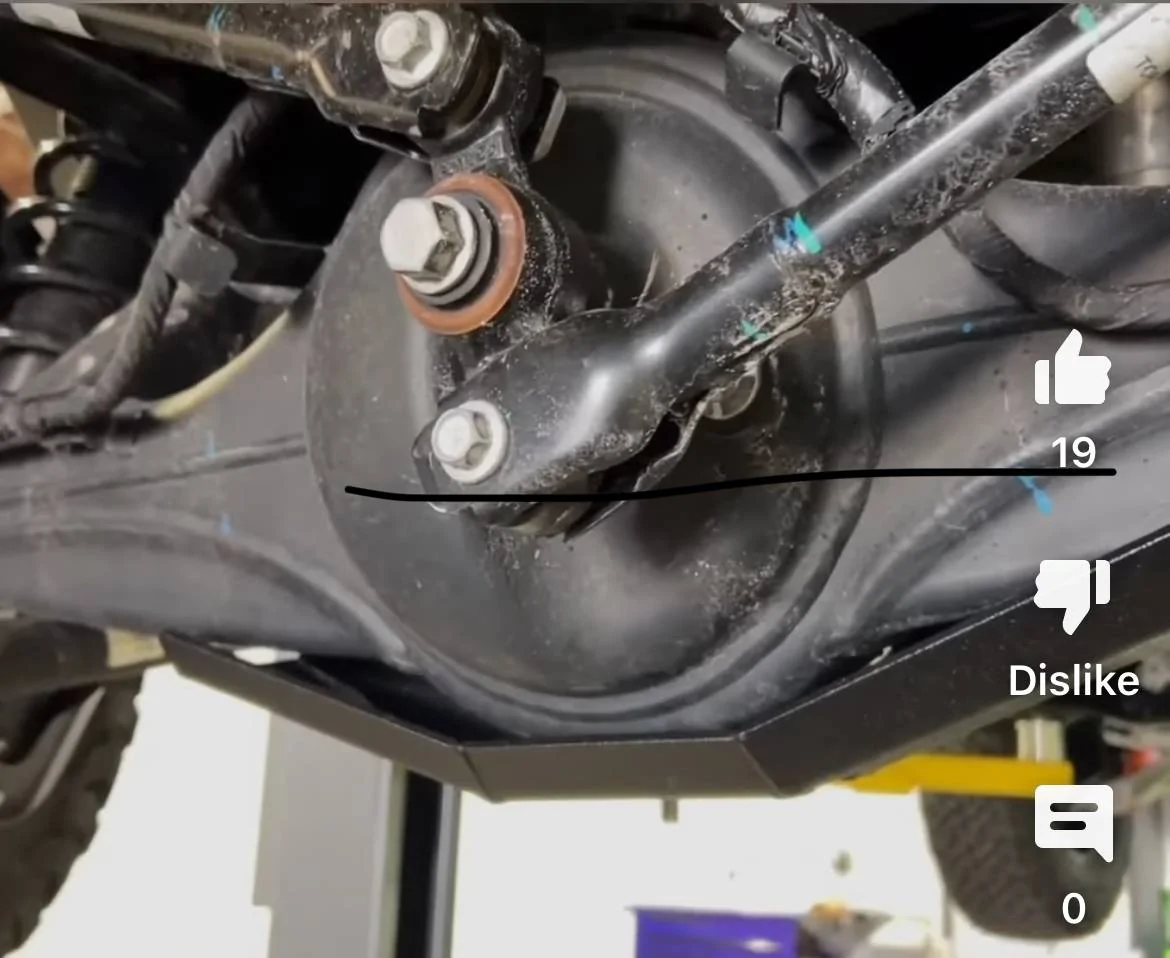
Just saw this on a YouTube channel. What has this setup? Ranger Raptor and or Braptor?
Wats link (sp?) and drop out diff? We should all have this on our regular Broncos. (I know not everyone needs it but man that’s a better setup).
IMG_1929.webp
View attachment 688694
Watts link is frickin sweet. Ranger Raptor for sure has it.

I think the hard part for something like our bronco in particular is how low the lower link would need to be, or at least based on my understanding of what would go into building a custom watts link setup to handle all the extra articulation the lower link would be fairly low. Could certainly be making that up.
Sponsored
 

Fordified1

Black Diamond
Well-Known Member
First Name
Bob
Joined
Nov 1, 2023
Threads
25
Messages
3,523
Reaction score
9,238
Location
Mid South Texas
Vehicle(s)
‘15 Mustang ecoboost, 4wd Excursion, ‘69 Mach 1
Your Bronco Model
Black Diamond
Clubs
 
Watts link is frickin sweet. Ranger Raptor for sure has it.

I think the hard part for something like our bronco in particular is how low the lower link would need to be, or at least based on my understanding of what would go into building a custom watts link setup to handle all the extra articulation the lower link would be fairly low. Could certainly be making that up.
That and attaching it to a bolt-on cover could be an issue.
I contacted Curry asking why they don’t offer a bolt-in 9” axle assembly and they said is wasn’t cost effective for a couple reasons. I don’t understand this really because Curry made thier name building custom 9” stuff.
I have a ton of 9” parts. I just need the housing.
 

SierraBronco

Wildtrak
Well-Known Member
Joined
Mar 27, 2024
Threads
43
Messages
5,358
Reaction score
14,537
Location
USA
Vehicle(s)
2022 Wildtrak, 2024 Wildtrak, 2024 Wildtrak
Your Bronco Model
Wildtrak
That and attaching it to a bolt-on cover could be an issue.
I contacted Curry asking why they don’t offer a bolt-in 9” axle assembly and they said is wasn’t cost effective for a couple reasons. I don’t understand this really because Curry made thier name building custom 9” stuff.
I have a ton of 9” parts. I just need the housing.
Yeah, I would think you’d want to do something different instead of using the diff cover. I don’t know how Ford has theirs set up but I can’t imagine it’s as simple as it looks from the outside.

But! I also thought you wanted the bars parallel with the axle. Guess that picture could have been taken on a maintenance lift though.
 

Snacktime

Black Diamond
Well-Known Member
First Name
Nate
Joined
Jul 14, 2020
Threads
73
Messages
3,992
Reaction score
9,982
Location
Sac-a-tomatoes
Vehicle(s)
Bronco, F150
Your Bronco Model
Black Diamond
Clubs
 
Use to use watts link on bagged trucks, excellent for tucking big wheels and not rubbing. Watts is one of the better options as it distributes lateral load to both sides of the frame.

I rather have a 5 link for offroading since it is the simplest way to keep the load across the joints in line. Having dealt with 4 links in the past the weak link is always the joints since they usually have a side load.
 

Fordified1

Black Diamond
Well-Known Member
First Name
Bob
Joined
Nov 1, 2023
Threads
25
Messages
3,523
Reaction score
9,238
Location
Mid South Texas
Vehicle(s)
‘15 Mustang ecoboost, 4wd Excursion, ‘69 Mach 1
Your Bronco Model
Black Diamond
Clubs
 
Yeah, I would think you’d want to do something different instead of using the diff cover. I don’t know how Ford has theirs set up but I can’t imagine it’s as simple as it looks from the outside.

But! I also thought you wanted the bars parallel with the axle. Guess that picture could have been taken on a maintenance lift though.
Yes that pic was at full droop on a lift.
 

Sponsored
OP
OP

87-Z28

Outer Banks
Well-Known Member
First Name
Andy
Joined
Sep 1, 2022
Threads
3
Messages
1,304
Reaction score
3,210
Location
Texas
Vehicle(s)
BMW
Your Bronco Model
Outer Banks
Clubs
 
I think the hard part for something like our bronco in particular is how low the lower link would need to be, or at least based on my understanding of what would go into building a custom watts link setup to handle all the extra articulation the lower link would be fairly low. Could certainly be making that up.
the longer the upper and lower links are the shorter the center link can be to accommodate the same vertical motion.


I rather have a 5 link for offroading since it is the simplest way to keep the load across the joints in line. Having dealt with 4 links in the past the weak link is always the joints since they usually have a side load.
Oem 4 link geometry does not constrain lateral motion of the axle very well. The links would resist lateral motion by bending and stressing the crap out of the bushings and frame hard point attachment.

In order to better restrain lateral motion the upper links could be “triangulated” so that the can also carry some axial loads (not just bending). This would then transmit the axial loads through the joints and into frame mounts. However now the frame mounts and joints may become the weak link.

adding a 5th link to 4 link setup allows for a simple way to carry lateral loads completely in line (axial) along the 5th link. 5th link is slightly redundant for triangulated 4 link and will compete for lateral loading.

some articulation loss may occur as a result of 5th link but lateral load carrying capacity is much easier to deal with. that’s a trade off. Oem frame hard points for 4 link joints are probably not designed to carry significant lateral load, since panhard bar does this.
 
Last edited:
OP
OP

87-Z28

Outer Banks
Well-Known Member
First Name
Andy
Joined
Sep 1, 2022
Threads
3
Messages
1,304
Reaction score
3,210
Location
Texas
Vehicle(s)
BMW
Your Bronco Model
Outer Banks
Clubs
 
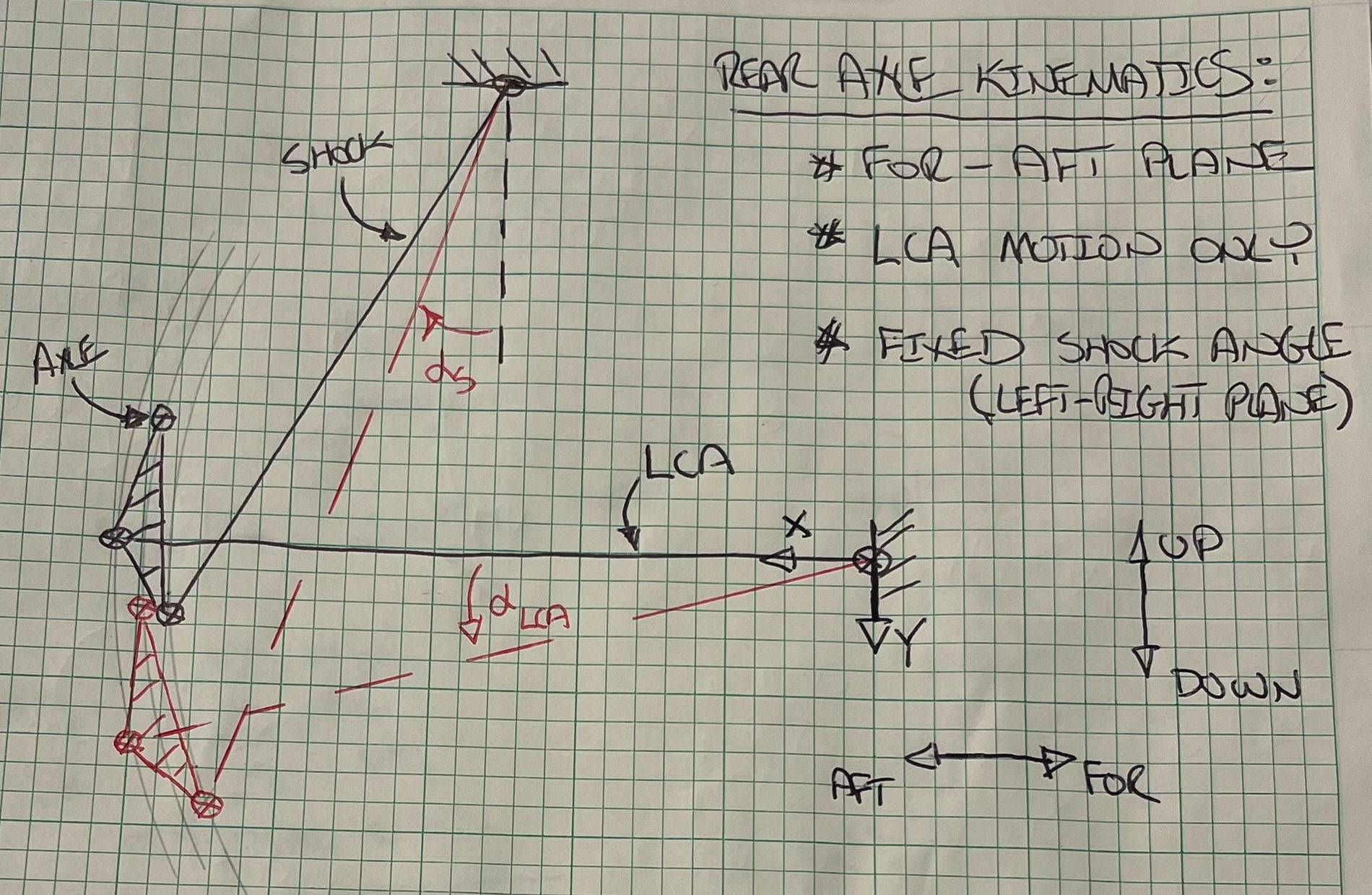
here is a kinematic model of rear axle. Model includes LCA, axle, shock, and frame hard points. Does not include affects of UCA on axle motion, which is minimal in vertical direction and mostly results in for-aft motion of axle. Will try to include UCA at some point in future. Model defines motion of axle in for-aft plane only. Left-right shock angle is assumed to be constant (about 15 degrees). Figure of model is to scale and shows how shock angle changes wrt LCA angle, ie, shock angle becomes more vertical as LCA angle increases hence increasing motion ratio.

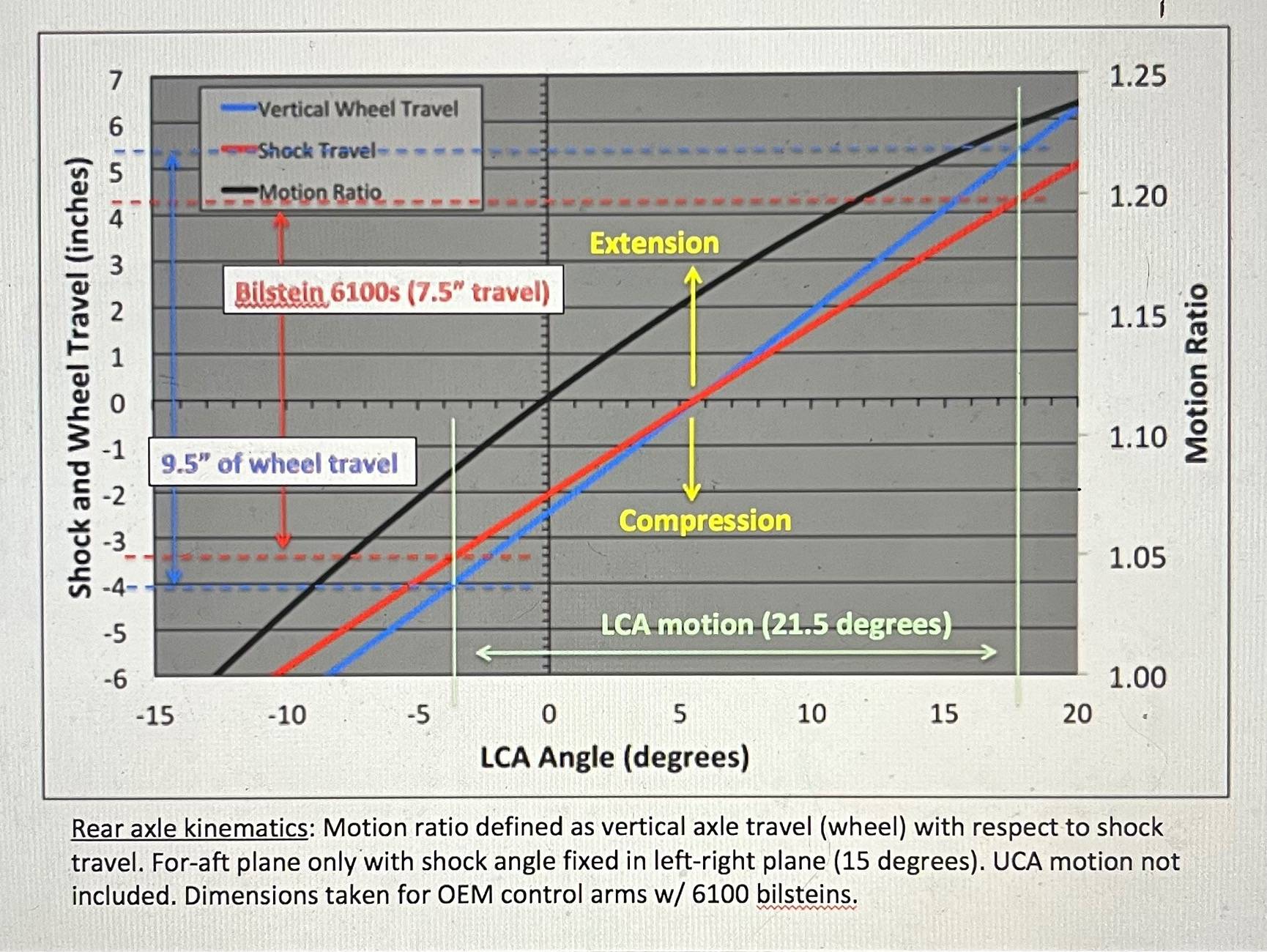
plot shows motion ratio, shock travel, and wheel travel as functions of LCA angle. Motion ratio is defined as true vertical wheel travel vs shock travel. Note axle moves in arc defined by LCA. True vertical wheel travel is the vertical component of this arc motion.

Dimensions are from my Bronco with OEM links and 6100 bilsteins. Probably +/- 10% accuracy. Ride height (static equilibrium) is referenced as zero shock and wheel travel. Negative travel represents shock compression. My bilsteins provide 7.5” of travel, resulting in 9.5” of true vertical wheel travel. LCA swings through an arc of 21 degrees. Motion ratio is nonlinear but always greater than 1:1, due to leverage on LCA. Leverage can easily be seen from model figure. Moving shock attachment point on axle further forward will increase leverage and motion ratio.

Ford Bronco Some stock suspension calculations and measurements IMG_6583


Ford Bronco Some stock suspension calculations and measurements IMG_6581
 
OP
OP

87-Z28

Outer Banks
Well-Known Member
First Name
Andy
Joined
Sep 1, 2022
Threads
3
Messages
1,304
Reaction score
3,210
Location
Texas
Vehicle(s)
BMW
Your Bronco Model
Outer Banks
Clubs
 
Lots of threads on here about, “I have added weight and now my ride height has dropped. What should I do, spring preload or strut spacer” so I thought I would post this.

Some objectives to achieve with a suspension modification may be, in no particular order;

1) clearance at ride height
2) mid shock stroke at ride height
3) ride quality
4) wheel travel

In order to achieve each of these, proper spring rates are required and knowledge of static weight at wheel.

Clearance at ride height is the easiest to achieve and most threads on here are singularly focused on that. Simple solutions are centered around shock length increase (spacers) or spring preload adjustment (spring seat collars and adjustable spring seats). These are both viable solutions that can have different consequences. However neither solution adequately addresses the other objectives. If corner weights start to get big due to modifications proper spring rate is the only way to address all of the objectives.

most people aren’t thinking this way or tracking this. I myself have 6100 bills and use spring preload to dial in my ride height. Although I do know as I add weight I need to rethink things.
 
OP
OP

87-Z28

Outer Banks
Well-Known Member
First Name
Andy
Joined
Sep 1, 2022
Threads
3
Messages
1,304
Reaction score
3,210
Location
Texas
Vehicle(s)
BMW
Your Bronco Model
Outer Banks
Clubs
 
Posting this here to keep this stuff in one place.


There are a bunch of posts about suspension “upgrades” similar to this. “I want to eliminate drake dive and body roll without having a harsh ride quality.”

the fundamental physics of a mass and spring/damper system dictates that, displacements (brake dive and body roll) are inversely proportional to forces (ride quality or harshness transferred to body). So decreasing displacements (improved handling) will increases forces (ride harshness). displacements and forces are both controlled by spring and damper rates.

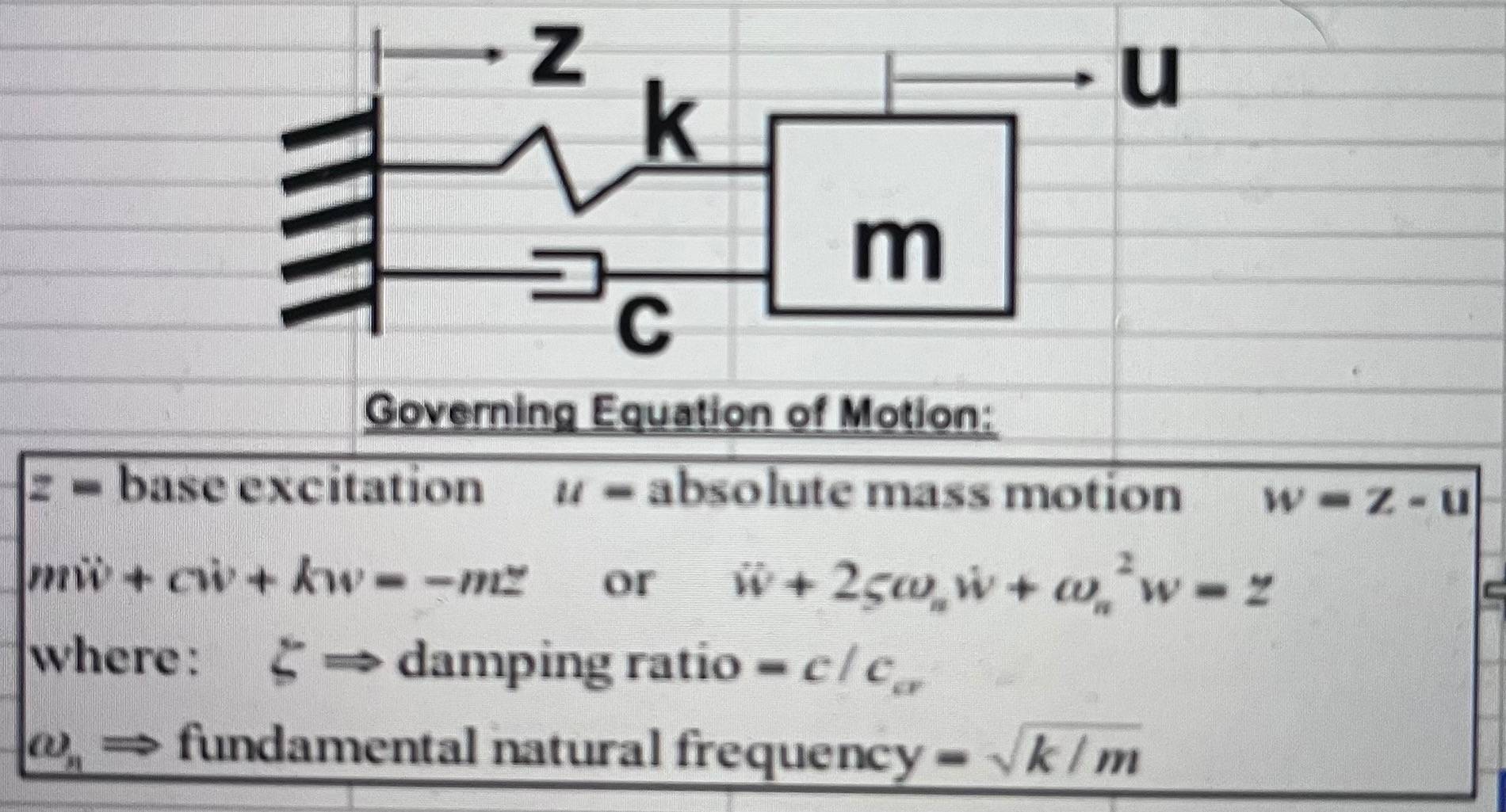
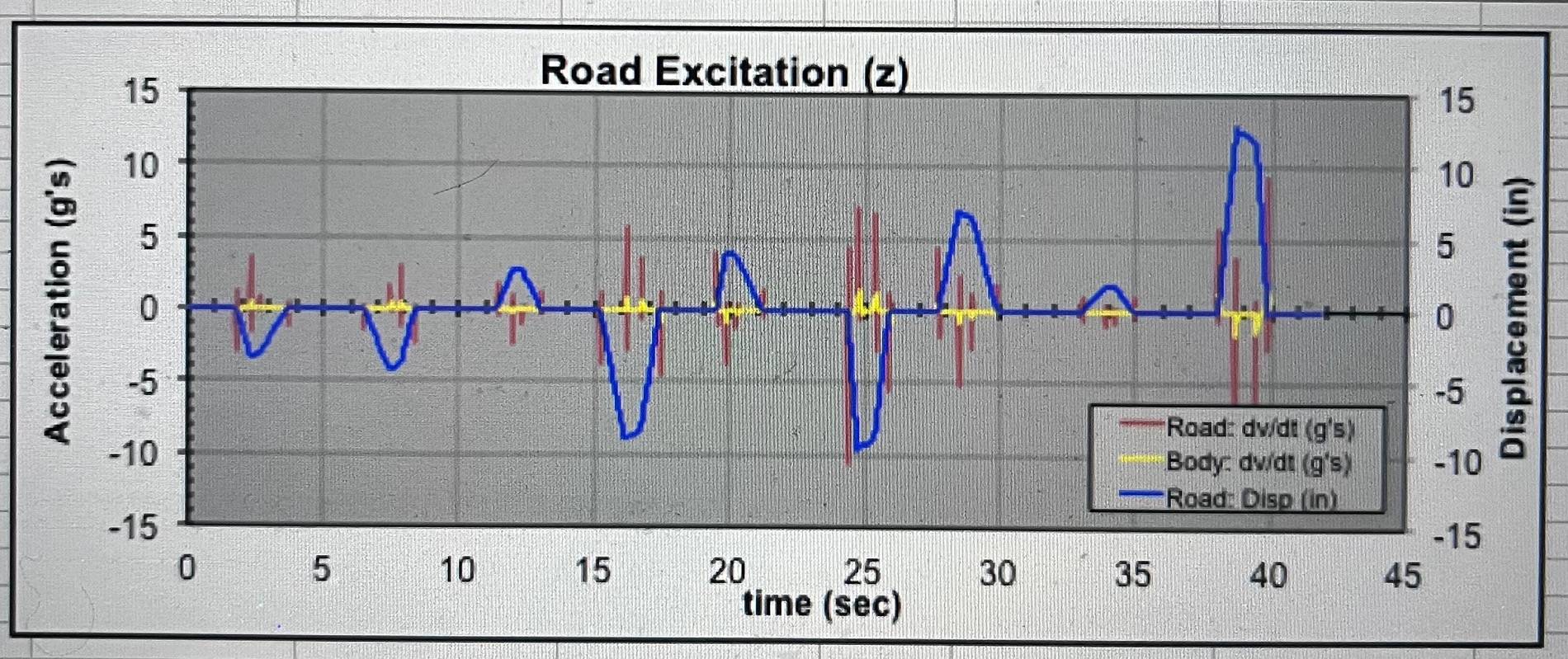
The major player here is spring rate. An example for OEM Bronco follows. Consider a single degree of freedom (SDOF) mass spring/damper system subjected to a base excitation as shown in first plot. The mass is the vehicle body and the base excitation (z) is the motion of the wheel as it traverses a “rough” road.

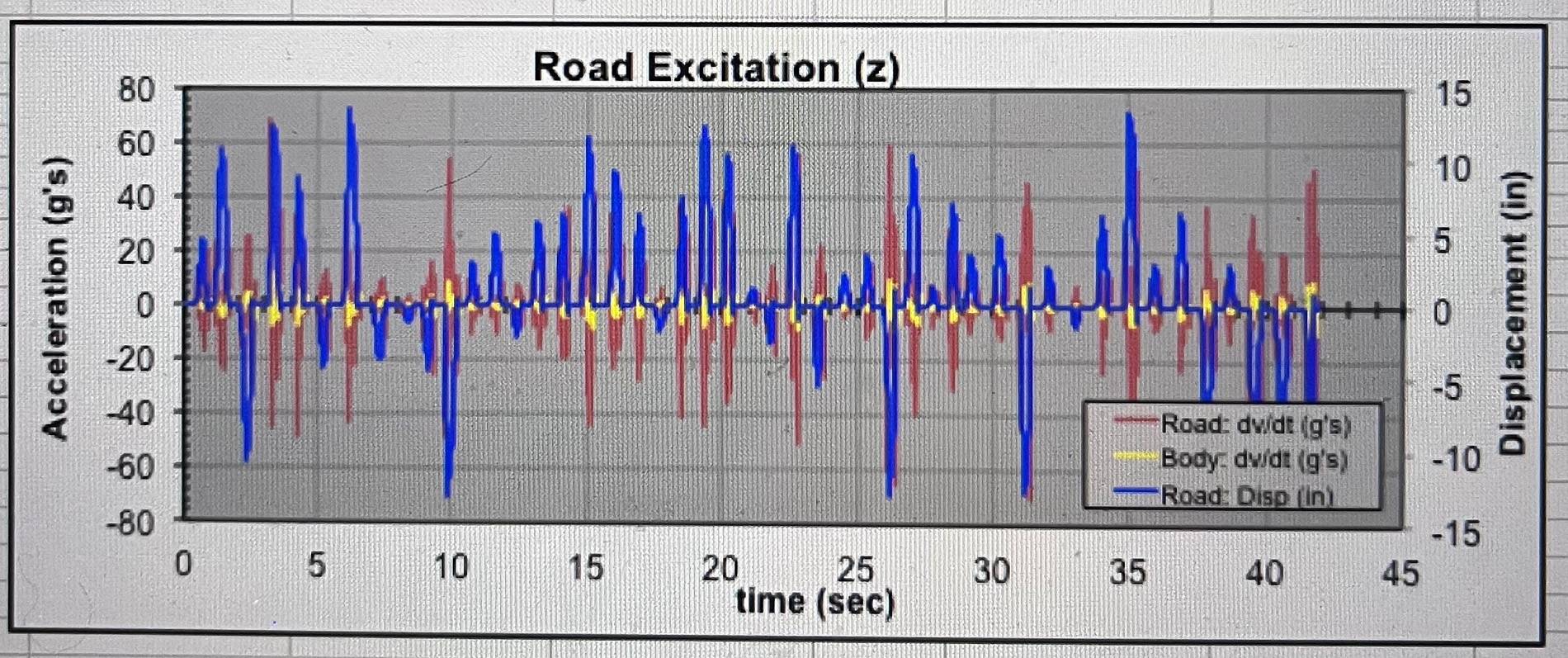
The base excitation was modeled as a randomly varying surface with large scale bumps and dips. Perturbation scales were; bump/dip height about 12”, bump/dip length about 10 feet, and distance between bump/dip about 30 feet. So this is simulating bombing through large scale rough terrain like dessert running, NOT rock crawling.

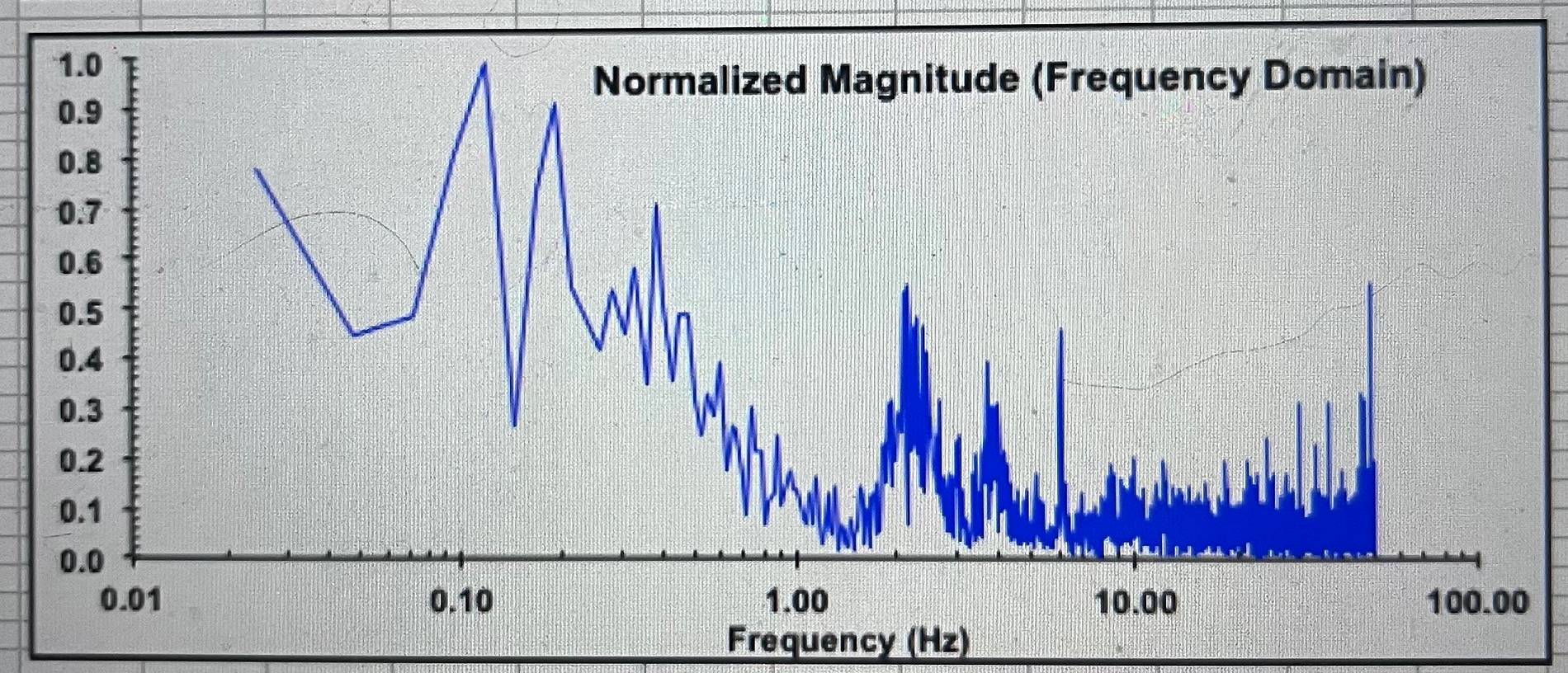
So the base excitation for the model input is the displacement time history of the random terrain. At a 10 mph vehicle speed the bumps and dips come slowly, but at 50 mph they get intense. This can be seen from 2nd and 3rd plots showing 10 mph base excitation along with a frequency domain plot of this slow speed excitation. Notice the major frequency content occurs well below 1 Hz (1 cycle per second). So many seconds (~10) for a complete suspension cycle.

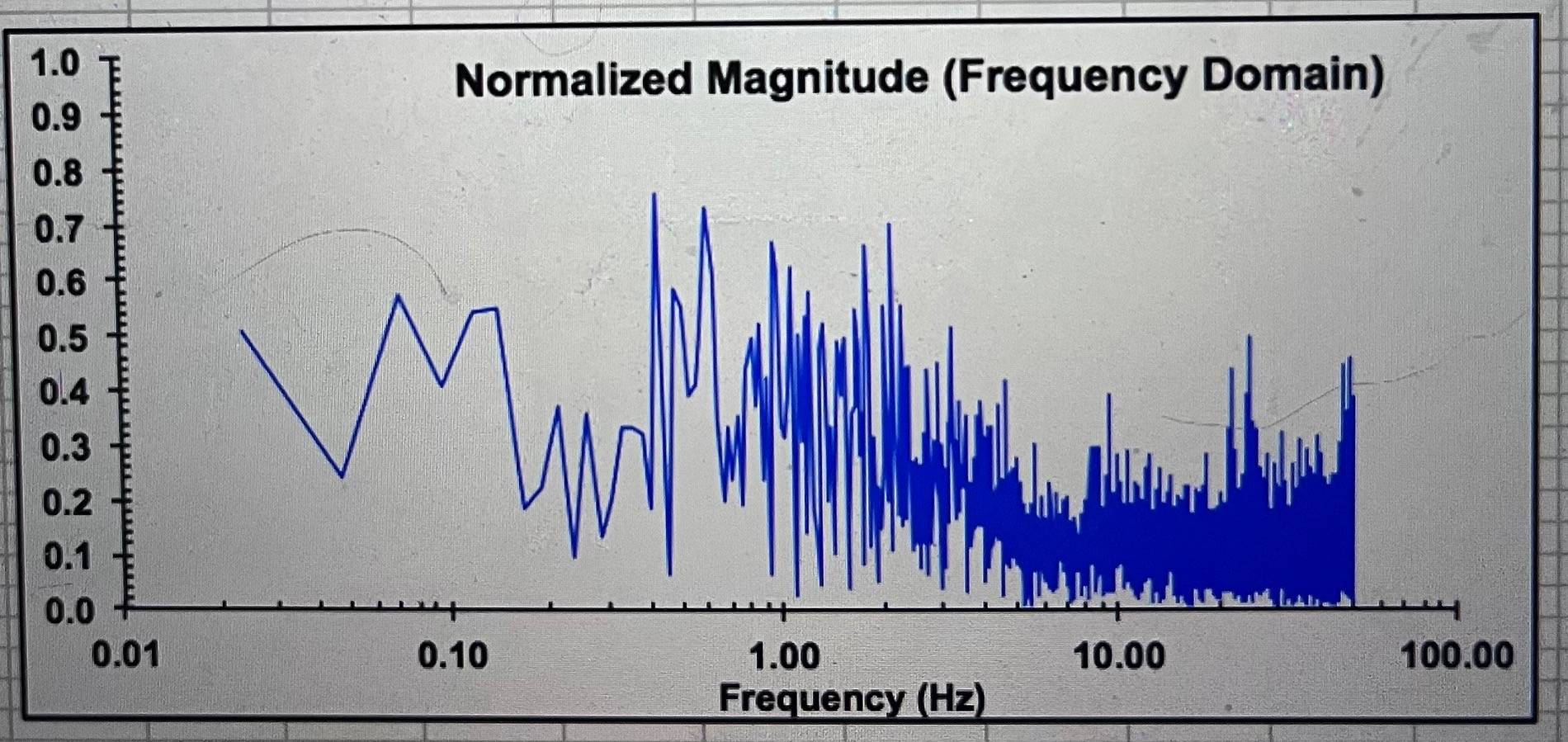
The 4th and 5th plots show the same rough terrain model but at a vehicle speed of 50 mph. So the base excitation now becomes more intense. The major frequency content is now near 1 hz, so full suspension cycling every second.

So what do we do with these obviously different base excitations that occur at the wheels? Generating an SDOF shock spectrum of the base excitation can highlight the difference in system behavior as spring and damper rates vary. This is of course a primary goal, what spring and damper rates work best.

The shock spectrum generates a plot of peak force and displacement for the given base excitation, ie, as the fundamental frequency of the system varies. Each given coilover (fox, king, ride, …) has a single fundamental frequency response dictated by the spring rate, NOT damping rate.

Consider linear spring rates and linear damping rates. The fundamental frequency of the coilover is the square root of (K/M). K is effective spring rate at wheel and mass is static weight at wheel divided by gravity.

Some numbers; front motion ratio is 1.6, weight is 2880/2=1440 lbs for SAS badlands front axle.

For OEM SAS spring rate of ~425 lbs/in the fundamental frequency is 2.7 Hz. For RIDE “soft” spring rate of 550 the frequency is 3.1 Hz. Other spring rates and mass combos (extra weight from bumpers …) have different fundamental frequencies.

For damping rates, a linear force vs shock velocity produces a constant damping rate (constant slope of curve). Many shocks have digressive damping rates (a decreasing slope), but linear damping makes the math simple and shows the basic response (RIDE shocks claim to be near linear).

Critical damping rate, defined by a complete decay of displacement within one cycle, is calculated as the square root of (4 K M). That is why damping rates are tuned to spring rates. Once again spring rate is the dominant term. For OEM critical damping rate is close to 125 lbs-sec/in. For 550 RIDE spring it is close to 145.

So now we can plot the shock spectral analysis for both base excitations. 10 mph and 50 mph. The 6th plot shows the shock spectrum for 10 mph and the 7th is for 50 mph. The shock spectrum is plotted only for the relevant frequencies of interest, from 1 to 5 Hz. All Bronco coilovers will fall in this range. The shock forces are shown by dashed lines and the displacements by solid lines. The plots show different damping ratios with respect to critical damping (60-90%).

Notice that both shock forces and displacements are significantly greater when traversing the fixed rough terrain in our example at 50 mph.

The two different coilovers for our example are also shown (SAS and RIDE). The response for any given coilover is restricted to its fundamental frequency. So OEM response to base excitations necessarily only occurs along the vertical line at 2.7 Hz.

Notice that, for a given coilover (fixed frequency), increasing damping rates will decrease displacements (brake dive) and increase forces (harshness). With oem the damping rate is not adjustable but for the fancy coilovers different rates can be set (low, mid, or high piston velocities or even compression vs rebound). This effectively moves you along a fixed coilover frequency but allows for different responses, ie, shock force and displacement. This can provide many different responses, but is LIMITED to the given fundamental frequency since the mechanical coil spring rate can NOT be changed.

Super fancy “active” control of damping rates uses feedback loops to automatically set damping based on some logic controlled by real time data. So automatically adjusted instead of predetermined via a manual knob. This may be able to “actively” fine tune suspension response nicely (damping rates only) but will still only operate along the fundamental frequency of the coilover, which is solely dictated by the spring rate and vehicle mass.

Damper has NO say in fundamental frequency. So choose spring rates carefully. Adjusting preload does NOT affect spring rate it only alters static load deflection of spring, ie, ride height. Spring rate is an inherent mechanical property of a coil spring. To change spring rate a new spring is required.

Notice that the ride shocks provide a different fundamental frequency (controlled by spring rate) and thus provides an increased stiffness. As spring rate increases (stiffness increases) resulting in increased forces (harshness) and decreased displacements (brake dive).

Many of the aftermarket coilover manufacturers choose increased fundamental frequencies over OEM design. This helps reduce shock displacements and keep the larger tires (37-38s) out of the fenders. See shock spectrum comparison of oem and RIDE. The trade off is less displacement (shock travel) for same base excitation (road terrain).

Increased coilover frequencies are a big benefit for high speed dessert running with large tires. RIDE has significantly reduced displacements compared to OEM for our 50 mph rough terrain example. For slow rock crawling the Increased fundamental frequencies reduce shock travel.

A major coilover design goal is to operate at a desired frequency. Thus spring rates should be tuned to static vehicle weight and the damping rates are then tuned to the spring rate.

Finding a good balance between ride quality (shock forces) and suspension handling (displacements) can be challenging. They are inversely related.

IMG_7363.jpeg


IMG_7356.jpeg


IMG_7357.jpeg


IMG_7359.jpeg


IMG_7360.jpeg


View attachment 733781

View attachment 733782
 

Fordified1

Black Diamond
Well-Known Member
First Name
Bob
Joined
Nov 1, 2023
Threads
25
Messages
3,523
Reaction score
9,238
Location
Mid South Texas
Vehicle(s)
‘15 Mustang ecoboost, 4wd Excursion, ‘69 Mach 1
Your Bronco Model
Black Diamond
Clubs
 
😵💫🤯… nice write up. Too bad most of it’s way over my head lol.

I’ll say it again. My brake dive doesn’t bother me because I know it’s a trade off for articulation and a smooth ride on a lifted vehicle. I also don’t have a sway bar. I have adjusted for both by the way I drive. Love me some speed bumps now lol.
Have y’all noticed how much brake dive Monster Trucks have? Because they have huge amounts of articulation with relatively soft stacks of springs. The driver just has to adjust for it and even uses it to do amazing things with a huge powerful “truck”.
 

Sponsored
OP
OP

87-Z28

Outer Banks
Well-Known Member
First Name
Andy
Joined
Sep 1, 2022
Threads
3
Messages
1,304
Reaction score
3,210
Location
Texas
Vehicle(s)
BMW
Your Bronco Model
Outer Banks
Clubs
 
😵💫🤯… nice write up. Too bad most of it’s way over my head lol.

I’ll say it again. My brake dive doesn’t bother me because I know it’s a trade off for articulation and a smooth ride on a lifted vehicle. I also don’t have a sway bar. I have adjusted for both by the way I drive. Love me some speed bumps now lol.
Have y’all noticed how much brake dive Monster Trucks have? Because they have huge amounts of articulation with relatively soft stacks of springs. The driver just has to adjust for it and even uses it to do amazing things with a huge powerful “truck”.
indeed.

I gotta give ford some credit. They did put some effort into trying to dial in spring rates for different trim weights. Also kept rates on the low side to get decent shock travel. I don’t mind the brake dive either, but a compromise based on use case for sure.
 

mpeugeot

Outer Banks
Well-Known Member
First Name
Mark
Joined
May 14, 2021
Threads
24
Messages
9,147
Reaction score
18,929
Location
Texas
Vehicle(s)
97 Ferrari F355, 11 Ford F-150, 21 OBX 2D
Your Bronco Model
Outer Banks
indeed.

I gotta give ford some credit. They did put some effort into trying to dial in spring rates for different trim weights. Also kept rates on the low side to get decent shock travel. I don’t mind the brake dive either, but a compromise based on use case for sure.
Ok, I am completely lost, it's obviously an excellent write up, I just have to understand it. lol.
 

SierraBronco

Wildtrak
Well-Known Member
Joined
Mar 27, 2024
Threads
43
Messages
5,358
Reaction score
14,537
Location
USA
Vehicle(s)
2022 Wildtrak, 2024 Wildtrak, 2024 Wildtrak
Your Bronco Model
Wildtrak
I think we should start calling @87-Z28 “The Professor”.
Definitely a gem here on the forum. He’s helping with our suspension(s) and I always end up needing to go to the internet for further getting learned to comprehend the information as I don’t want to take up more of his time asking him to educate a plebeian.
 
OP
OP

87-Z28

Outer Banks
Well-Known Member
First Name
Andy
Joined
Sep 1, 2022
Threads
3
Messages
1,304
Reaction score
3,210
Location
Texas
Vehicle(s)
BMW
Your Bronco Model
Outer Banks
Clubs
 
I think we should start calling @87-Z28 “The Professor”.
definitely not the professor, but I did stay at a holiday inn express last night. If you keep taking the classes over and over eventually you pass and something sinks in. I am just trying to put my education to good use.

I need to learn how to weld. The art of getting it right is just cool. Sierrabronco thinks he can teach me, but.. I spent last weekend drilling out my wheel locks because apparently I must have left the key on the wheel at some point and drove off. You just can’t teach stupid.
Sponsored


Top