OP
OP

- First Name
- Gary
- Joined
- Aug 18, 2024
- Threads
- 36
- Messages
- 570
- Reaction score
- 482
- Location
- Costa Mesa CA
- Vehicle(s)
- 2002 Ford Ranger FX4, 1969 Fairlane Cobra, 1970 2800CS BMW, 1961 Austin Healey S
- Your Bronco Model
- Badlands
- Thread starter
- #31
Everything was good until your last paragraph. If takes 1000 lbs to compress a spring 2 inches to say 8 inch spring height loaded, it also takes 1000 lbs to compress a preloaded spring to that 8 inch spring height. Just because it was preload compressed 1 inch at 500 lbs, then another 1 inch with 1000 lbs force does not mean it becomes stiffer. A spring has the same force at 8 inches spring height no matter how many steps it took to get there. Preload is just one of those steps to get to the full 1000 lbs load.Ok, another engineer, let me take a crack at it.
First, spring rate is progressive and measured in lbs/in. If your spring rate is 500, it takes 500 lbs to move the spring 1 inch and you need 500 lbs x2 or 1000 lbs to move it 2 inches. (if it wasn't progressive, putting 500 lbs of force on the spring would fully collapse it).
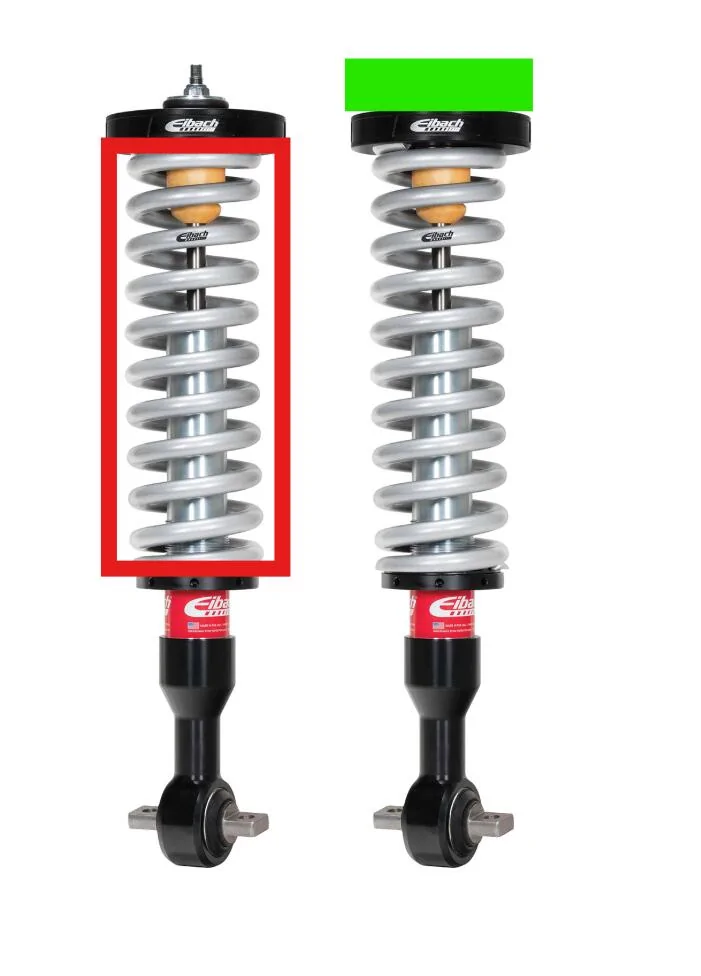
Now, when you tighten your bottom perch by 1 inch (and pre-load your spring) you are putting 500 lbs of force on the perch (that can't go anywhere if the shock is fully extended). When you put the weight of the vehicle on the coilover assembly, it will only compress if you exceed the 500 lbs of force that the compressed (or loaded) spring is exerting to extend. Before preloading the spring, 500 lbs would compress the coilover 1 inch because the spring wasn't already compressed and pushing back, after preload, you need 1000 lbs to compress coilover 1 inch (again, because the spring is already compressed 1 inch against the shock that can't extend any more).
So preloading the spring both raises the ride height, because the spring is pushing to extend the assembly with a preloaded amount of force, but it also makes it require more force to compress the coilover assembly (thus making it feel stiffer).
Sponsored