

As someone who use to work at discount tire, anti seize or an equivalent is what we used on stud threads.
Sponsored

Centering ring?I have aftermarket wheels and tires with balance beads. ~34" Toyo ATIII and Method wheels. Anyone else experiencing a high speed shudder with or without aftermarket wheels? The wheels have a much bigger than stock bore but I am using centering rings.
Doesn’t take a college linebacker to pull 150ft-lbs… I mean maybe a child or a frail elderly person wouldn’t be able to do it but that’s just a completely ridiculous statement.Unless you bend the wheels.
While the 150 ft-lb is widely specd across Ford trucks to me it seems like way too much. I have never owned an impact wrench that would go above 120 and always felt being in the danger zone at 80-90. Are we sure this 150 number that nobody but a college linebacker will be able to duplicate changing wheels in the wild or even doing your own rotations

Right from Permatex...use caution if using "lube" and torquing to recommended specs.As someone who use to work at discount tire, anti seize or an equivalent is what we used on stud threads.
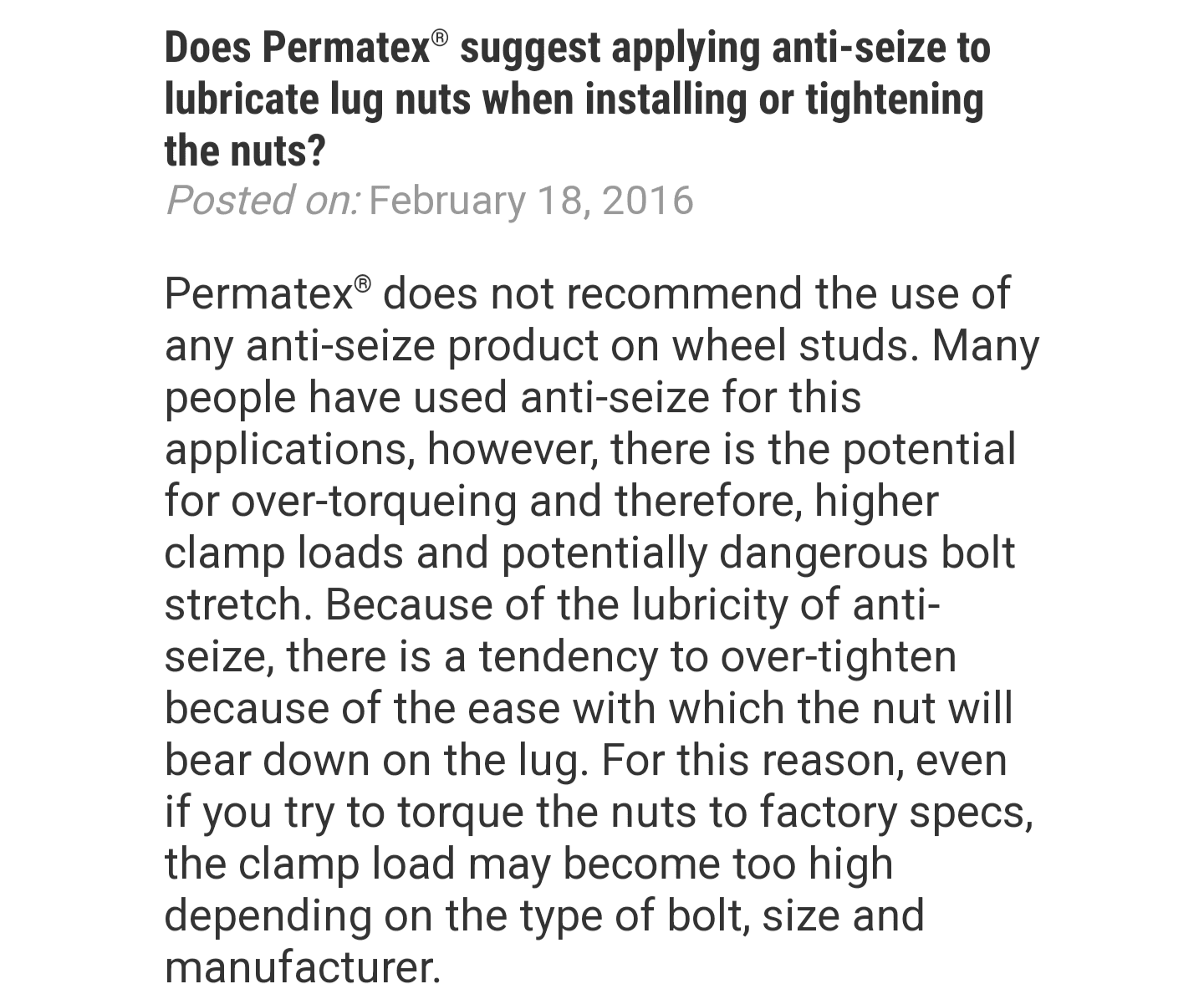
Sounds like a cya on their part. Using that rationale, would that not apply to any and all things threaded that requires torquing? Ever tried to take off lug nuts that were dry threads that have been on awhile? Generally not fun. But hey, I’m no scientist. Remember that article when you snap off a dry stud after a northern winter or extended period of timeRight from Permatex...use caution if using "lube" and torquing to recommended specs.

I live in Northern Michigan and have changed more tires than I can count, never once have I snapped a stud...and never once have I used anti-seize on a personal vehicle or customer vehicle (when I worked in a shop). Impact to take off, impact back on with torque limiting stick. Check final torque with torque wrench.Sounds like a cya on their part. Using that rationale, would that not apply to any and all things threaded that requires torquing? Ever tried to take off lug nuts that were dry threads that have been on awhile? Generally not fun. But hey, I’m no scientist. Remember that article when you snap off a dry stud after a northern winter or extended period of time
I yield. Tire change championI live in Northern Michigan and have changed more tires than I can count, never once have I snapped a stud...and never once have I used anti-seize on a personal vehicle or customer vehicle (when I worked in a shop). Impact to take off, impact back on with torque limiting stick. Check final torque with torque wrench.
As long as threads are clean, shouldn't have a problem.
You do it your way, if that works for you. I don't care. Just know that by using any lubricant you can over torque. Just trying to help..I yield. Tire change champion
You do it your way, if that works for you. I don't care. Just know that by using any lubricant you can over torque. Just trying to help..
I’m lost on this?The Sasquatch deal keeps getting better and better

A manual transmission is an amazing experience, but it won’t balance your wheels and tires.This is why stick is best. My Sasquatch at 85 mph is smooth, perfect!

It does apply, and if its a sensitive application, you need to reduce torque applied (25%-40%) if using lube or Anti-seize as to not apply too much force.I’m just playin man. That’s good information. I really am curious though how that doesn’t apply to every threaded torque application though
I agree, but that's like two of us. I have built engines and vehicles and know that using antiseize when dry is called for can result in higher applied torque than your wrench indicates. Or increased compression of the materials being clamped, which could be a worse outcome. That is one reason why engine bolts especially head are torqued in steps.It does apply, and if its a sensitive application, you need to reduce torque applied (25%-40%) if using lube or Anti-seize as to not apply too much force.
Some fasteners may specify the use of Anti-seize, so it would already be accounted for in the spec?