

Sponsored

Kicker Key 200.4 Done Correctly

OP
OP
AZCoyote

AZCoyote

Big Bend
Well-Known Member
First Name
Wiley
Joined
Jul 18, 2025
Threads
11
Messages
291
Reaction score
412
Location
Phoenix
Vehicle(s)
2024 Big Bend Sasquatch
Your Bronco Model
Big Bend
Thanks for the write-up. I've got the kicker key 200.4 and 500.1 waiting for time to install. Planning to wire the 200.4 for bi-amp dash and kick panels.

One thing though, you mentioned Forscan EQ change is only needed if upgrading or amping the roll cage speakers? So the OEM EQ does not impact at all the dash/kick panel head unit outputs?
****CORRECTION - per MOBRONCO data. It does flatten the EQ in front

It does not. I did a ton of reading in this forum to find the data. Thanks to people like RagnarKon and others who do write ups, we have tons of info available. The forscan change only changes to pod EQ. Front stage is already full range.

I also found a post talking about the poster testing for the bass roll off for sub signal and they found it is not happening until about 20hz which is fine. I’ve chased the 20hz wave before and it was fun but this system is for regular use not organ pedal tones.

I am installing a Key 500 next week. I will be tapping the low level signal off the OEM subwoofer harness first and hopefully that works. I plan to take some pics for that and post up a follow up to this thread.
Sponsored

 
Last edited:
MOBRONCO

Big Bend
Well-Known Member
Joined
Mar 9, 2020
Threads
6
Messages
307
Reaction score
411
Location
MO
Vehicle(s)
F150
Your Bronco Model
Big Bend
Sure. We can electrical geek if we must.

Resistance can vary. However, there’s no argument that wired as sold on the third-party harnesses they are sending a 2 ohm load to the amp.

If Ohm rating didn’t matter it would not be listed. The times the load is within spec aren’t the issue obviously. The times when resistance is high is absolutely what matters. Wired like they are bought, the harnesses are overloading every Kicker 200 that is in a Bronco and sending a 2 ohm load. That’s not theoretical. That is observable fact.

The amplifier gets crazy hot, performs mediocre, and for some has failed. Every person who complains that the auto tune won’t work should realize that the amp is working hard to stay alive. That’s the most likely reason people have had sub-optimal experiences with this amp.

Bi-amp is the way. I guarantee anyone who makes the change will be thankful they did. It’s like buying a brand new amp with twice the power. The change is that dramatic.
I'll agree that Bi-Amp will get better results in a lot of scenarios, but given most co-axes in the dash have an inline capacitor, adding in the transient nature of music and the volumes that most people will listen at the majority of the time wiring a mid and dash speakers together in parallel will NOT cause issues for over 95+% of installations people are doing here.
 

MOBRONCO

Big Bend
Well-Known Member
Joined
Mar 9, 2020
Threads
6
Messages
307
Reaction score
411
Location
MO
Vehicle(s)
F150
Your Bronco Model
Big Bend
It does not. I did a ton of reading in this forum to find the data. Thanks to people like RagnarKon and others who do write ups, we have tons of info available. The forscan change only changes to pod EQ. Front stage is already full range.

I also found a post talking about the poster testing for the bass roll off for sub signal and they found it is not happening until about 20hz which is fine. I’ve chased the 20hz wave before and it was fun but this system is for regular use not organ pedal tones.

I am installing a Key 500 next week. I will be tapping the low level signal off the harness first and hopefully that works. I plan to take some pics for that and post up a follow up to this thread.
This is false on the EQ. Here is my post from years ago showing the original factory EQ settings for all 4 speakers. I haven't ever measured the 7 speaker and B&O system as I don't have one.

https://www.bronco6g.com/forum/thre...sured-flat-front-rear-forscan-settings.50301/
 
OP
OP
AZCoyote

AZCoyote

Big Bend
Well-Known Member
First Name
Wiley
Joined
Jul 18, 2025
Threads
11
Messages
291
Reaction score
412
Location
Phoenix
Vehicle(s)
2024 Big Bend Sasquatch
Your Bronco Model
Big Bend
This is false on the EQ. Here is my post from years ago showing the original factory EQ settings for all 4 speakers. I haven't ever measured the 7 speaker and B&O system as I don't have one.

https://www.bronco6g.com/forum/thre...sured-flat-front-rear-forscan-settings.50301/
Thanks for the clarification on the EQ. Looks like your post should be authoritative on the EQ assuming the head unit does the same for all SKUS. There are some incorrect posts in the forum regarding EQ.

The roll off at 25 Hz doesn’t look very concerning since the kick panel is never gonna be reproducing 25 Hz. Those dips in the center were probably DSP’d out already during the auto tune set up. I’ll flip the EQ switch in forscan and rerun the auto tune on the Key though. I don’t expect it will be significantly different since flattening the EQ is exactly what happened when it ran last time. It should result in the key doing less work though.
 
OP
OP
AZCoyote

AZCoyote

Big Bend
Well-Known Member
First Name
Wiley
Joined
Jul 18, 2025
Threads
11
Messages
291
Reaction score
412
Location
Phoenix
Vehicle(s)
2024 Big Bend Sasquatch
Your Bronco Model
Big Bend
I'll agree that Bi-Amp will get better results in a lot of scenarios, but given most co-axes in the dash have an inline capacitor, adding in the transient nature of music and the volumes that most people will listen at the majority of the time wiring a mid and dash speakers together in parallel will NOT cause issues for over 95+% of installations people are doing here.
You are correct about the EQ but entirely wrong about the ohm load. The capacitor is there to high pass the tweeter on the coaxial speaker. The woofer still offers a full 4 ohm resistance.

The vast number of people in here complaining about the performance of the Key were using the harness and that is telling. My own experience also proves that the load on the amp is negatively effecting performance. I said at the start that it CAN be run the way the harness makers have wired it up. It’s not within manufacture spec for correct usage. People are seeing failures and poor performance. None of that is rhetorical. It is a result of loading a 4 ohm stable amp down to 2 ohms. If you were correct, the amp would not get crazy hot and clip out the gains in 1/10th of a dial turn.

95% of the installations here are living with it and don’t know or care. They are missing out on a way better experience.
 

Sponsored

Brian_B

Big Bend
Well-Known Member
First Name
Brian
Joined
Sep 14, 2023
Threads
62
Messages
8,438
Reaction score
14,940
Location
Central CA
Vehicle(s)
'23 BB 4dr 7MT, '22 BSport OBX, '87 B-II XL
Your Bronco Model
Big Bend
Clubs
 
I didn’t read the entire linked thread (yet)

but there are two distinct types of settings in Forscan

one it lists clearly as EQ - which I think is what the post talks about and most people refer to. I think it does enable more than just an EQ - I think it has timing adjustments and other things as well - it enables selection of two pre-programmed DSP profiles (Driver and Normal - accessible via Sound settings in sync)

Then there is also speaker size - tweeter, woofer, both, none. Does that also adjust the EQ profile further or does it just affect expected ohm load the ACM should expect to see prior to throwing a silent code for bad/missing speaker?
 
OP
OP
AZCoyote

AZCoyote

Big Bend
Well-Known Member
First Name
Wiley
Joined
Jul 18, 2025
Threads
11
Messages
291
Reaction score
412
Location
Phoenix
Vehicle(s)
2024 Big Bend Sasquatch
Your Bronco Model
Big Bend
Then there is also speaker size - tweeter, woofer, both, none. Does that also adjust the EQ profile further or does it just affect expected ohm load the ACM should expect to see prior to throwing a silent code for bad/missing speaker?
Speaker size settings may affect crossover points for high pass but it will not affect OHMs as that is a matter of resistance.
 
Last edited:

MOBRONCO

Big Bend
Well-Known Member
Joined
Mar 9, 2020
Threads
6
Messages
307
Reaction score
411
Location
MO
Vehicle(s)
F150
Your Bronco Model
Big Bend
You are correct about the EQ but entirely wrong about the ohm load. The capacitor is there to high pass the tweeter on the coaxial speaker. The woofer still offers a full 4 ohm resistance.

The vast number of people in here complaining about the performance of the Key were using the harness and that is telling. My own experience also proves that the load on the amp is negatively effecting performance. I said at the start that it CAN be run the way the harness makers have wired it up. It’s not within manufacture spec for correct usage. People are seeing failures and poor performance. None of that is rhetorical. It is a result of loading a 4 ohm stable amp down to 2 ohms. If you were correct, the amp would not get crazy hot and clip out the gains in 1/10th of a dial turn.

95% of the installations here are living with it and don’t know or care. They are missing out on a way better experience.
Again, you are confusing resistance and impedance.

Here is the manual of JL Audio’s fantastic 6.5” C7 driver showing its impedance curve. They list it as a 4 ohm driver, but if you look at the curve it crosses 5 ohms at around 1100 hz and jumps over 10 ohms at 6500 hz.

https://static.garmin.com/pumac/C7650cw_MAN.pdf

Here is a video working through this also.


And as far as the caps impact

https://soundcertified.com/what-does-capacitor-inductor-do-in-speaker-crossover/

Capacitors store an electrical charge using extremely thin and tightly wound electric conductors separated by an insulator. This can be an electrolyte, mica, or several other types of materials. While they do not allow a direct current (DC) signal to pass, they do allow alternating current (AC) voltage & signals to pass.

They have an interesting characteristic: capacitors allow only high frequencies to pass – they increase their impedance (frequency-based resistance) when lower frequencies are applied.

The point at which this takes place is carefully chosen to be the crossover frequency. There are two fundamental types of capacitors with one in particular used for audio.
 
OP
OP
AZCoyote

AZCoyote

Big Bend
Well-Known Member
First Name
Wiley
Joined
Jul 18, 2025
Threads
11
Messages
291
Reaction score
412
Location
Phoenix
Vehicle(s)
2024 Big Bend Sasquatch
Your Bronco Model
Big Bend
Again, you are confusing resistance and impedance.

Here is the manual of JL Audio’s fantastic 6.5” C7 driver showing its impedance curve. They list it as a 4 ohm driver, but if you look at the curve it crosses 5 ohms at around 1100 hz and jumps over 10 ohms at 6500 hz.

https://static.garmin.com/pumac/C7650cw_MAN.pdf

Here is a video working through this also.


And as far as the caps impact

https://soundcertified.com/what-does-capacitor-inductor-do-in-speaker-crossover/

Capacitors store an electrical charge using extremely thin and tightly wound electric conductors separated by an insulator. This can be an electrolyte, mica, or several other types of materials. While they do not allow a direct current (DC) signal to pass, they do allow alternating current (AC) voltage & signals to pass.

They have an interesting characteristic: capacitors allow only high frequencies to pass – they increase their impedance (frequency-based resistance) when lower frequencies are applied.

The point at which this takes place is carefully chosen to be the crossover frequency. There are two fundamental types of capacitors with one in particular used for audio.
Your graphs on EQ and RTA work were stellar. Your understanding of impedance and amps is not.

Go read your boxes for the speakers and amps you bought. When you read the impedance of the hardware, it is talking about resistance in ohms. The amp can do X ohms. The speaker represent Y ohms. Wiring choices generate Z ohms. This is the standard.

the capacitor in your example does not affect the woofer or change the load the speaker presents to the amplifier. It attenuates low frequencies to the tweeter. The speaker is still seen as a 4 ohm load and when wired in parallel with another 4 ohm speaker the load will be 2 ohms.

variable resistance based upon frequency input is immaterial. You seem to want to use that as your argument for load and resistance. I get your point about variance but that isn’t how car audio hardware is rated. We don’t buy “amps that handle 2 ohms at 100hz to 400 ohms at 10,000hz” amplifiers. We use nominal values which are the standard.

If you still think you are correct, the entire car audio industry owes you millions of dollars. We can now just attach endless numbers of speakers to an amp if we throw a capacitor on there. Sweet.
 

MOBRONCO

Big Bend
Well-Known Member
Joined
Mar 9, 2020
Threads
6
Messages
307
Reaction score
411
Location
MO
Vehicle(s)
F150
Your Bronco Model
Big Bend
Your graphs on EQ and RTA work were stellar. Your understanding of impedance and amps is not.

Go read your boxes for the speakers and amps you bought. When you read the impedance of the hardware, it is talking about resistance in ohms. The amp can do X ohms. The speaker represent Y ohms. Wiring choices generate Z ohms. This is the standard.

the capacitor in your example does not affect the woofer or change the load the speaker presents to the amplifier. It attenuates low frequencies to the tweeter. The speaker is still seen as a 4 ohm load and when wired in parallel with another 4 ohm speaker the load will be 2 ohms.

variable resistance based upon frequency input is immaterial. You seem to want to use that as your argument for load and resistance. I get your point about variance but that isn’t how car audio hardware is rated. We don’t buy “amps that handle 2 ohms at 100hz to 400 ohms at 10,000hz” amplifiers. We use nominal values which are the standard.

If you still think you are correct, the entire car audio industry owes you millions of dollars. We can now just attach endless numbers of speakers to an amp if we throw a capacitor on there. Sweet.
I gave you a link to describe how it works, speakers are complex motors including dynamic factors. Manufacturers utilize simple things to make it easier for people who don’t understand advanced concepts to get things mostly right.

Feel free to explain how a capacitor filters frequencies other than by increasing electrical resistance below its targeted frequency.

Here’s some more reading for you on this.


https://www.audiofrog.com/to-cap-or-not-to-cap-tweeters-in-systems-with-active-crossovers/

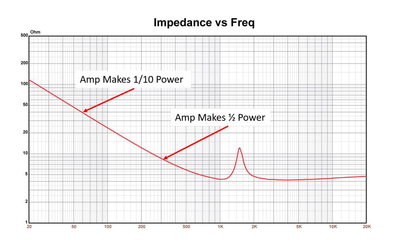
If we think about the distribution of energy in terms of amplifier power, things become a little clearer. In the picture below, I’ve indicated the amount of amplifier power necessary to reproduce this track. If your amplifier produces 100 watts at low frequencies, it only needs to be able to make about 6 watts between 1 kHz and 2.5 kHz to play this track. At really high frequencies, 1/10 of a watt is all that’s needed. So, no matter how powerful your amplifier is, when you listen to Hotel California, your amp doesn’t actually make much power at really high frequencies and that’s just fine for the little voice coil in the tweeter.


Here’s how that works. As I mentioned above, the resistance of the voice coil determines how much current flows from the amp and through the speaker. A capacitor, simply stated, increases the resistance of the circuit at low frequencies. If the resistance of the circuit is increased, less current flows. The amplifier makes less power at frequencies where the resistance is higher.

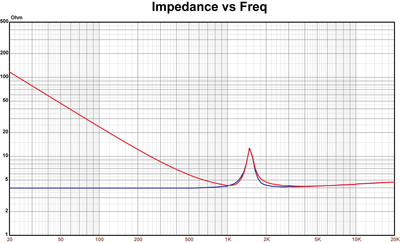
Below is a graph of the impedance curve of the tweeter with and without the cap. At low frequencies, the impedance is much higher.


Ford Bronco Kicker Key 200.4 Done Correctly 25-Z-with-and-Without-Ca


Here’s how that affects the amount of power the amp produces. This shapes the frequency response and protects the tweeter.


Ford Bronco Kicker Key 200.4 Done Correctly 26-Z-With-Cap-With-Callouts
 

Sponsored
OP
OP
AZCoyote

AZCoyote

Big Bend
Well-Known Member
First Name
Wiley
Joined
Jul 18, 2025
Threads
11
Messages
291
Reaction score
412
Location
Phoenix
Vehicle(s)
2024 Big Bend Sasquatch
Your Bronco Model
Big Bend
I gave you a link to describe how it works, speakers are complex motors including dynamic factors. Manufacturers utilize simple things to make it easier for people who don’t understand advanced concepts to get things mostly right.

Feel free to explain how a capacitor filters frequencies other than by increasing electrical resistance below its targeted frequency.

Here’s some more reading for you on this.


https://www.audiofrog.com/to-cap-or-not-to-cap-tweeters-in-systems-with-active-crossovers/

If we think about the distribution of energy in terms of amplifier power, things become a little clearer. In the picture below, I’ve indicated the amount of amplifier power necessary to reproduce this track. If your amplifier produces 100 watts at low frequencies, it only needs to be able to make about 6 watts between 1 kHz and 2.5 kHz to play this track. At really high frequencies, 1/10 of a watt is all that’s needed. So, no matter how powerful your amplifier is, when you listen to Hotel California, your amp doesn’t actually make much power at really high frequencies and that’s just fine for the little voice coil in the tweeter.


Here’s how that works. As I mentioned above, the resistance of the voice coil determines how much current flows from the amp and through the speaker. A capacitor, simply stated, increases the resistance of the circuit at low frequencies. If the resistance of the circuit is increased, less current flows. The amplifier makes less power at frequencies where the resistance is higher.

Below is a graph of the impedance curve of the tweeter with and without the cap. At low frequencies, the impedance is much higher.


25-Z-with-and-Without-Cap.png


Here’s how that affects the amount of power the amp produces. This shapes the frequency response and protects the tweeter.


26-Z-With-Cap-With-Callouts.png
I think I need to send out a “Copper Alert”.

There is a collective of electrical engineering students gathered around a water cooler somewhere who haven’t noticed that you’ve gone missing.

In the interest of getting you to NOT dilute the usefulness of this thread further, you WIN the argument about how varying frequency will alter impedance. It doesn’t matter in how reality works with attaching two 4 ohm speakers in parallel to a 4 ohm stable amp thus driving that amp at 2 ohms…. But you are correct. The impedance with rise and fall based upon the frequency input.

to everyone who slogs this far into the thread, please give the bi-amp setup a try. It is worth your time. It alleviates the unsupported load on the Key and makes an enormous change in volume and quality of the front sound stage.

You may want to do the EQ setting in forscan based upon what MOBRIDGE posted from his RTA experiments. That work was brilliant. He clearly took his Asperger’s medicine that day.
 
Last edited:

Brian_B

Big Bend
Well-Known Member
First Name
Brian
Joined
Sep 14, 2023
Threads
62
Messages
8,438
Reaction score
14,940
Location
Central CA
Vehicle(s)
'23 BB 4dr 7MT, '22 BSport OBX, '87 B-II XL
Your Bronco Model
Big Bend
Clubs
 
Speaker size settings may affect crossover points for high pass but it will not affect OHMs as that is a matter of resistance.
Right.

The ACM uses the ohms to determine if a speaker is open/shorted though. And this setting ~may~ tell the ACM what load to expect before it sets a code

but I don’t know if it also affects the equalizer setting applied by the the ACM

That’s what I was getting at
 

Brian_B

Big Bend
Well-Known Member
First Name
Brian
Joined
Sep 14, 2023
Threads
62
Messages
8,438
Reaction score
14,940
Location
Central CA
Vehicle(s)
'23 BB 4dr 7MT, '22 BSport OBX, '87 B-II XL
Your Bronco Model
Big Bend
Clubs
 
And if the speaker size affects crossover points - then you need to make sure to adjust it as well, not just the EQ setting in Forscan

most guides around here do mention that - turn EQ off and set speaker size to Tweet + Mid

But I don’t know exactly what the effect of that speaker size setting is, which is why I asked if it had been tested to see if it does affect crossover/EQ points at the ACM output. I know the EQ does - and if you do not have a DSP you should leave it on or the timing gets all mucked up.

but for the purposes of this thread, the kicker does have a DSP and part of the cal procedure I assume corrects for timing in the outputs
 
OP
OP
AZCoyote

AZCoyote

Big Bend
Well-Known Member
First Name
Wiley
Joined
Jul 18, 2025
Threads
11
Messages
291
Reaction score
412
Location
Phoenix
Vehicle(s)
2024 Big Bend Sasquatch
Your Bronco Model
Big Bend
And if the speaker size affects crossover points - then you need to make sure to adjust it as well, not just the EQ setting in Forscan

most guides around here do mention that - turn EQ off and set speaker size to Tweet + Mid

But I don’t know exactly what the effect of that speaker size setting is, which is why I asked if it had been tested to see if it does affect crossover/EQ points at the ACM output. I know the EQ does - and if you do not have a DSP you should leave it on or the timing gets all mucked up.

but for the purposes of this thread, the kicker does have a DSP and part of the cal procedure I assume corrects for timing in the outputs
This is a great point for a Segway back to what the thread is about.

What you start with and intended use probably factors.

my Seven speaker no BO doesn’t require changing the rear speaker size since I’m only using head unit power and those 4” speakers won’t fair well at high volume with full range. I’d consider it if I powered them and changed them to 6.5 pods.

Based upon MOBRODGE awesome thread, turning off EQ would be better labeled as “disable DSP” since it clearly removes the time alignment for seating position as well as the EQ curve. I happen to have my radio set with the driver position stuff OFF so timing delays are already defeated. I’d wager the Key already corrected the EQ bumps too.

I will forscan those changes later today and retune. I suspect it won’t make much difference in my specific case. Someone who has upgraded pods might have a different outcome.
 

Brian_B

Big Bend
Well-Known Member
First Name
Brian
Joined
Sep 14, 2023
Threads
62
Messages
8,438
Reaction score
14,940
Location
Central CA
Vehicle(s)
'23 BB 4dr 7MT, '22 BSport OBX, '87 B-II XL
Your Bronco Model
Big Bend
Clubs
 
I happen to have my radio set with the driver position stuff OFF so timing delays are already defeated
If you disable the EQ in Forscan, that option goes away in Sync entirely.
Sponsored


Top