
- First Name
- Chris
- Joined
- Dec 1, 2025
- Threads
- 6
- Messages
- 39
- Reaction score
- 90
- Location
- California
- Vehicle(s)
- 2023 Ford Bronco
- Your Bronco Model
- Badlands
- Thread starter
- #1
The Mystery of the Missing Up-travel
The Bronco6G Stickied Shock Database shows the following information for the SAS coilover:
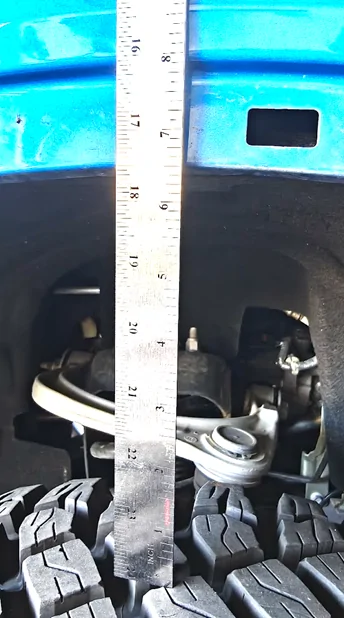
Assuming wheel travel of 10.15”, and ride height in the middle of the travel range, there should be 5” up-travel and 5” downtravel. Here is a picture of the distance between my 35” tire and the fender at ride height, showing 6.5” of available up-travel:

So, shouldn't there be at least 1.5” of up-travel that could be used if you could find a coilover with a shorter compressed length? As the Project Farm guy says, Let’s Find Out!
Removal of Coilover
I disassembled the front suspension by removing the axle nut, tie rod ball joint nut, UCA ball joint nut, swaybar link lower nut, two lower coilover nuts, and three upper coilover nuts. I didn’t do the LCA method because I didn’t want to mess with an alignment, so I did not loosen the UCA or LCA bolts. I have the electronic swaybar and forgot to disconnect it, so I also removed the swaybar link lower nut on the other side, and swung it up out of the way.
The tie rod ball joint popped off with an air hammer. The UCA ball joint was a pain, I tried an air hammer on it, just bashed up the bottom. I tried the PITTSBURGH 3/4 in. Ball Joint Separator from Harbor Freight, but it didn’t have the required height.
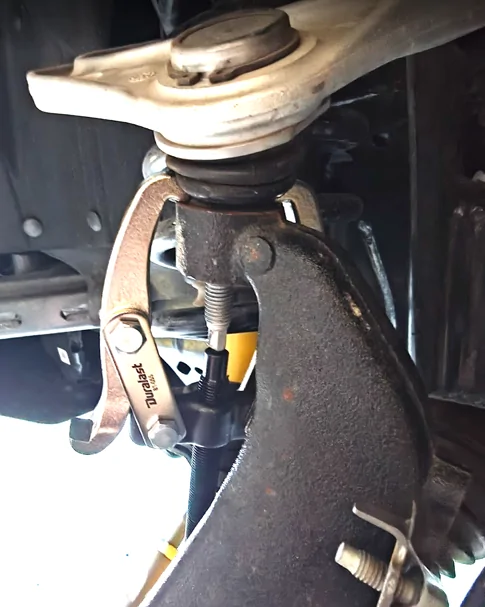
I finally got it separated using this tool from Autozone: Duralast 5 Ton 2 Jaw Puller. Link.
You can rent it for free at Autozone. Here’s a pic:

Coil Spring Removal
I read too many stories about dodgy “widowmaker” spring compressors. ~$50 get you this this:

Semi-pro or pro spring compressors (e.g. Branick) are $1,000+. There are couple “pro-sumer” models like Jack Tech and Cal-Van Tools in the $400-600 range. Still very spendy.
I looked around a ton for a non-sketchy spring compressor that wasn’t too expensive. The next level up from the widowmakers at around $125 are these:

The only thing holding the compressed spring is the ridge on the semicircular plates, still too sketchy. JEGS has one with a better-looking attachment system for $200:

I almost bought it. I was a little worried about the thin curved metal arms at the top and the hydraulics. Finally, I saw an OEM Tools compressor very similar to the Cal-Van Tools model on sale at Autozone for $260: OEM Tools Suspension Strut Mount Tool 37037: Link.
It does not have any hydraulics to break, just a big screw at the top. The arms are thick metal, bolted together. Heavy is reliable. It handled the SAS coilover without complaint:

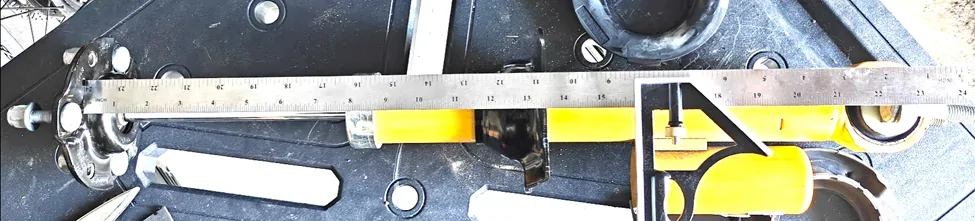
Measurement of Fully Extended Coilover - 23.3"
Here’s the fully extended coilover:


13.5” Spring Length at Max Coilover Extension

Measurement of Spring Length of Compressed Coilover - 7.5"
I compressed the coilover as far as I could with my body weight and used the compressor to hold it for a pic:

I inadvertently compressed it slightly more when I reinstalled it, down to 7.31”. 6.25” claimed total compression travel would imply max compression at 7.25”, so this is a couple mm from the claimed max compression.
Note the amount of shaft showing is about 1”.
16.75” Spring Free Length


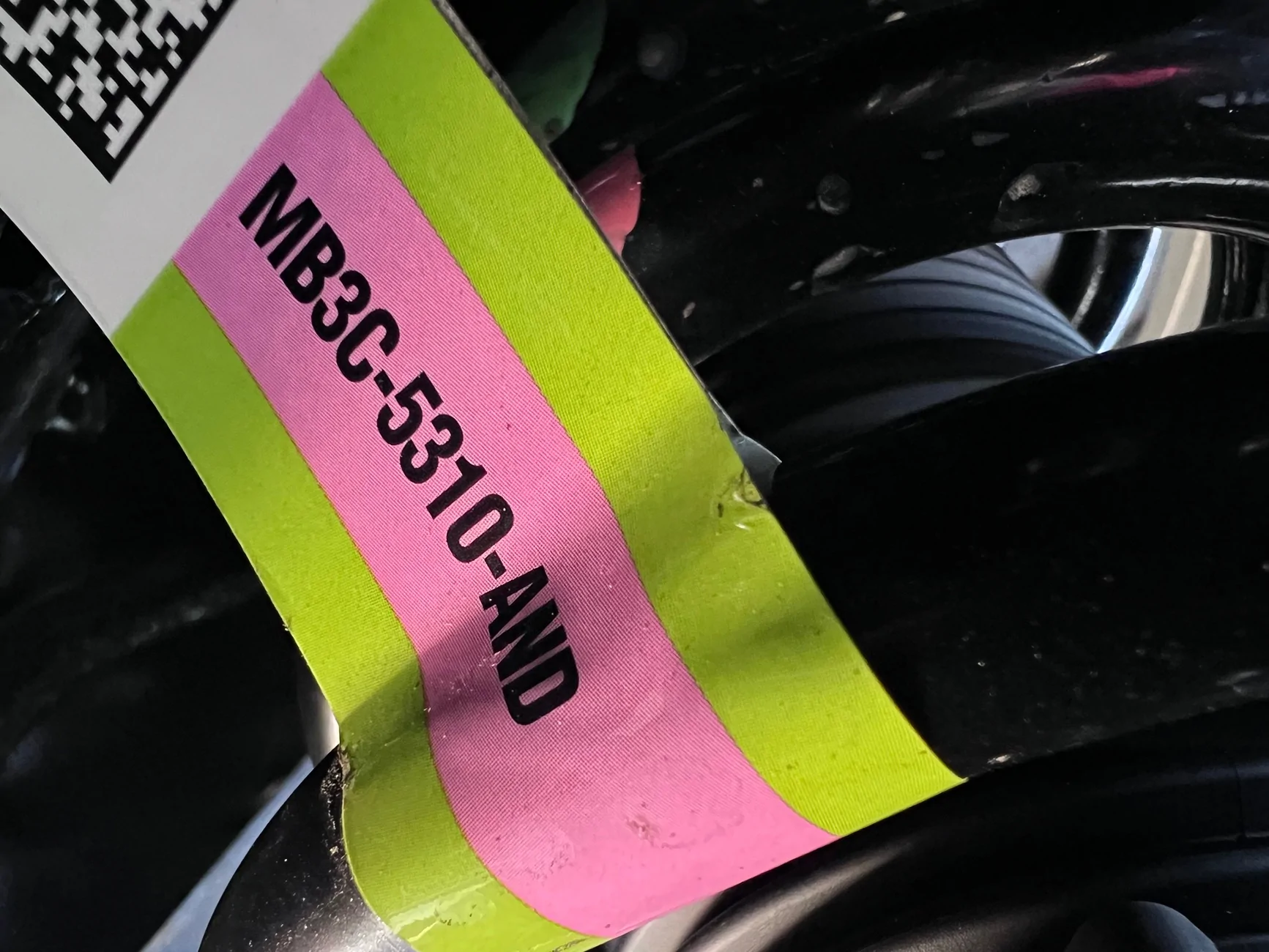
The tag on the spring shows a part number of MB3C-5310-AND. This is from a 2023 2 door 2.7L Badlands Sasquatch.
Preload of Hoss 2.0 Coilover is 3.25”
16.75” Spring Free Length – 13.5” Spring Length at Max Coilover Extension = 3.25” Preload
We can calculate the spring rate from this if we know the vehicle weight. That’s an upcoming post after I get everything put back together and the front axle weighed. Edit: It's on page 2 of this thread, 357 lb/in
Installation of Coilover Without Spring
I wanted to measure the motion ratio of the suspension, and measure the max up-travel of the SAS coilover. I reinstalled the coilover without the spring, and reattached the UCA.
Measurement of Center of Axle to Fender vs. Spring Length
I measured from the spring perch, which is the same for all non-Raptor Broncos, and from the top of the fender, which is also shared by all non-Raptor Broncos. I think. Maybe the Heritage/Everglades fenders are a different height?
Here is a plot of the measured spring lengths vs the axle position:

The slope of the line of best fit is .5855. This is the installation ratio/motion ratio.
I was expecting the slope to closely match the Motion Ratio calculated as follows:


(from the Eibach Suspension Worksheet) I measured d1 = 9.537, d2 = 14.687, A = 16 deg at max compression, decreasing to 9 deg. at full droop. The ratio calculated from the measured LCA varies from .624 to .64. Accurately measuring the LCA is difficult, I am currently chalking the discrepancy up to the d1 and/or d2 measurement being a little off, and a slight curve hiding in the data noise. Maybe someone with some CAD data can provide more accurate d1 and d2 measurements to see whether the two methods of determining the motion ratio match.
Fender/Tire Gap vs Coilover Length
I measured my stock SAS Goodyear 35” wheel/tire diameter as 34.2” The center of the wheel hub to the tire surface is therefore 17.1”. The tire gap is the measured fender to axle length - 17.1” wheel/tire radius.
Here is the plot of the fender/tire gap vs coilover length:

The measured fender gap is -0.01” at a measured coilover length of 17.11”. The claimed compressed coilover length is 17.063”, so the SAS coilover reaches its minimum length at almost exactly the same time as the tire hits the fender.
So, apparently Ford maximized the up-travel! Or did they?
We Need to Talk About the Bump Stop. . .
This is the bump stop:


The upper part of the bumpstop is compressible. Here is the bump stop under a chair with about 200 lbs of weight on it:

The bottom part is a very hard polyurethane or similar material. It’s an incompressible brick. If you applied 10,000 lbs to the bump stop, you might compress it to 1.5” in height. It's going to crack/shatter before it compresses more than that.
The bump stop limits travel. Here is a chart showing a few notable coilover lengths:
At max compression (17.11” coilover length), the exposed shaft is shorter than the bump stop. There isn’t room for the bump stop until the coilover is 17.8” long, and the wheel is 1.23” below the fender.
At ride height, there is 1.1” of coilover compression before contact with the bump stop.
At ride height, there is a total of 3.1" of available coilover compression = 5.27" wheel up-travel.
At ride height, there is a total of 2.4" available coilover extension = 4.08" wheel down-travel.
Conclusion:
Revisiting the original data:
The SAS Hoss 2.0 coilover at max compression to bump stop is 17.8” long. With a 34.2” diameter tire, there is 1.23” of additional wheel up-travel available before fender contact.
Options to reclaim 1.23” of additional wheel up-travel:
The Bronco6G Stickied Shock Database shows the following information for the SAS coilover:
| Compressed Length (in) | Extended Length (in) | Travel (in) | Claimed Wheel Travel (in) | Calc Wheel Travel (in)* | Ratio | Front Spring Rate (lbf/in) |
| 17.063 | 23.313 | 6.250 | 9.45 | 10.15 | 1.51 |
Assuming wheel travel of 10.15”, and ride height in the middle of the travel range, there should be 5” up-travel and 5” downtravel. Here is a picture of the distance between my 35” tire and the fender at ride height, showing 6.5” of available up-travel:
So, shouldn't there be at least 1.5” of up-travel that could be used if you could find a coilover with a shorter compressed length? As the Project Farm guy says, Let’s Find Out!
Removal of Coilover
I disassembled the front suspension by removing the axle nut, tie rod ball joint nut, UCA ball joint nut, swaybar link lower nut, two lower coilover nuts, and three upper coilover nuts. I didn’t do the LCA method because I didn’t want to mess with an alignment, so I did not loosen the UCA or LCA bolts. I have the electronic swaybar and forgot to disconnect it, so I also removed the swaybar link lower nut on the other side, and swung it up out of the way.
The tie rod ball joint popped off with an air hammer. The UCA ball joint was a pain, I tried an air hammer on it, just bashed up the bottom. I tried the PITTSBURGH 3/4 in. Ball Joint Separator from Harbor Freight, but it didn’t have the required height.
I finally got it separated using this tool from Autozone: Duralast 5 Ton 2 Jaw Puller. Link.
You can rent it for free at Autozone. Here’s a pic:
Coil Spring Removal
I read too many stories about dodgy “widowmaker” spring compressors. ~$50 get you this this:
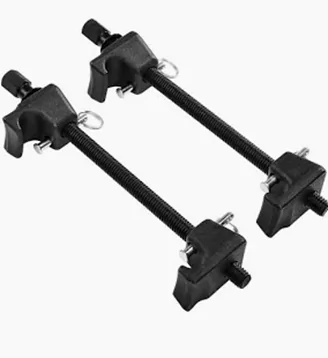
Semi-pro or pro spring compressors (e.g. Branick) are $1,000+. There are couple “pro-sumer” models like Jack Tech and Cal-Van Tools in the $400-600 range. Still very spendy.
I looked around a ton for a non-sketchy spring compressor that wasn’t too expensive. The next level up from the widowmakers at around $125 are these:
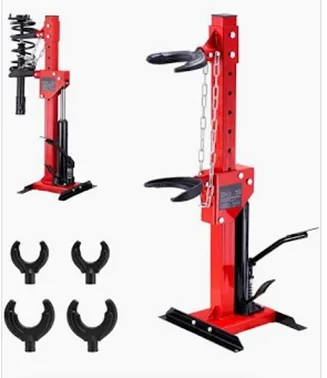
The only thing holding the compressed spring is the ridge on the semicircular plates, still too sketchy. JEGS has one with a better-looking attachment system for $200:
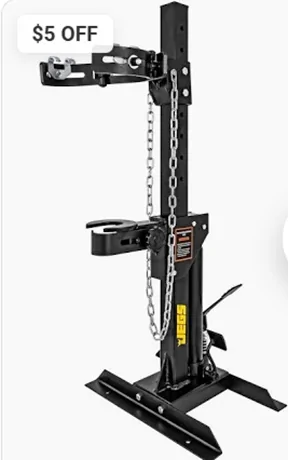
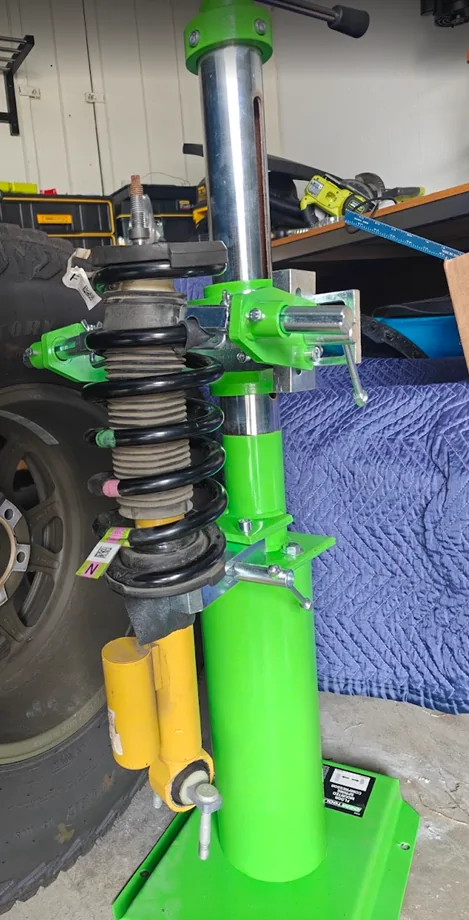
I almost bought it. I was a little worried about the thin curved metal arms at the top and the hydraulics. Finally, I saw an OEM Tools compressor very similar to the Cal-Van Tools model on sale at Autozone for $260: OEM Tools Suspension Strut Mount Tool 37037: Link.
It does not have any hydraulics to break, just a big screw at the top. The arms are thick metal, bolted together. Heavy is reliable. It handled the SAS coilover without complaint:
Measurement of Fully Extended Coilover - 23.3"
Here’s the fully extended coilover:
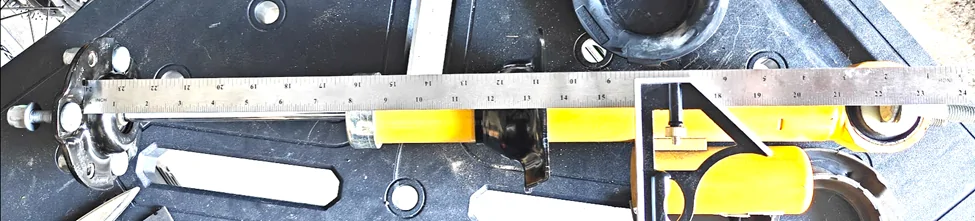
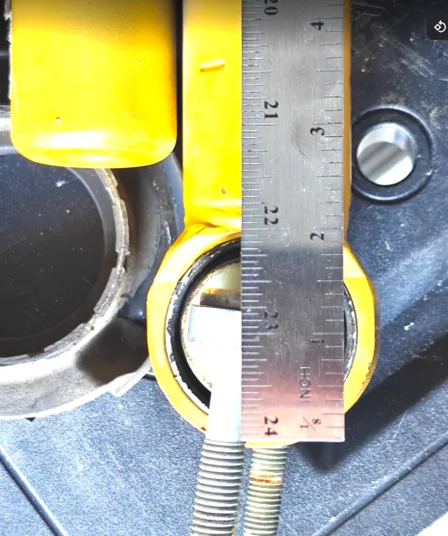
13.5” Spring Length at Max Coilover Extension
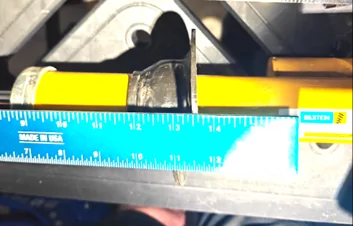
Measurement of Spring Length of Compressed Coilover - 7.5"
I compressed the coilover as far as I could with my body weight and used the compressor to hold it for a pic:
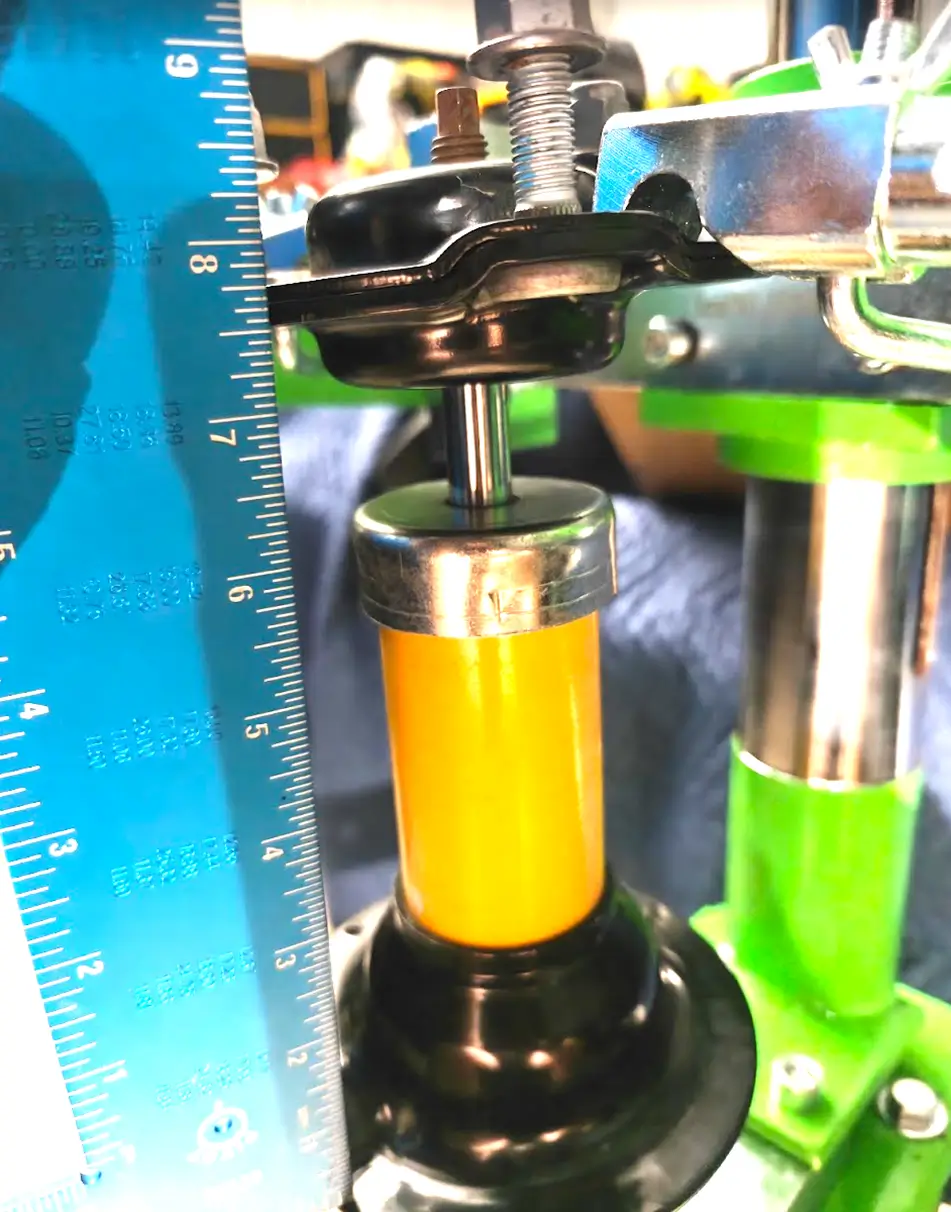
I inadvertently compressed it slightly more when I reinstalled it, down to 7.31”. 6.25” claimed total compression travel would imply max compression at 7.25”, so this is a couple mm from the claimed max compression.
Note the amount of shaft showing is about 1”.
16.75” Spring Free Length
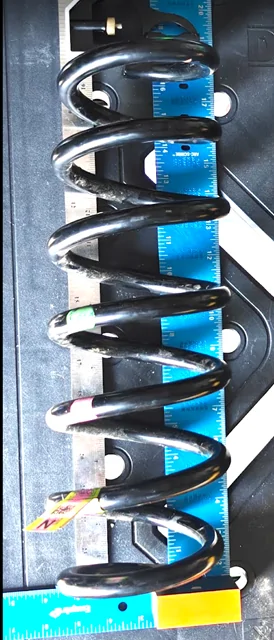
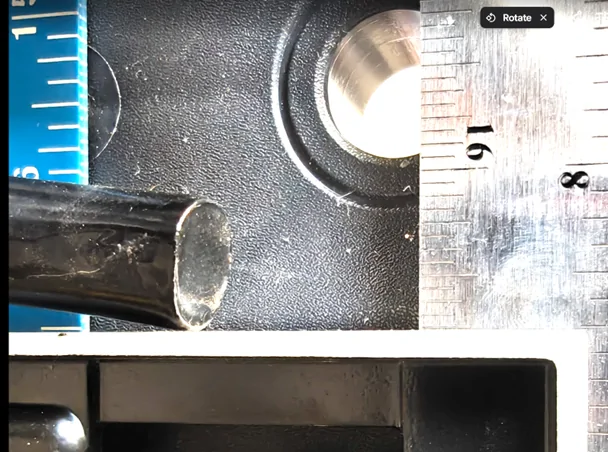
The tag on the spring shows a part number of MB3C-5310-AND. This is from a 2023 2 door 2.7L Badlands Sasquatch.
Preload of Hoss 2.0 Coilover is 3.25”
16.75” Spring Free Length – 13.5” Spring Length at Max Coilover Extension = 3.25” Preload
We can calculate the spring rate from this if we know the vehicle weight. That’s an upcoming post after I get everything put back together and the front axle weighed. Edit: It's on page 2 of this thread, 357 lb/in
Installation of Coilover Without Spring
I wanted to measure the motion ratio of the suspension, and measure the max up-travel of the SAS coilover. I reinstalled the coilover without the spring, and reattached the UCA.
Measurement of Center of Axle to Fender vs. Spring Length
I measured from the spring perch, which is the same for all non-Raptor Broncos, and from the top of the fender, which is also shared by all non-Raptor Broncos. I think. Maybe the Heritage/Everglades fenders are a different height?
Here is a plot of the measured spring lengths vs the axle position:
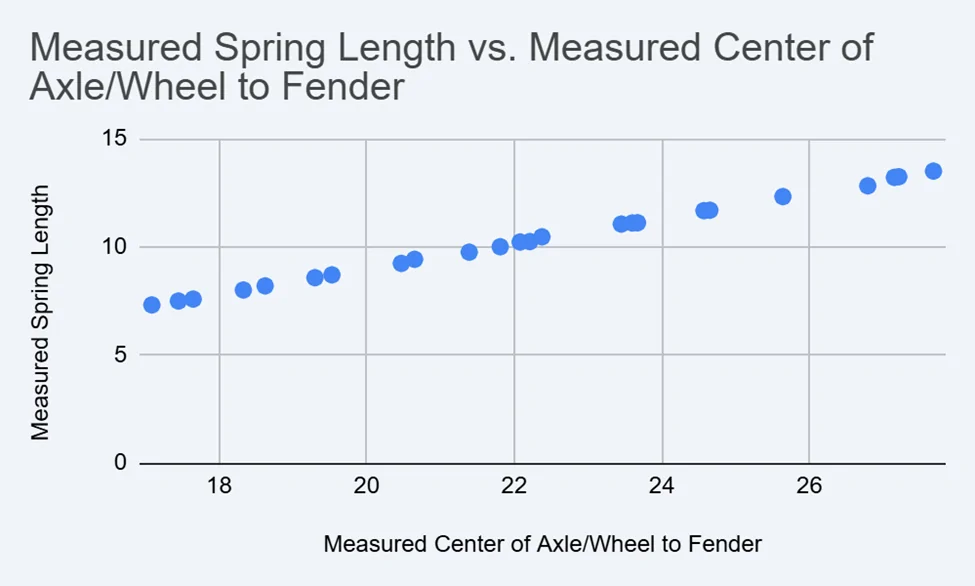
The slope of the line of best fit is .5855. This is the installation ratio/motion ratio.
I was expecting the slope to closely match the Motion Ratio calculated as follows:
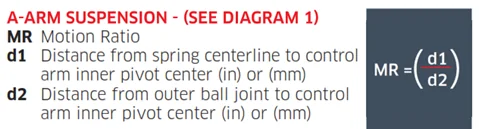
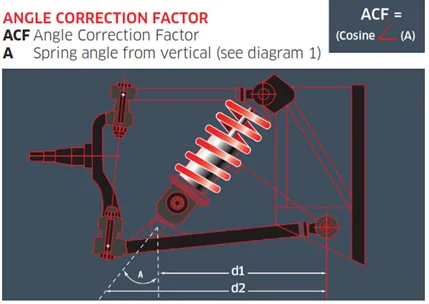
(from the Eibach Suspension Worksheet) I measured d1 = 9.537, d2 = 14.687, A = 16 deg at max compression, decreasing to 9 deg. at full droop. The ratio calculated from the measured LCA varies from .624 to .64. Accurately measuring the LCA is difficult, I am currently chalking the discrepancy up to the d1 and/or d2 measurement being a little off, and a slight curve hiding in the data noise. Maybe someone with some CAD data can provide more accurate d1 and d2 measurements to see whether the two methods of determining the motion ratio match.
Fender/Tire Gap vs Coilover Length
I measured my stock SAS Goodyear 35” wheel/tire diameter as 34.2” The center of the wheel hub to the tire surface is therefore 17.1”. The tire gap is the measured fender to axle length - 17.1” wheel/tire radius.
Here is the plot of the fender/tire gap vs coilover length:
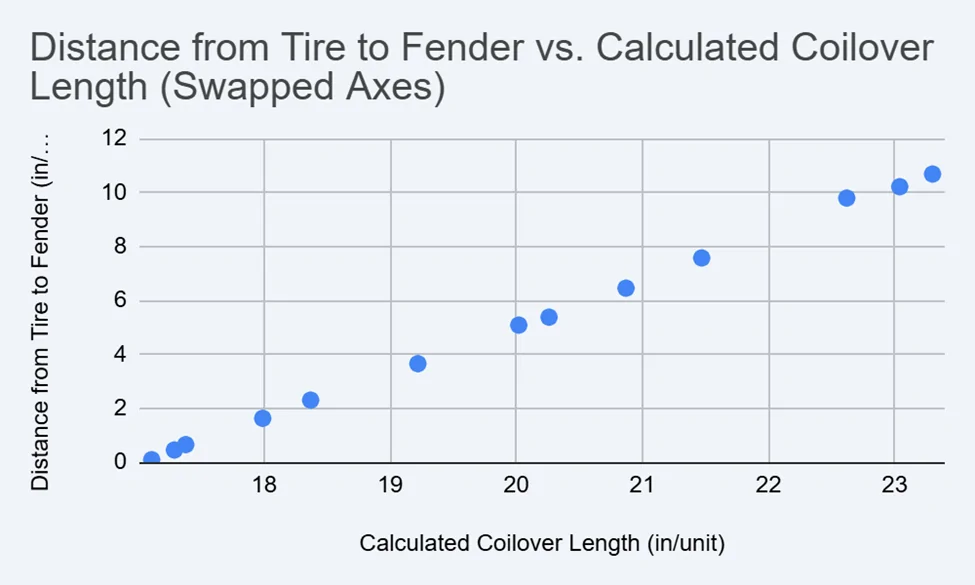
The measured fender gap is -0.01” at a measured coilover length of 17.11”. The claimed compressed coilover length is 17.063”, so the SAS coilover reaches its minimum length at almost exactly the same time as the tire hits the fender.
So, apparently Ford maximized the up-travel! Or did they?
We Need to Talk About the Bump Stop. . .
This is the bump stop:
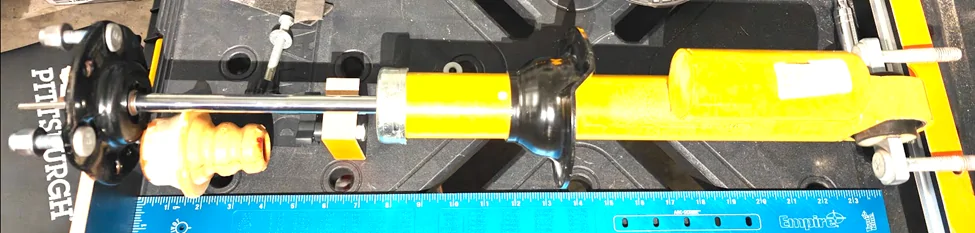
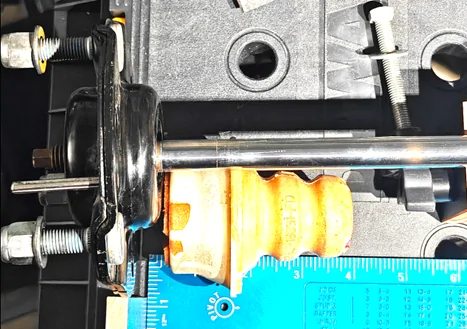
The upper part of the bumpstop is compressible. Here is the bump stop under a chair with about 200 lbs of weight on it:

The bottom part is a very hard polyurethane or similar material. It’s an incompressible brick. If you applied 10,000 lbs to the bump stop, you might compress it to 1.5” in height. It's going to crack/shatter before it compresses more than that.
The bump stop limits travel. Here is a chart showing a few notable coilover lengths:
| Calculated Length of exposed shaft Measured min/max | Measured Center of axle/wheel to Fender | Measured Spring Length | Calculated Distance from Tire to Fender | Calculated Coilover Length 23.3 - 13.5 max spring compression + measured spring length | ||
| Max Compression/Min Tire to Fender | 0.81 | 17.09 | 7.31 | -0.01 | 17.11 | |
| Bump stop turns into a rock at 1.5" of exposed shaft- End of Compression Travel | 1.5 | 18.33 | 8 | 1.23 | 17.8 | |
| Bump Stop 3.5" uncompressed | 3.5 | 21.81 | 10 | 4.71 | 19.8 | |
| Measured Ride Height 6.5" Tire to Fender | 4.6 | 23.6 | 11.1 | 6.5 | 20.9 | |
| Measured Full Droop 10.6" Tire to Fender | 7 | 27.68 | 13.5 | 10.58 | 23.3 |
At max compression (17.11” coilover length), the exposed shaft is shorter than the bump stop. There isn’t room for the bump stop until the coilover is 17.8” long, and the wheel is 1.23” below the fender.
At ride height, there is 1.1” of coilover compression before contact with the bump stop.
At ride height, there is a total of 3.1" of available coilover compression = 5.27" wheel up-travel.
At ride height, there is a total of 2.4" available coilover extension = 4.08" wheel down-travel.
Conclusion:
Revisiting the original data:
| Compressed Length (in) | Extended Length (in) | Travel (in) | Claimed Wheel Travel (in) | Calc Wheel Travel (in)* | Ratio | Front Spring Rate (lbf/in) |
| 17.063 | 23.313 | 6.250 | 9.45 | 10.15 | 1.51 | Upcoming Post |
| CONFIRMED | CONFIRMED | CONFIRMED (6.19, plausible to continue compression to 6.25) | CONFIRMED The measured tire travel from full droop to Bump-stop-limited travel is 9.35”. Ford’s claimed actual wheel travel is accurate within 0.1”. | NOT CONFIRMED Wheel Travel with bump stop 9.55”. Wheel Travel without bump stop 10.59 | NOT CONFIRMED This number is arrived at by taking the bump-stop-limited wheel travel of 9.45, divided by the non-bump-stop-limited total coilover travel of 6.25. |
The SAS Hoss 2.0 coilover at max compression to bump stop is 17.8” long. With a 34.2” diameter tire, there is 1.23” of additional wheel up-travel available before fender contact.
Options to reclaim 1.23” of additional wheel up-travel:
- Install a coilover with a compressed length including the compressed bump stop of ~17.1” + whatever additional “safety” fender gap you are comfortable with.
- Remove the factory bump stop and install an external bump stop that limits compression travel to the “safety” fender gap you are comfortable with..
- Do what @BigMeatsBronco did in 2022 and cut the bump stop down. Link
Sponsored
Last edited: