

Sponsored

I need help validating my power distribution idea

evgenyvasenev

Badlands
Well-Known Member
First Name
Evgeny
Joined
Oct 23, 2020
Threads
25
Messages
962
Reaction score
773
Location
Gig Harbor, WA
Website
www.instagram.com
Vehicle(s)
Ford Bronco Badlands
Your Bronco Model
Badlands
Clubs
 
I'm kind of new to electrical work and would appreciate some help validating my setup.

I'm planning to install the @genesisoffroad dual battery kit soon and want to add outlets in my trunk. Specifically, I'm installing a 700W inverter and connecting 2 12V outlets (this kit), 1 USB outlet with a voltmeter, and 1 110V outlet. Additionally, I'm considering running an extension cord from the inverter outside and hiding it under the bumper, just in case I need an outlet outside. Here are my questions:

  1. For the 15-foot run to the inverter, it seems I'll need 2 AWG wire according to this calculator. I'm unsure whether the negative wire should be connected to the battery or if connecting it to the body is sufficient. Also, the calculator mentions the distance should be a roundtrip, implying around 30 feet total. Using 2 AWG seems quite substantial...
  2. I plan to install a bus near the inverter (rear passenger quarter) for connecting outlets and other electronics. Is it correct that I need to run these thicker wires to this bus, with everything else (outlets, inverter, etc.) connected to the bus? Is it ok to use this one?
  3. It seems I need to install a fuse; I'm considering a 70 amp fuse. Would this be adequate? Though I don't anticipate exceeding it, would it be safer to opt for a 100 amp fuse (70 for the inverter and 30 for the rest)? Something like that.
  4. Many components come with their own fuses. If I have a main fuse, what should I do with these additional fuses? Should they be installed closer to the battery, or is it acceptable to connect everything to the bus? I'm a bit confused on this point...
  5. The voltmeter, as I am connecting the wires to the second battery, will it show the charge of this battery only? Right?
  6. For one of the outlets (USB) I need to extend wires from 2 feet to probably 8. Should I take bigger wires or the same size?
Sponsored


 

RagnarKon

Badlands
Well-Known Member
First Name
Bryan
Joined
Aug 5, 2021
Threads
41
Messages
5,454
Reaction score
14,500
Location
New England
Vehicle(s)
Ford Bronco, Escape, Focus
Your Bronco Model
Badlands
Clubs
 
For the 15-foot run to the inverter, it seems I'll need 2 AWG wire according to this calculator. I'm unsure whether the negative wire should be connected to the battery or if connecting it to the body is sufficient. Also, the calculator mentions the distance should be a roundtrip, implying around 30 feet total. Using 2 AWG seems quite substantial...
2 AWG is about right if you intend on pulling a continual 700 watts. Not sure I really really understand the "round trip length" business on that calculator, but 2 AWG is correct. so I'm just going to roll with it.

With a circuit this large you Ideally want to create your own grounding point on the frame of the vehicle, but if you don't want to do that, then yes you'll have to run the negative back. Regardless which you chose, the negative wire needs to be the same wire gauge (or thicker) and have roughly the same length (or shorter) as the positive for safety.
  1. I plan to install a bus near the inverter (rear passenger quarter) for connecting outlets and other electronics. Is it correct that I need to run these thicker wires to this bus, with everything else (outlets, inverter, etc.) connected to the bus? Is it ok to use this one?
You can do that. But a better & safer solution would be to have your thicker "bus wire" lead to a secondary fuse block in the rear of the Bronco. That way each circuit you have in the rear of the Bronco is fused and protected independently.

(Note there are multiple fuse blocks out there, that was just the first result on Amazon, and Blue Sea stuff is generally well-regarded.)
  1. It seems I need to install a fuse; I'm considering a 70 amp fuse. Would this be adequate? Though I don't anticipate exceeding it, would it be safer to opt for a 100 amp fuse (70 for the inverter and 30 for the rest)? Something like that.
You absolutely need a fuse, and that fuse should be placed relatively close to the battery (within a foot or so).

The fuse is there primarily to prevent the wiring from overheating. So if you go with a larger fuse, you may need to adjust your wire gauge accordingly.
  1. Many components come with their own fuses. If I have a main fuse, what should I do with these additional fuses? Should they be installed closer to the battery, or is it acceptable to connect everything to the bus? I'm a bit confused on this point...
You don't need to do anything with them, they are there to protect the device. Your fuses protect the wiring and any misbehaving devices that don't have their own fuse.
  1. The voltmeter, as I am connecting the wires to the second battery, will it show the charge of this battery only? Right?
It will show the voltage of whatever circuit they are connected to at the point you are measuring it from. If you only have a single battery in the circuit, it will show the voltage of that battery minus the voltage drop caused by the resistance in the wiring/terminals/etc.
  1. For one of the outlets (USB) I need to extend wires from 2 feet to probably 8. Should I take bigger wires or the same size?
Just have to size the wire appropriately for the current/power draw.
 
Last edited:

cr117

Badlands
Well-Known Member
Joined
May 18, 2023
Threads
11
Messages
717
Reaction score
1,923
Location
PNW
Vehicle(s)
Bronco, EV6
Your Bronco Model
Badlands
Clubs
 
What all are you planning on powering with this setup? A 700W inverter and a couple of 12V outlets is technically do-able with that Genesis setup, but with around 30Ah of useable power, it’s not going to run stuff for very long.

I agree with everything @RagnarKon said. I added that tooltip to the length of wire field so you consider the total distance the current needs to travel in the circuit, including the positive and negative lines. If you’re grounding to the frame near where the devices are connected, the frame then acts as the “negative” line to the battery, so you’re fine to only consider the positive trip in this case.

For the fuse on the primary wire coming off the battery, I’d go a little bigger (without exceeding the max amps of the 2 AWG wire) in case you want to run the inverter at the same time as other 12V devices. Total up the amp draw of everything that you think you’ll need to run simultaneously, and size your wires and fuse for that.
 
Last edited:

RagnarKon

Badlands
Well-Known Member
First Name
Bryan
Joined
Aug 5, 2021
Threads
41
Messages
5,454
Reaction score
14,500
Location
New England
Vehicle(s)
Ford Bronco, Escape, Focus
Your Bronco Model
Badlands
Clubs
 
I agree with everything @RagnarKon said. I added that tooltip to the length of wire field so you consider the total distance the current needs to travel in the circuit, including the positive and negative lines. If you’re grounding to the frame, the frame then acts as the “negative” line to the battery, so you’re fine to only consider the positive trip in this case.
Oh hey, that's your calculator!! I was just reading the source code to check the math on it, and seems to check out.

---

Anyway... yes, I agree with what @cr117 said.

I guess the overall question is what you intend to power that needs a 700 watt inverter. That's just a lot of juice, and at that power draw you're only going to get 20-30 minutes of run time out of a 30 Ah battery. So depending on what you need to power there may be better solutions.
 

cr117

Badlands
Well-Known Member
Joined
May 18, 2023
Threads
11
Messages
717
Reaction score
1,923
Location
PNW
Vehicle(s)
Bronco, EV6
Your Bronco Model
Badlands
Clubs
 
Oh hey, that's your calculator!! I was just reading the source code to check the math on it, and seems to check out.
Glad it all looks right. I’ve been meaning to put the formula I’m using in the calculator’s description for educational purposes but I haven’t gotten around to it yet.
 

Sponsored
OP
OP
evgenyvasenev

evgenyvasenev

Badlands
Well-Known Member
First Name
Evgeny
Joined
Oct 23, 2020
Threads
25
Messages
962
Reaction score
773
Location
Gig Harbor, WA
Website
www.instagram.com
Vehicle(s)
Ford Bronco Badlands
Your Bronco Model
Badlands
Clubs
 
2 AWG is about right if you intend on pulling a continual 700 watts. Not sure I really really understand the "round trip length" business on that calculator, but 2 AWG is correct. so I'm just going to roll with it.

With a circuit this large you Ideally want to create your own grounding point on the frame of the vehicle, but if you don't want to do that, then yes you'll have to run the negative back. Regardless which you chose, the negative wire needs to be the same wire gauge (or thicker) and have roughly the same length (or shorter) as the positive for safety.

You can do that. But a better & safer solution would be to have your thicker "bus wire" lead to a secondary fuse block in the rear of the Bronco. That way each circuit you have in the rear of the Bronco is fused and protected independently.

(Note there are multiple fuse blocks out there, that was just the first result on Amazon, and Blue Sea stuff is generally well-regarded.)

You absolutely need a fuse, and that fuse should be placed relatively close to the battery (within a foot or so).

The fuse is there primarily to prevent the wiring from overheating. So if you go with a larger fuse, you may need to adjust your wire gauge accordingly.

You don't need to do anything with them, they are there to protect the device. Your fuses protect the wiring and any misbehaving devices that don't have their own fuse.

It will show the voltage of whatever circuit they are connected to at the point you are measuring it from. If you only have a single battery in the circuit, it will show the voltage of that battery minus the voltage drop caused by the resistance in the wiring/terminals/etc.

Just have to size the wire appropriately for the current/power draw.
Thanks a lot! It's almost clear. So for 15-17 feet (one way) 2 AWG is fine? Just double checking.
700W is to much, I agree, I am not going to cook or something. Most likely my case is to connect a few charges to charge my camera batteries, a laptop, a heater (200W) a cooler and be sure it works fine.

The most unclear part for me is the fuse box. I am not sure why it has a bunch of fuses? I mean I gave 70amp near the battery, each device and 12V outlets all have fuses, what fare those fuses for?

And is it ok to have this box injected to those 2 AWG wires? I mean both wires go from the battery to the fuse box, but from the inverter I can use smaller (included) wires?
 
OP
OP
evgenyvasenev

evgenyvasenev

Badlands
Well-Known Member
First Name
Evgeny
Joined
Oct 23, 2020
Threads
25
Messages
962
Reaction score
773
Location
Gig Harbor, WA
Website
www.instagram.com
Vehicle(s)
Ford Bronco Badlands
Your Bronco Model
Badlands
Clubs
 
What all are you planning on powering with this setup? A 700W inverter and a couple of 12V outlets is technically do-able with that Genesis setup, but with around 30Ah of useable power, it’s not going to run stuff for very long.

I agree with everything @RagnarKon said. I added that tooltip to the length of wire field so you consider the total distance the current needs to travel in the circuit, including the positive and negative lines. If you’re grounding to the frame near where the devices are connected, the frame then acts as the “negative” line to the battery, so you’re fine to only consider the positive trip in this case.

For the fuse on the primary wire coming off the battery, I’d go a little bigger (without exceeding the max amps of the 2 AWG wire) in case you want to run the inverter at the same time as other 12V devices. Total up the amp draw of everything that you think you’ll need to run simultaneously, and size your wires and fuse for that.
A lilt bigger, 100 amp is fine? Or more? As I don't think I would run 700 and something else, but I will run stuff simultaneously, but my guess it would not exceed 700-1000 for sure. So that's why I thought 100 amp is max.
 

cr117

Badlands
Well-Known Member
Joined
May 18, 2023
Threads
11
Messages
717
Reaction score
1,923
Location
PNW
Vehicle(s)
Bronco, EV6
Your Bronco Model
Badlands
Clubs
 
So for 15-17 feet (one way) 2 AWG is fine?
Yes, 2 AWG will suffice.

The most unclear part for me is the fuse box. I am not sure why it has a bunch of fuses? I mean I gave 70amp near the battery, each device and 12V outlets all have fuses, what fare those fuses for?
All wires in an electrical system should be fused to protect from shorts, and thus should be placed as close to the power source/distributer as possible. Even if the device you’re hooking up has a built in fuse, that won’t protect from shorts in the wire delivering the power to said device.

And is it ok to have this box injected to those 2 AWG wires? I mean both wires go from the battery to the fuse box, but from the inverter I can use smaller (included) wires?
It should be fine. Personally, I prefer crimping terminals onto the wire and bolting to a fuse (using a holder like this) rather than relying on a screw making a solid enough connection with the wire.

A lilt bigger, 100 amp is fine? Or more? As I don't think I would run 700 and something else, but I will run stuff simultaneously, but my guess it would not exceed 700-1000 for sure. So that's why I thought 100 amp is max.
Unless you know the max amps draw of the device(s) you’re connecting, you’re fusing for to the wire’s max capacity specs. This will allow for some additional margin if you end up drawing more than originally planned. 100-120A should be fine, I wouldn’t got more than 140A with the 2 AWG wire.
 
OP
OP
evgenyvasenev

evgenyvasenev

Badlands
Well-Known Member
First Name
Evgeny
Joined
Oct 23, 2020
Threads
25
Messages
962
Reaction score
773
Location
Gig Harbor, WA
Website
www.instagram.com
Vehicle(s)
Ford Bronco Badlands
Your Bronco Model
Badlands
Clubs
 
Yes, 2 AWG will suffice.


All wires in an electrical system should be fused to protect from shorts, and thus should be placed as close to the power source/distributer as possible. Even if the device you’re hooking up has a built in fuse, that won’t protect from shorts in the wire delivering the power to said device.


It should be fine. Personally, I prefer crimping terminals onto the wire and bolting to a fuse (using a holder like this) rather than relying on a screw making a solid enough connection with the wire.


Unless you know the max amps draw of the device(s) you’re connecting, you’re fusing for to the wire’s max capacity specs. This will allow for some additional margin if you end up drawing more than originally planned. 100-120A should be fine, I wouldn’t got more than 140A with the 2 AWG wire.
Thanks, sorry for all those questions, but I am lost :)

So I have two 2 AWG wires, they go directly from a battery. Near the battery I have THIS BOX with 100-120 AMP fuse.

They go to the rear part to the FUSE BOX.

Each device/outlet (except 110V, which plugs into the inverter) goes to the same fuse box with using included wires.

And in the fuse box I add needed fuses (the same AMPs that each device already has). Correct? So 2 fuses to the each device?

So for the inverter, for example, I use included 6 AWG wires and use 70 amp fuse in the fuse box.
 

RagnarKon

Badlands
Well-Known Member
First Name
Bryan
Joined
Aug 5, 2021
Threads
41
Messages
5,454
Reaction score
14,500
Location
New England
Vehicle(s)
Ford Bronco, Escape, Focus
Your Bronco Model
Badlands
Clubs
 
Thanks, sorry for all those questions, but I am lost :)

So I have two 2 AWG wires, they go directly from a battery. Near the battery I have THIS BOX with 100-120 AMP fuse.

They go to the rear part to the FUSE BOX.

Each device/outlet (except 110V, which plugs into the inverter) goes to the same fuse box with using included wires.

And in the fuse box I add needed fuses (the same AMPs that each device already has). Correct? So 2 fuses to the each device?

So for the inverter, for example, I use included 6 AWG wires and use 70 amp fuse in the fuse box.
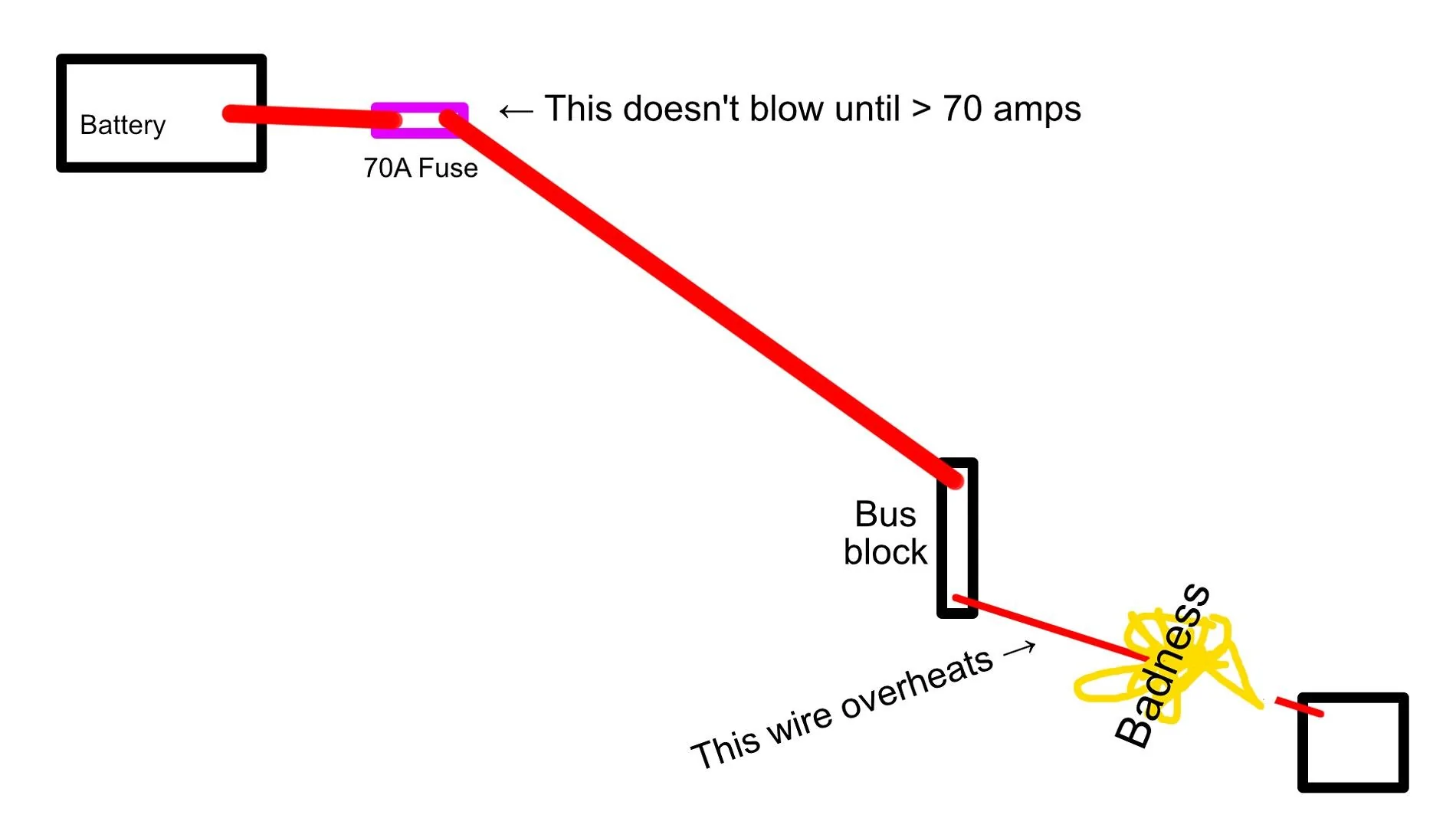
@cr117 already answered, but let's see if diagram helps.

Let's pretend you have a 70 Amp fuse with a distribution block. From the battery to the to the distribution block (or bus block) you have a 2 AWG cable. That cable is well suited for a 70 amp load. BUT, from the bus block to the USB ports, you only have a 18 AWG wire, because that's all that's needed to power those ports. 70 amps is definitely WAY too much current draw for an 18 AWG cable.

If you have a break, short, or some other issue along that 18 AWG line, the fuse isn't going to blow until the current exceeds 70 amps. By that time, you will have overheated the 18 AWG cable and potentially ended up with an extra-crispy Bronco.

Ford Bronco I need help validating my power distribution idea 1720843030242-4l


----

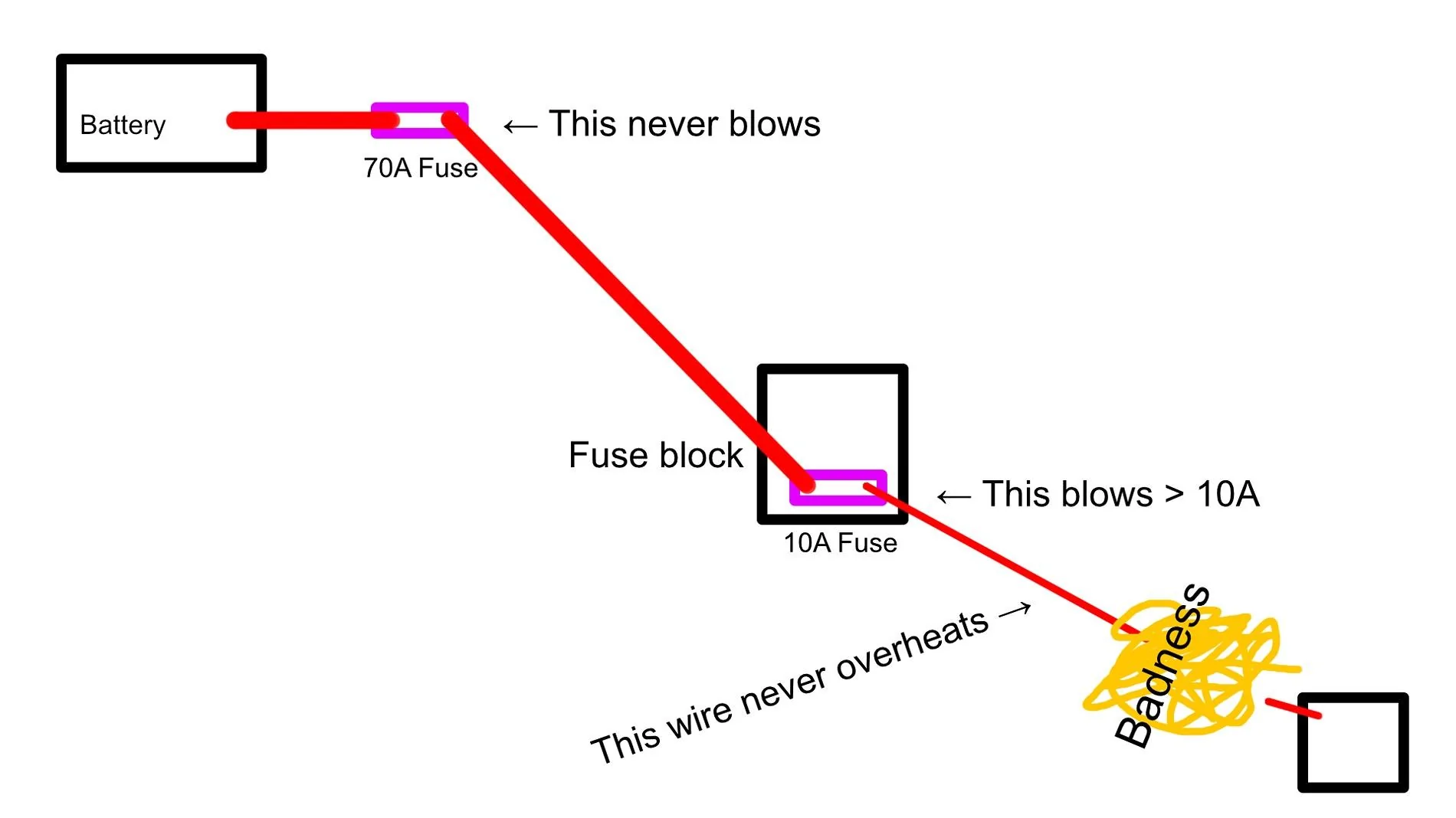
Now let's replace the bus block with a fuse block. And let's put in a 10 amp fuse to protect that 18 AWG cable.

If there is a break along that 18 AWG cable, this time the 10 amp fuse blows. 18 AWG is perfectly fine for a 10 amp load, meaning the wire never overheats, Bronco doesn't turn into a fireball, everyone is happy.

Ford Bronco I need help validating my power distribution idea 1720843452631-z1


----

The goal is to place fuses at the appropriate spots to protect the wiring. So obviously the wire heading to your inverter will need to be a fairly thick wire, and have a fairly hefty fuse to go along with it. The fuse to your USB ports probably only needs to be 16/18 AWG, and therefore only needs a 10/15 amp fuse.

If you don't use a fuse block, then you basically have to use 2 AWG wires everywhere.
 

Sponsored
OP
OP
evgenyvasenev

evgenyvasenev

Badlands
Well-Known Member
First Name
Evgeny
Joined
Oct 23, 2020
Threads
25
Messages
962
Reaction score
773
Location
Gig Harbor, WA
Website
www.instagram.com
Vehicle(s)
Ford Bronco Badlands
Your Bronco Model
Badlands
Clubs
 
@cr117 already answered, but let's see if diagram helps.

Let's pretend you have a 70 Amp fuse with a distribution block. From the battery to the to the distribution block (or bus block) you have a 2 AWG cable. That cable is well suited for a 70 amp load. BUT, from the bus block to the USB ports, you only have a 18 AWG wire, because that's all that's needed to power those ports. 70 amps is definitely WAY too much current draw for an 18 AWG cable.

If you have a break, short, or some other issue along that 18 AWG line, the fuse isn't going to blow until the current exceeds 70 amps. By that time, you will have overheated the 18 AWG cable and potentially ended up with an extra-crispy Bronco.

1720843030242-4l.jpg


----

Now let's replace the bus block with a fuse block. And let's put in a 10 amp fuse to protect that 18 AWG cable.

If there is a break along that 18 AWG cable, this time the 10 amp fuse blows. 18 AWG is perfectly fine for a 10 amp load, meaning the wire never overheats, Bronco doesn't turn into a fireball, everyone is happy.

1720843452631-z1.jpg


----

The goal is to place fuses at the appropriate spots to protect the wiring. So obviously the wire heading to your inverter will need to be a fairly thick wire, and have a fairly hefty fuse to go along with it. The fuse to your USB ports probably only needs to be 16/18 AWG, and therefore only needs a 10/15 amp fuse.

If you don't use a fuse block, then you basically have to use 2 AWG wires everywhere.
Thanks! It helps. So the only question is that each cable already has and installed fuse, which is ON THE WIRE (not the fuse box). I just ignore it and add one more fuse (the same amp) and kind of double this protection. Is it correct?
 

cr117

Badlands
Well-Known Member
Joined
May 18, 2023
Threads
11
Messages
717
Reaction score
1,923
Location
PNW
Vehicle(s)
Bronco, EV6
Your Bronco Model
Badlands
Clubs
 
Agree with all the above. One thing I’ll add is the inverter should have its own fuse separate from the fuse block. Blade fuses cannot support 70A, so this will need to be a midi or mega fuse (or something else that can protect against that amperage).


Thanks! It helps. So the only question is that each cable already has and installed fuse, which is ON THE WIRE (not the fuse box). I just ignore it and add one more fuse (the same amp) and kind of double this protection. Is it correct?
Yes, you should add your own fuse in addition to the ones provided to protect the wiring.
 

Brian_B

Big Bend
Well-Known Member
First Name
Brian
Joined
Sep 14, 2023
Threads
60
Messages
8,265
Reaction score
14,642
Location
Central CA
Vehicle(s)
'23 BB 4dr 7MT, '22 BSport OBX, '87 B-II XL
Your Bronco Model
Big Bend
Clubs
 
Equipment manufacturers will often add fuses to protect their item. You see them a lot in the 12V plugs too, and it's great that they are there.

12V outlets, though, are fuse protected to keep the wire inside the trim from melting. So even though you don't see it - some of your stuff has been double-fused all along.

You want the fuse as close to the battery, or distribution block, as you can possibly get. The two biggest causes of "badness" are a wire that gets pinched or rubbed raw, and so it welds itself to the chassis (that is literal, not an exaggeration - it can arc weld and throw molten metal and all sorts of badness), or water gets spilled into something and that grounded it out, causing it to throw sparks and magic smoke.

The easiest way to describe the need for the fuse box here, and this is hypothetical so you have to play along a bit here - you are going to connect wires up to it. Those wires have a fuse waaaaay out at your heater, or at your battery charger, or at your laptop. And if you spill coffee on your laptop, the fuse for your lapop goes and yay, catastrophe averted (well, the laptop is probably toast, but at least you didn't catch the Bronco on fire, which is all the matters right?) But if that wire were to get hung up and closed in the door - what would protect that when it goes to start welding to the door frame?
 

RagnarKon

Badlands
Well-Known Member
First Name
Bryan
Joined
Aug 5, 2021
Threads
41
Messages
5,454
Reaction score
14,500
Location
New England
Vehicle(s)
Ford Bronco, Escape, Focus
Your Bronco Model
Badlands
Clubs
 
Thanks! It helps. So the only question is that each cable already has and installed fuse, which is ON THE WIRE (not the fuse box). I just ignore it and add one more fuse (the same amp) and kind of double this protection. Is it correct?
Yes, you should add your own fuse in addition to the ones provided to protect the wiring.
Yeah I agree with @cr117 again (we're on a roll tonight :wink:). There really is no harm in double-fusing.
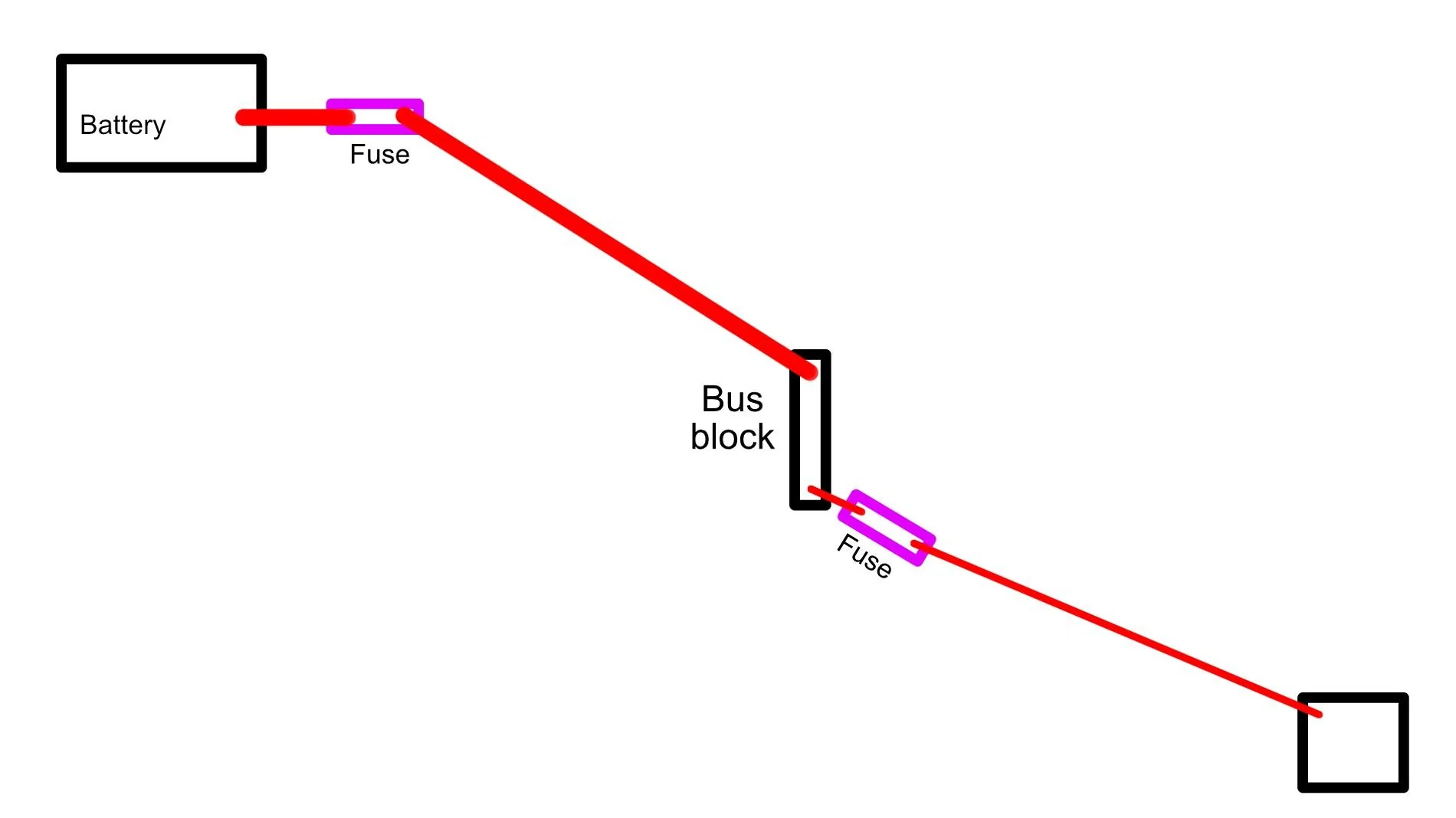
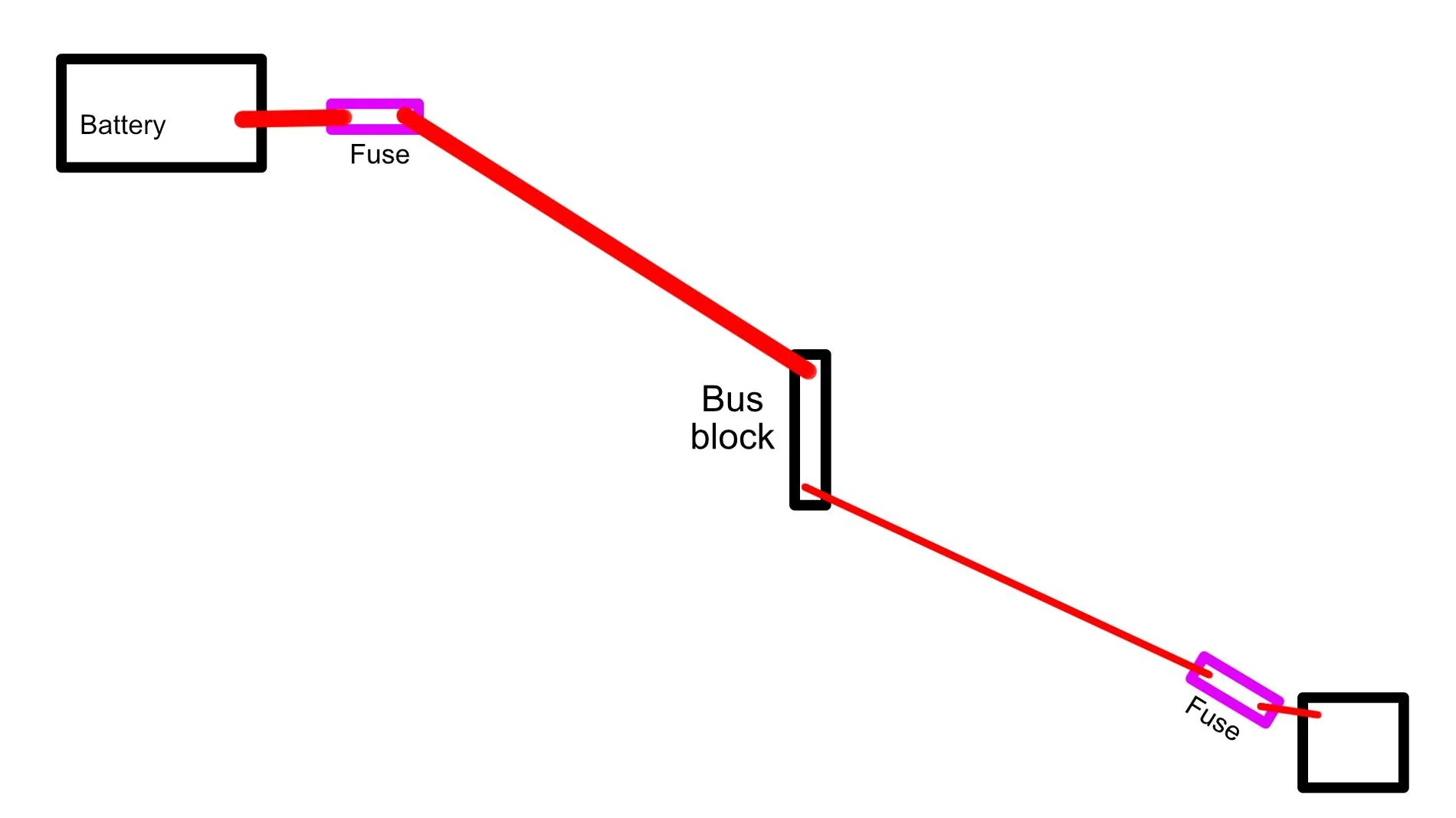
But to more broadly answer your question... the fuse should be as close to the power source as possible, because fuses can only protect "downstream". (This is one of the reasons why the fuse box in the Bronco is right next to the battery.)

So something like this is (probably) okay. It's not ideal, but the chances of having an issue are slim.

Ford Bronco I need help validating my power distribution idea 1720844923689-wc


Something like this is NOT okay, because it's only really protecting the device itself... it's doing literally nothing to protect the wiring.

Ford Bronco I need help validating my power distribution idea 1720844955656-x0
Sponsored


Top