

Sponsored

Voltage fluctuations

Area51BS

Badlands
Well-Known Member
First Name
Ron
Joined
Sep 20, 2022
Threads
228
Messages
3,091
Reaction score
4,994
Location
Florida
Vehicle(s)
Badlands non SAS 4dr 2.3
Your Bronco Model
Badlands
Notice my blower motor changes speeds, not the selection. Just cruising around town at 35-40mph voltage reads 13.2-4 volts. Let off gas and voltage goes to 14.4 and blower speeds up. Obviously due to the voltage increase. Back on gas and the voltage goes back down to 13.2-4. What could be drawing so much cruising to create enough draw to drop a volt. At idle parked and applying throttle there is no change in voltage or blower speed. Normal? Check your out if possible.
Sponsored

 

flip

Badlands
Well-Known Member
Base Sponsor (Level 1)
First Name
Phil
Joined
Jul 21, 2020
Threads
45
Messages
4,822
Reaction score
16,000
Location
IN
Website
www.ruxerparts.com
Vehicle(s)
Fords
Your Bronco Model
Badlands
Clubs
 
You are just going off the display in the cluster or have you actually put a meter on the blower? HVAC system has it's own control system and as long as it's 13ish volts, everything should have adequate power to run correctly. Lots of factors that could influence this but there would be a ton more tests needed, especially blower motor draw, to see if you actually have an issue. I would not worry about it unless you actually have an issue like it quits working, blower speed isn't increasing/decreasing when requested, heat/cooling adjustment, etc. You have a sun load sensor that influences HVAC operation too.

Long read but may help ease some of your concerns.
Climate Control System - Vehicles With: Dual Automatic Temperature Control (DATC) - System Operation and Component Description
System Operation

System Diagram

door actuatorPassenger temperature door actuatorAir inlet door actuatorBlower motor relayBlower motor control moduleHVAC control moduleGWMAmbient Air Temperature (AAT) sensorA/C pressure transducerA/C clutch relayA/C compressor clutch field coilIn-vehicle temperature and humidity sensorDriver side footwell air discharge temperature sensorDriver side register air discharge temperature sensorEvaporator temperature sensorAPIMDriver temperature door actuatorPassenger side footwell air discharge temperature sensorPassenger side register air discharge temperature sensorSunload sensorPCMExternally Controlled Variable Displacement Compressor (EVDC)Start-Stop Disable Switch
Network Message Charts

Module Network Input Messages - APIM


Broadcast MessageOriginating ModuleMessage Purpose
Climate control temperature display (gateway)HVAC Control ModuleThis message contains the value status for temperature display.


Module Network Input Messages - IPC


Broadcast MessageOriginating ModuleMessage Purpose
Climate control statusHVAC Control ModuleThis message contains the HVAC mode status for the mode indicators.


Module Network Input Messages - PCM


Broadcast MessageOriginating ModuleMessage Purpose
A/C request (gateway)HVAC Control ModuleThis message requests the A/C compressor clutch to be engaged.


Module Network Input Messages - HVAC Control Module


Broadcast MessageOriginating ModuleMessage Purpose
Climate control requests (gateway) BCMThis message contains all climate control system controls requests except blower motor speed.
Remote start status BCMThis message contains the climate control system controls request for remote start.
A/C clutch status PCMThis message contains the A/C compressor clutch status.
Ambient air temperature PCMThis message contains raw value from the ambient air temperature sensor.


The Refrigerant Cycle

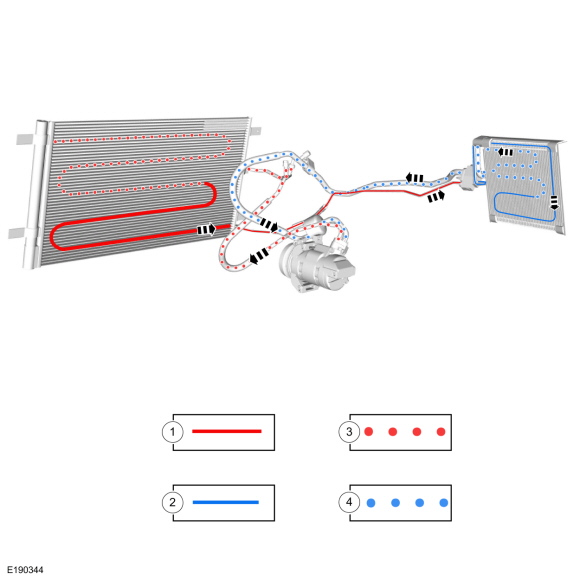
For information regarding basic HVAC (heating, ventilation and air conditioning) system refrigerant operation, refer to the current Ford Web Based Technical Training courses. The following diagram shows the refrigerant system state in each component.

The following are characteristics of the DATC system:

  • The PCM controls the A/C clutch relay.
  • The evaporator temperature sensor monitors the temperature of the air that has passed through the evaporator core and sends a signal to the PCM . If the temperature of the evaporator core discharge air is low enough to cause the condensed water vapor to freeze, the A/C clutch is disengaged by the PCM .
  • The line pressure is monitored so that A/C compressor operation is interrupted if the system pressure becomes too high or too low.
  • The A/C compressor relief valve opens and vents refrigerant to relieve unusually high system pressure.
NOTE: Typical A/C flow and state shown in graphic others similar.

A/C Flow and State

Ford Bronco {thread} {filename}


ItemDescription
1High pressure liquid
2Low pressure liquid
3High pressure vapor
4Low pressure vapor
Control System Logic

When the customer directly inputs a climate control setting or an A/C request into the HVAC control module, the module sends the request to the GWM over the MS-CAN . The GWM relays the request to the PCM over the FD-CAN . The PCM controls the A/C clutch relay.

A/C Request

When the A/C is requested, the HVAC control module sends the message over the MS-CAN to the GWM . The GWM sends the A/C request through the FD-CAN to the PCM .

When an A/C request is received by the PCM , the PCM engages the A/C clutch relay when all of the following conditions are met:

  • Excessively high or low refrigerant pressure from the A/C pressure transducer is not detected.
  • Ambient air temperature is above approximately 0°C (32°F).
  • Engine coolant temperature conditions are within normal parameters.
  • Wide Open Throttle (WOT) condition is not present.
  • Evaporator temperature is above approximately 2°C (35.6°F).
  • Engine torque conditions are within normal parameters.
  • Battery state of charge conditions are within normal parameters.
Compressor control and the evaporator temperature are a function of many parameters, not just a straight on/off, to avoid freezing the evaporator. The PCM monitors multiple temperature sensors for correlation including, but not limited to, AAT, CACT, CHT, ECT, IAT, IAT2, MAF, MAPT, TCB and TCIPT Parameter Identifications (PIDs) (as applicable). The PCM runs this logic after an engine off and a calibrated soak period of 6 to 8 hours. This soak period allows the Ambient Air Temperature (AAT) sensor and the other temperature sensors to stabilize and not differ by greater than a calibrated value, typically 16.7ºC (30ºF). If a temperature sensor input is found to be reporting a temperature imbalance the PCM does not allow the A/C clutch to engage.

The PCM monitors the discharge pressure measured by the A/C pressure transducer. The PCM interrupts A/C compressor operation in the event the A/C pressure transducer indicates high system discharge pressures. It is also used to sense low charge conditions. If the pressure is below a predetermined value for a given ambient temperature, the PCM does not allow the A/C clutch to engage

Heating and Ventilation

The heating and ventilation system:

  • controls the temperature of the air inside the vehicle.
  • delivers heated or cooled air to maintain the vehicle interior temperature and comfort level.
  • reduces the relative humidity of the air inside the vehicle (during A/C compressor operation).
The heating and ventilation system uses a reheat method to provide conditioned air to the passenger compartment. Temperature blending is controlled by the temperature doors, which regulate the amount of air that flows through and around the heater core, where it is then mixed and distributed. All airflow from the blower motor passes through the A/C evaporator core.

This vehicle is equipped with Auto-Start-Stop and has a cabin heater coolant pump.

Cabin heat during an Auto Start-Stop operation

The cabin heater coolant pump is available on vehicles equipped with Auto Start - Stop feature. The cabin heater coolant pump provides coolant to the heater core whenever the HVAC system requests heat and the vehicle is in auto start-stop mode. Refer to the Owner's Literature, Unique Driving Characteristics for full auto start-stop enabling/disabling information.

Auto Start-Stop Deactivation Switch

The Auto Start-Stop deactivation switch is available on vehicles equipped with Auto Start- Stop feature. Auto Start-Stop deactivation switch is a momentary contact switch that includes a LED indicator. This switch is used to deactivate the Auto Start-Stop mode. Refer to the Owner's Literature, Unique Driving Characteristics, for full Auto Start-Stop enabling/disabling information.

Air Handling

There are 4 door actuators that control the HVAC system air flow into the passenger compartment:

  • Air distribution
  • Air inlet
  • Driver temperature
  • Passenger temperature
All of the door actuators contain a reversible electric motor and a potentiometer. The potentiometer circuit consists of a 5-volt reference signal connected to one end of a variable resistor, and a signal ground connected to the other. A signal circuit is connected to a contact wiper, which is driven along the variable resistor by the actuator shaft. The signal to the HVAC control module from the contact wiper indicates the actuator door position. The HVAC control module powers the actuator motors to move the doors to the desired positions. The desired door positions are calculated by the HVAC control module based on the set temperature, in-vehicle temperature, and ambient air temperature.

When an airflow mode, desired temperature, fresh air, or recirculation mode is selected, the HVAC control module moves the actuator motor in the desired direction.

The HVAC control module sends a PWM signal to the blower motor control module to regulate the blower speed as necessary. The blower motor control module provides variable ground feed for the blower motor based on the input from the HVAC control module. A delay function provides a gradual increase or decrease in blower motor speed under all conditions.

AUTO

When AUTO is selected:

  • the HVAC system operates in a manner to achieve and maintain the temperature set by the operator.
  • the air inlet door actuator is automatically controlled by the HVAC module based on the temperature setting.
  • the mode door actuator is automatically controlled by the HVAC module based on the temperature setting.
  • the temperature door is automatically controlled by the HVAC module based on the temperature setting.
  • the A/C compressor is automatically controlled by the HVAC control module based on the temperature setting. The A/C compressor does not operate if the outside temperature is below approximately 2ºC (35.6ºF).
  • the blower motor speed is automatically controlled through the blower motor speed control when it receives a PWM signal from the HVAC control module based on the temperature setting, but can be manually adjusted if desired.
OFF

When OFF is selected:

  • the recirculated air request button is disabled.
  • the A/C request button is disabled.
  • the air inlet door closes, preventing outside air and allowing only recirculated air.
  • the blower motor is off.
Max A/C

When MAX A/C mode is selected:

  • the air distribution doors operate simultaneously to direct airflow to the instrument panel registers. A small amount of airflow from the floor ducts are present.
  • the temperature door moves to the full cool position.
  • the blower motor is commanded to the highest speed, but can be manually adjusted if desired.
  • the air inlet door closes, preventing outside air and admitting only recirculated air.
  • the recirculated air indicator is illuminated (recirculated air forced on).
  • the A/C button is illuminated.
  • the A/C compressor operates if the outside temperature is above approximately 2°C (35.6°F).
PANEL

When PANEL mode is selected:

  • the mode doors direct airflow to the instrument panel registers. A small amount of airflow from the floor ducts is present.
  • the recirculated air request button can be enabled.
  • blended air temperature is available. The airflow temperature can only be cooled below the outside air temperature when the A/C is commanded on.
  • the blower motor is on and the speed is adjustable.
PANEL-FLOOR

When PANEL-FLOOR mode is selected:

  • the mode doors direct airflow to the floor ducts and the instrument panel registers.
  • the recirculated air request button can be enabled.
  • blended air temperature is available. The airflow temperature can only be cooled below the outside air temperature when the A/C is commanded on.
  • the blower motor is on and the speed is adjustable.
FLOOR

When FLOOR is selected:

  • the mode doors direct airflow to the floor ducts.
  • the recirculated air request button can be enabled.
  • blended air temperature is available. The airflow temperature can only be cooled below the outside air temperature when the A/C is commanded on.
  • the blower motor is on and the speed is adjustable.
FLOOR-DEFROST

When FLOOR-DEFROST is selected:

  • the mode doors direct airflow to the floor ducts, the defroster duct and the side window demisters.
  • the recirculated air request button can be enabled, but can automatically turn off.
  • blended air temperature is available. The airflow temperature can only be cooled below the outside air temperature when the A/C is commanded on.
  • the blower motor is on and the speed is adjustable.
DEFROST

When DEFROST is selected:

  • the mode doors direct airflow to the defroster duct and side window demisters. A small amount of airflow from the floor ducts is present.
  • the recirculated air request button can be enabled, but can automatically turn off.
  • the A/C is automatically commanded on and remains on until the system is either turned off or the airflow mode has changed and the A/C button is pressed.
  • the A/C compressor operates as long as the outside temperature is above approximately 2°C (35.6°F).
  • the blower motor is on and the speed is adjustable.
Remote Start

Remote start is an optional feature available on this vehicle. In addition to being able to start the vehicle remotely, the remote start feature also utilizes other vehicle systems to increase the level of comfort to the vehicle occupants upon entering the vehicle. Additional information on the remote start feature and the other vehicle systems, refer to Owner's Literature.

When the factory remote start feature is used, the climate control system runs at the setting it was set to when the vehicle was last turned off. This feature is enabled through the information and entertainment display unit settings. Refer to the Owner's Literature for more information.

Component Description

Component Description

Heating Ventilation Air Conditioning (HVAC) Control Module


The DATC system uses the HVAC control module to monitor and control the HVAC system. It also controls the outputs for rear window defrost and climate controlled seats. For details on the HVAC control module communication, refer to Control System Logic in this section.

The HVAC control module utilizes a Field-Effect Transistor (FET) protective circuit strategy for its actuator outputs. Output load (current level) is monitored for excessive current (typically short circuits) and is shut down (turns off the voltage or ground provided by the module) when a fault event is detected. A short circuit DTC is stored at the fault event and a cumulative counter is started.

When the demand for the output is no longer present, the module resets the Field-Effect Transistor (FET) circuit protection to allow the circuit to function. The next time the driver requests a circuit to activate that has been shut down by a previous short (Field-Effect Transistor (FET) protection) and the circuit is still shorted, the Field-Effect Transistor (FET) protection shuts off the circuit again and the cumulative counter advances.

When the excessive circuit load occurs often enough, the module shuts down the output until a repair procedure is carried out. The Field-Effect Transistor (FET) protected circuit has 3 predefined levels of short circuit tolerance based on the harmful effect of each circuit fault on the Field-Effect Transistor (FET) and the ability of the Field-Effect Transistor (FET) to withstand it. A module lifetime level of fault events is established based upon the durability of the Field-Effect Transistor (FET). If the total tolerance level is determined to be 600 fault events, the 3 predefined levels would be 200, 400 and 600 fault events

When each tolerance level is reached, the short circuit DTC that was stored on the first failure cannot be cleared by a command to clear the Diagnostic Trouble Codes (DTCs). The module does not allow the DTC to be cleared or the circuit to be restored to normal operation until a successful self-test proves that the fault has been repaired. After the self-test has successfully completed (no on-demand Diagnostic Trouble Codes (DTCs) present), DTC U1000:00 and the associated DTC (the DTC related to the shorted circuit) automatically clears and the circuit function returns.

When each level is reached, the DTC associated with the short circuit sets along with DTC U1000:00. These Diagnostic Trouble Codes (DTCs) can be cleared using the module self-test, then the Clear DTC operation on the scan tool. The module never resets the fault event counter to zero and continues to advance the fault event counter as short circuit fault events occur.

If the number of short circuit fault events reach the third level, then Diagnostic Trouble Codes (DTCs) U1000:00 and U3000:49 set along with the associated short circuit DTC. DTC U3000:49 cannot be cleared and a new module must be installed after the repair.

The HVAC control module requires Programmable Module Installation (PMI) when it is replaced.

A/C Pressure Transducer

The PCM monitors the discharge pressure measured by the A/C pressure transducer. As the refrigerant pressure changes, the resistance of the A/C pressure transducer changes. It is not necessary to recover the refrigerant before moving the A/C pressure transducer.

A 5-volt reference voltage is supplied to the A/C pressure transducer from the PCM . The A/C pressure transducer receives a ground from the PCM . The A/C pressure transducer then sends a voltage to the PCM to indicate the A/C refrigerant pressure.

Ambient Air Temperature (AAT) Sensor

The Ambient Air Temperature (AAT) sensor is an input to the PCM . If the outside air temperature is below approximately 0°C (32°F), the PCM does not allow the A/C compressor clutch to engage.

The PCM sends raw ambient air temperature data to the HVAC control module. The HVAC control module filters the raw data, sends it to the APIM and the touchscreen displays the outside temperature.

After replacing an Ambient Air Temperature (AAT) sensor, the sensor data must be reset by following the menu prompts on the FDRS scan tool.
Refer to: Reset the Outside Air Temperature Sensor Learned Values (412-00 Climate Control System - General Information, General Procedures).

A/C Compressor Clutch Assembly

When battery voltage is applied to the A/C compressor clutch field coil, the clutch disc and hub assembly is drawn toward the A/C clutch pulley. The magnetic force locks the clutch disc and hub assembly and the A/C clutch pulley together as one unit, causing the compressor shaft to rotate with the engine. When battery voltage is removed from the A/C compressor clutch field coil, springs in the clutch disc and hub assembly move the clutch disc away from the A/C clutch pulley.

An A/C clutch diode is integrated into the coil for A/C clutch field coil circuit spike suppression.

Air Discharge Temperature Sensors

There are 4 air discharge temperature sensors in the DATC system:

  • Driver side footwell air discharge temperature sensor
  • Driver side register air discharge temperature sensor
  • Passenger side footwell air discharge temperature sensor
  • Passenger side register air discharge temperature sensor
The air discharge temperature sensors contain a thermistor and are inputs to the HVAC control module. The sensors resistance varies with the temperature. As the temperature rises, the resistance falls. As the temperature falls, the resistance rises. The HVAC control module uses the sensor information to maintain the desired temperature of the passenger cabin air.

Air Distribution Door Actuator

The air distribution door actuator contains a reversible electric motor and a potentiometer. The potentiometer allows the HVAC control module to monitor the position of the airflow mode door.

Air Inlet Door Actuator

The air inlet door actuator contains a reversible electric motor and a potentiometer. The potentiometer allows the HVAC control module to monitor the position of the airflow mode door. The HVAC control module drives the actuator motor in the direction necessary to move the door to the position set by the recirculation button and when the MAX A/C, Defrost or MAX Defrost buttons are selected.

Blower Motor Control Module

The blower motor and the blower motor speed control are combined into one assembly called the blower motor control module. The blower motor pulls air from the air inlet and forces it into the climate control housing and the plenum chamber where it is mixed and distributed. The blower motor speed control uses a PWM signal from the HVAC Control Module to determine the desired blower speed and varies the ground feed for the blower motor to control the speed.

Cabin Heater Coolant Pump

The cabin heater coolant pump is utilized to circulate coolant though the vehicles cooling system based on certain vehicle demands. During low engine speeds the pump increases heater core flow that the main engine coolant pump provides. The specific RPM threshold varies based on the ambient and coolant temperatures. It also supplies coolant flow during an auto start - stop condition to maintain the cabin temperature when the cabin heat is turned on. The pump also turns on in response to high engine oil temperatures and increases the flow through the oil cooler to reduce the oil temperature. The pump is commanded on by the PCM .

Climate Control Housing

The climate control housing directs airflow from the blower motor through the evaporator core and heater core. All airflow from the blower motor passes through the evaporator core. The airflow is then directed through or around the heater core by the temperature doors. After passing through the heater core, the airflow is distributed to the selected outlets by the airflow mode doors.

A/C Condenser

The A/C condenser is an aluminum fin-and-tube design heat exchanger. It cools compressed refrigerant gas by allowing air to pass over fins and tubes to extract heat, and condenses gas to liquid refrigerant as it is cooled.

Driver Temperature Door Actuator

The driver temperature door actuator contains a reversible electric motor and potentiometer. The potentiometer allows the HVAC control module to monitor the position of the temperature blend door.

Evaporator Core

The evaporator core is an aluminum tube and fin type and is located in the climate control housing. A mixture of liquid refrigerant and oil enters the evaporator core through the evaporator core inlet tube and continues out of the evaporator core through the evaporator core outlet tube as a vapor. During A/C compressor operation, airflow from the blower is cooled and dehumidified as it flows through the evaporator core fins.

Evaporator Temperature Sensor

The evaporator temperature sensor contains a thermistor. Sensor resistance varies with evaporator temperature. As the temperature rises, the resistance falls. As the temperature falls, the resistance rises. The evaporator temperature sensor is an input to the HVAC control module and the information is relayed to the PCM over the FD-CAN . If the temperature is below approximately 2°C (35.6°F), the PCM does not allow the A/C compressor clutch to engage.

Externally Controlled Variable Displacement Compressor

NOTE:
Proper Air Conditioning (A/C) system diagnosis on a vehicle's compressor is dependent on correct refrigerant system charge and tested in ambient temperatures above 21.1°C (70°F).

Variable displacement compressor internals has pistons that are placed around an angled plate (swash plate) and are pushed back and forth as the plate rotates. Variable displacement compressors vary the swash plate angle to allow piston displacement to vary from 5% (default) to 100% of full capacity to meet cooling demand.

The externally controlled variable displacement compressor has the following characteristics:

  • non-serviceable shaft seal.
  • a non-serviceable pressure relief valve installed in the rear of the compressor to protect the refrigerant system against excessively high refrigerant pressures.
  • Refer to Specifications in Group 412 for the appropriate refrigerant and refrigerant oil. This oil contains special additives required for the A/C compressor. The oil may have some slightly dark-colored streaks while maintaining normal oil viscosity. This is normal for this A/C compressor because of break-in wear that can discolor the oil.
The piston displacement of the externally controlled variable displacement compressor is controlled by a PWM signal from the PCM which electronically drives the control valve. The control valve drives the crankcase pressure and thus the swash plate angle. The externally controlled variable displacement compressor achieves precise cooling capability based on the cabin temperature and driving conditions, resulting in the target evaporator core temperature.

The PCM pulse width modulates the ground to the externally controlled variable displacement compressor control valve to change the displacement of the A/C compressor by changing the swash plate angle based on the following items:

  • Ambient air temperature
  • Engine RPM
  • Evaporator temperature
  • High side and low side A/C pressures
  • Temperature and mode settings of the climate control head
Heater Core

The heater core consists of fins and tubes arranged to extract heat from the engine coolant and transfer it to air passing through the heater core.

Internal Heat Exchanger (IHX)

The evaporator inlet and outlet manifold incorporates the IHX and is serviced as an assembly. The IHX combines a section of the A/C suction and liquid refrigerant lines into one component. It uses the cold vapor from the evaporator to cool the hot liquid from the condenser before it enters the Thermostatic Expansion Valve (TXV). After the Thermostatic Expansion Valve (TXV), more liquid refrigerant is available for absorbing heat in the evaporator. The result is an increase in cooling and operating efficiency of the HVAC system.

In-Vehicle Temperature and Humidity Sensor

The in-vehicle temperature and humidity sensor is an input to the HVAC control module. The in-vehicle temperature and humidity sensor contains a thermistor and a sensing element which separately measures the in-vehicle air temperature humidity. The in-vehicle temperature and humidity sensor has an electric fan within the sensor that draws in-vehicle air across the two sensing elements. The HVAC control module may adjust the air inlet door based on the in- vehicle temperature and humidity sensor information to maintain the desired humidity of the passenger cabin air.

Passenger Temperature Door Actuator

The passenger temperature door actuator contains a reversible electric motor and potentiometer. The potentiometer allows the HVAC control module to monitor the position of the temperature blend door.

Refrigerant System Dye

NOTE:
Check for leaks using a Rotunda-approved UV lamp and dye enhancing glasses.

A fluorescent refrigerant system dye wafer is added to the receiver drier desiccant bag at the factory to assist in refrigerant system leak diagnosis. This fluorescent dye wafer dissolves after about 30 minutes of continuous A/C operation. It is not necessary to add additional dye to the refrigerant system before diagnosing leaks, even if a significant amount of refrigerant has been removed from the system. REFER to the appropriate procedure in General Procedures.

Replacement desiccant bags, either separately or part of the receiver drier assembly, are equipped with a new fluorescent dye wafer. It is not necessary to add additional dye to the refrigerant system before diagnosing leaks. If the system has been out of refrigerant through the winter the dye at the leak point may have oxidized and may not fluoresce. If this happens, recharge and operate the A/C system to circulate the oil and allow any residual dye to show up at the leak point. It is important to understand that dye adheres to the oil not the refrigerant; the refrigerant carries the oil out of the leak point.

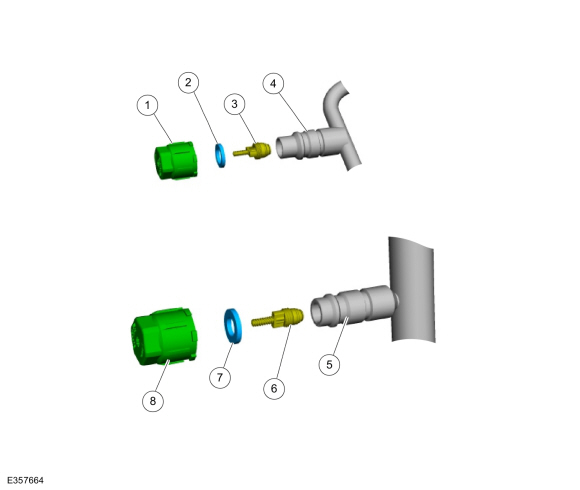
Service Gauge Port Valves

The service gauge port fitting is an integral part of the refrigerant line or component.

  • Prior to leak testing, blow air over service gauge port valves to insure an accurate test.
  • Special couplings are required for both the high-side and low-side service gauge ports.
  • A very small amount of leakage around the Schrader-type valve with the service gauge port valve cap removed is considered normal. Install a new Schrader-type valve core if the seal leaks excessively.
  • The A/C service gauge port valve caps are used as primary seals in the refrigerant system to prevent leakage through the Schrader-type valves from reaching the atmosphere. Always install and tighten the A/C service gauge port valve caps to the correct torque after they are removed.
  • Follow the procedure and the notes for electronic leak testing. REFER to the appropriate procedure in General Procedures.
Ford Bronco {thread} {filename}


ItemDescriptionTorque
1Low-pressure service gauge port valve cap 7 lb.in (.8 Nm)
2Low-pressure service gauge port valve O ring
3Low-pressure Schrader-type valve 16 lb.in (1.8 Nm)
4Low-pressure service gauge port valve
5High-pressure service gauge port valve
6High-pressure Schrader-type valve 22 lb.in (2.5 Nm)
7High-pressure service gauge port valve O ring
8High-pressure service gauge port valve cap 7 lb.in (.8 Nm)


Sunload Sensor

The sunload sensor supplies information to the HVAC control module indicating the intensity of the sun on the vehicle. The HVAC control module compensates high sun load with higher blower speed and reduced discharge temperatures.

Thermostatic Expansion Valve (TXV)

The Thermostatic Expansion Valve (TXV) is located at the evaporator core inlet and outlet tubes at the center rear of the engine compartment. The Thermostatic Expansion Valve (TXV) provides a restriction to the flow of refrigerant and separates the low-pressure and high-pressure sides of the refrigerant system. Refrigerant entering and exiting the evaporator core passes through the Thermostatic Expansion Valve (TXV) through 2 separate flow paths. An internal temperature sensing bulb senses the temperature of the refrigerant flowing out of the evaporator core and adjusts an internal pin-type valve to meter the refrigerant flow into the evaporator core. The internal pin-type valve decreases the amount of refrigerant entering the evaporator core at lower temperatures and increases the amount of refrigerant entering the evaporator core at higher temperatures.
 

akturbo

Badlands
Well-Known Member
Joined
Oct 15, 2020
Threads
41
Messages
802
Reaction score
1,272
Location
Seattle Eastside
Vehicle(s)
'21 Bronco, '24 2D HLE (wife's), 3500HD Chevy, Rav4Prime, Turbo Skidoo
Your Bronco Model
Badlands
Clubs
 
The alternators are smart nowadays, they output the voltage they're asked to put out. The computer is controlling the voltage, until you have an issue I wouldn't worry about it.
 
OP
OP
Area51BS

Area51BS

Badlands
Well-Known Member
First Name
Ron
Joined
Sep 20, 2022
Threads
228
Messages
3,091
Reaction score
4,994
Location
Florida
Vehicle(s)
Badlands non SAS 4dr 2.3
Your Bronco Model
Badlands
I’m not worried. Just caught my attention. So used to blowers and voltage going up when RPMs go up. Not the opposite. And the 14.4 voltage reading stays after letting off gas until you come to a stop. Then it stays in 13’s even when accelerating until you let off pedal again. Again just odd behavior. And the blower speed has been since new. Just caught the voltage change for first time today.
 
OP
OP
Area51BS

Area51BS

Badlands
Well-Known Member
First Name
Ron
Joined
Sep 20, 2022
Threads
228
Messages
3,091
Reaction score
4,994
Location
Florida
Vehicle(s)
Badlands non SAS 4dr 2.3
Your Bronco Model
Badlands
The alternators are smart nowadays, they output the voltage they're asked to put out. The computer is controlling the voltage, until you have an issue I wouldn't worry about it.
My question was more about the opposite effect rpm’s have on voltage from what we are accustomed to. The blower speed change just made me aware as I happen to see voltage change abruptly letting off the throttle.
 

Sponsored

TrdProDad

Badlands
Active Member
First Name
Adam
Joined
Jul 18, 2020
Threads
3
Messages
36
Reaction score
46
Location
New Rochelle, Ny
Vehicle(s)
2022 Badlands MT
Your Bronco Model
Badlands
Clubs
 
My question was more about the opposite effect rpm’s have on voltage from what we are accustomed to. The blower speed change just made me aware as I happen to see voltage change abruptly letting off the throttle.

I've noticed this as well. Although I'm not worried about, it definitely is peculiar to hear the blower motor speed going up and down.
 
OP
OP
Area51BS

Area51BS

Badlands
Well-Known Member
First Name
Ron
Joined
Sep 20, 2022
Threads
228
Messages
3,091
Reaction score
4,994
Location
Florida
Vehicle(s)
Badlands non SAS 4dr 2.3
Your Bronco Model
Badlands
I've noticed this as well. Although I'm not worried about, it definitely is peculiar to hear the blower motor speed going up and down.
I’ve learned that it is normal on many new vehicles. Dynamic charging/alternator.
 

Brian_B

Big Bend
Well-Known Member
First Name
Brian
Joined
Sep 14, 2023
Threads
60
Messages
8,240
Reaction score
14,587
Location
Central CA
Vehicle(s)
'23 BB 4dr 7MT, '22 BSport OBX, '87 B-II XL
Your Bronco Model
Big Bend
Clubs
 
I’ve learned that it is normal on many new vehicles. Dynamic charging/alternator.
Yup. Another interesting thing to watch: going downhill in the 7MT. If you have it in neutral coasting the battery will sit around 13.8. If you have it in gear coasting it will go up to around 14.8
 

BCHBRNC22

Black Diamond
Well-Known Member
First Name
Mike
Joined
Sep 5, 2022
Threads
2
Messages
103
Reaction score
115
Location
Virginia Beach
Vehicle(s)
2022 Ford Bronco
Your Bronco Model
Black Diamond
Clubs
 
I noticed this in my 2024 Heritage 2.7. The voltage drops upon acceleration. In my 2022 Blk diamond 2.7 the voltage goes up upon acceleration. Leading me to believe something might be off in the 2024?

I would be surprised if fake engine from the radio would do it.
Sponsored


Top