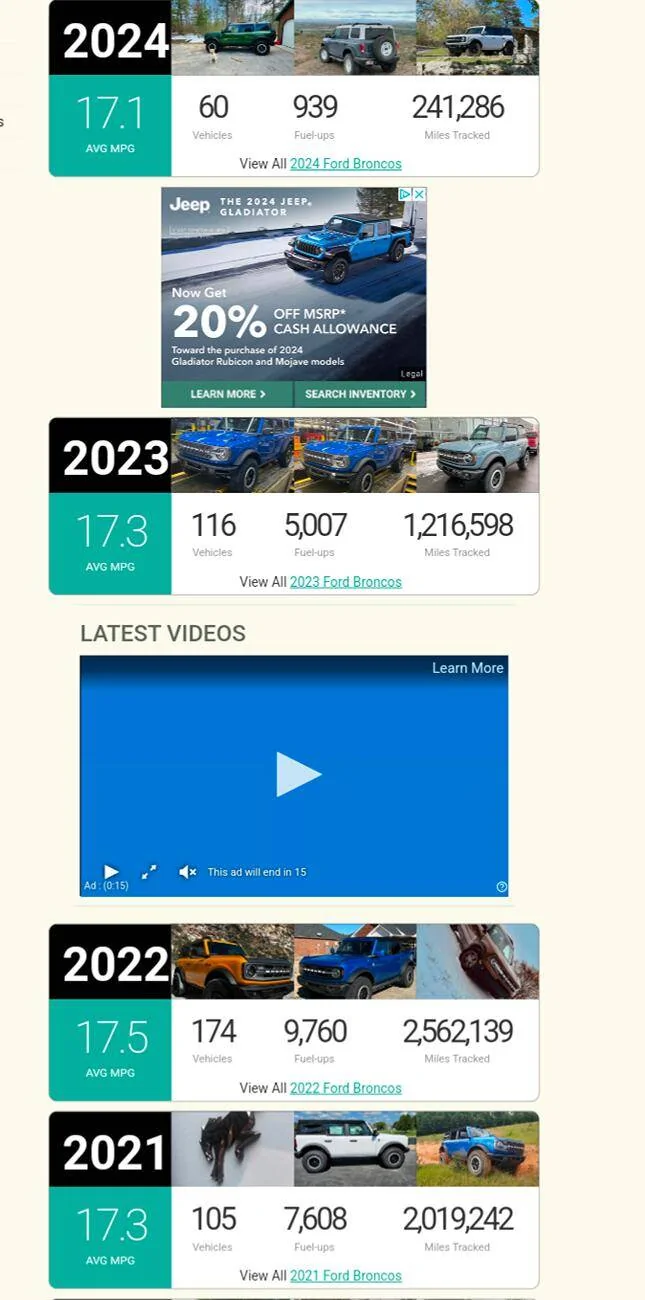

I did an 800 mile drive from Colorado to Arizona using 91 octane. Colorado does not have ethanol in their gas, Arizona has 10% ethanol in gas. My 2 door Heritage with 2.3L auto trans got 17.5 MPG.
Sponsored

I get 18.9 city driving fairly routineky. But I pay attention to the turbo gauge and lay off the gas pedal whenever feasible.I guess the only broncos with better than 18 mpg are on this forum


Octane has nothing to do with the quality of gasoline. You can get poor quality high octane.My SAS-spec Broncos all have the 2.3L. I've never gotten less than 18mpg, and that's with 87.
My 2-door averages 20mpg local and 22mpg highway. My 4-door averages 19-20mpg local and 20-21mpg highway.
I started out using 87. Performance was fine, but I now use 91. I do believe 89 is adequate, reasonably better than the lower quality 87.
My MPG numbers are from the instrument cluster.
Not driving the speed limit on the interstate (80 mph) makes a lot of difference but it is also downhill from Snowville to Meridian. If I drive that stretch with my wife's equinox diesel 80-85 I still get good mpg's but with my gas F250 I drive it at 70 because of mpg.Sometimes it's the fuel.
A couple of weeks ago I filled up at Walmart because my wife noticed the cheaper price there, then drove from Idaho to Utah. I've taken that particular trip multiple times, but this time I got at least 15% lower mileage than on previous trips. This is one of the few times I couldn't get at least 300 miles out of a tank. When I filled it up in Snowville, the first town inside Utah, the mileage immediately improved.
Coming back I filled up at that same station in Snowville and did 4 mpg better than the trip going there. I think I learned that the 8% cheaper price at Walmart was not worth 15% worse mileage.
All trips through this particular section of road were with the cruise control set at 70 mph with tires inflated to around 38 psi. I drove the same way every time, it was the fuel that made the big difference.
Idk - theres convexity to take into account in this type of situation. Extreme example - if you eat just enough to sustain life, that results in infinitely more m like then youd have with any amount of food below that level (dead). Then there’s diminishing returns, then negative returns/losses (obesity). That 3% could be > 3% gas mileage.The MOST you can expect from running higher octane is 3% improved MPG—and that is only if that premium fuel is ethanol free. Premium fuel is almost always 3% more expensive than 87, so it you are looking at it from an economics standpoint it is almost always cheaper to run 87.
Any difference you've seen beyond 3% has to do with driving conditions/style.
Personally around town I get about 16.5 MPG. On the highway I can get up to 23 MPG—particularly on the flat-and-boring Ohio Turnpike. Towing I get around 14.1 MPG.

Yes! Another strategy is to downshift and use some engine braking to slow the vehicle down before applying brakes. My last Wrangler JK made it to 110,000 miles on the original brakes; the pads and rotors were still good even at that point. Yet another advantage to the manual transmission...The second that traffic light ahead turns yellow, my foot is off the accelerator pedal. Brake wear is reduced significantly. Pads and rotors also last far longer due to less heat build-up.
On a side note, brake pad heat is dissipated out through the sides of the pad. So as the pads become thinner, their ability to efficiently dissipate heat decreases. Thus pads run hotter and inherently the rotors as well. But change your pads more often and they all run cooler.

Not sure what is counterintuitive here, this is exactly what you'd expect.I just drove to Off Rodeo TN (500 MI RT)
75-80 mph with cruise control on the way there. 18mpg
Stop and go traffic w/snow and never topping 50 on the way home. 19.2mpg
In worse conditions, it went up considerably.
Counter intuitive for sure but
driving habits and techniques matter!
Probably was thinking the city versus highway loop effect would be enough for gas mileage to go down at the lower speeds. There's a significant aerodynamic penalty once you are up at 75 mph that gets significantly worse with every 5 mph higher speed though.Not sure what is counterintuitive here, this is exactly what you'd expect.