
Sponsored

How much Load can Factory Accessory Switches handle ?

CNCBITS

Raptor
Member
Joined
Dec 24, 2025
Threads
2
Messages
17
Reaction score
27
Location
SOCAL
Vehicle(s)
Bronco Raptor
Your Bronco Model
Raptor
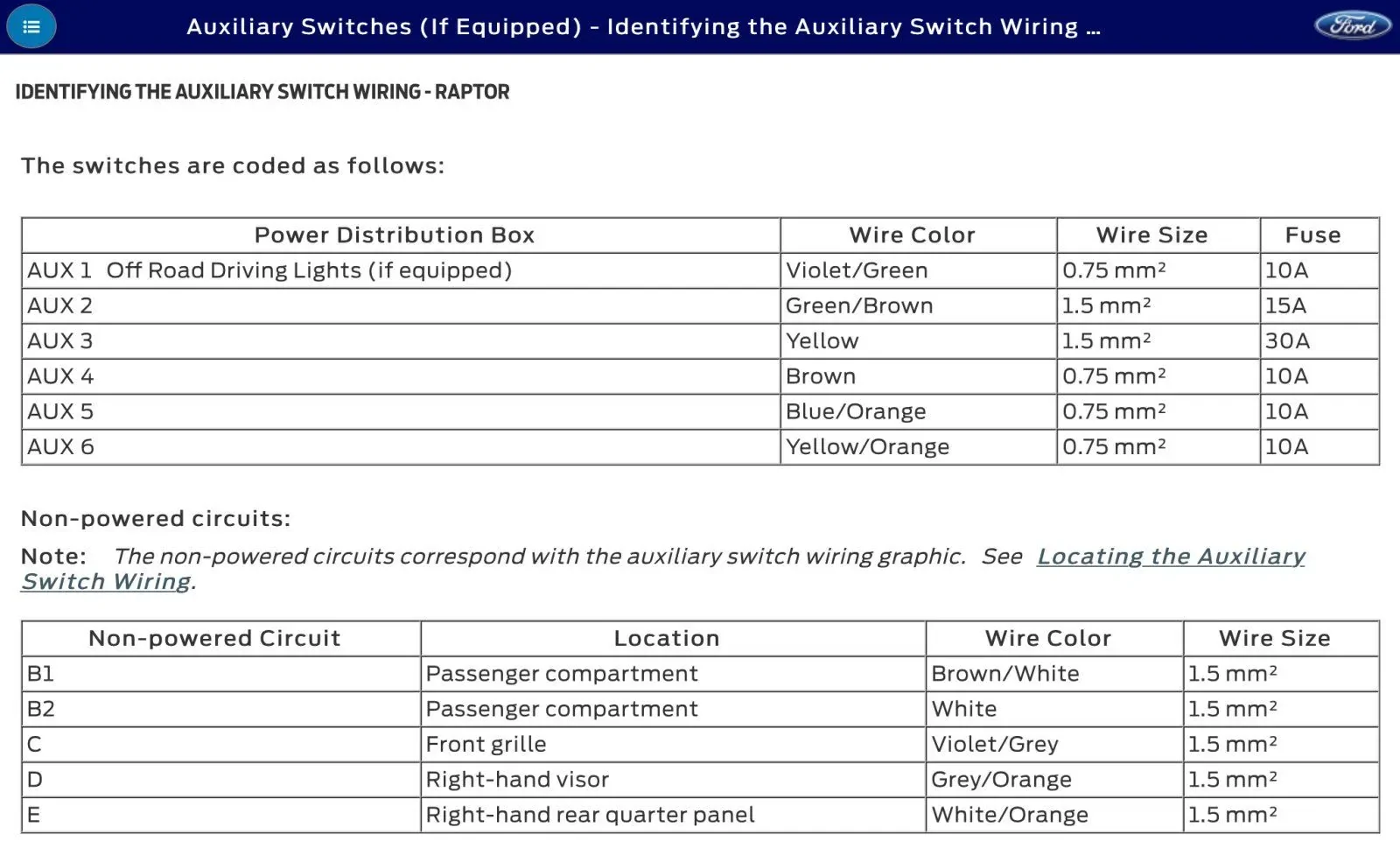
I have a 2025 Raptor and want to add some driving lights. Looking at the Roof Switches to turn them on and it looks like I have Aux 1 running factory Rigid lights on a 10AMP which leaves me Aux 2 at 15 AMP and AUX3 at 30 AMP. I want to run 4 x LP6 BD lights which are 7.5Amp each on high so 30 Amp all up.

Issue I have is I don't see how Ford are rating a 1.5mm2 wire at 30 Amp constant ... are people running this without issue or are people adding relays ?

Thanks for the help.


Ford Bronco How much Load can Factory Accessory Switches handle ? 1766619814115-lo
Sponsored


swamp2

Raptor
Well-Known Member
Joined
Dec 19, 2022
Threads
156
Messages
4,100
Reaction score
4,228
Location
San Diego
Vehicle(s)
911 Carrera S / 4Runner TRD Pro
Your Bronco Model
Raptor
I just installed my LP6s. More than you asked for but hopefully helpful:

1. If you get the lock out harness from BD, which I recommend, as it prevents powering LP6 Low and high at the same time, which can damage them, then any upfitter can power LP6 lows and highs as they are connected to your battery via appropriate relays.

2. Get yourself a crimper such as the Wirefly kit ( https://amzn.to/4ssB6L0 ) so you can shorten the final leads to the lights using the proper 4 pin Deutsch connectors that come with the BD lockout harness kit. The standard harness has a ton of extra length that you don't want to coil up and try to hide.

3. The SVP parking light splice/adapter is great way to get your LP back lights enabled.

4. Don't let those LP6 beauties get stolen. Check out my full locking bolt kit for the LP6 lights here.

Lastly Ford sized their wire and chart correctly:

1.5 mm^2 corresponds to right between 15 and 16 AWG, which with high quality GXL sheath, in the underhood environment, will be good for right about 30 A. However, as noted above, using that BD harness opens up any of the upfitter to control both low and high beams.
 
OP
OP

CNCBITS

Raptor
Member
Joined
Dec 24, 2025
Threads
2
Messages
17
Reaction score
27
Location
SOCAL
Vehicle(s)
Bronco Raptor
Your Bronco Model
Raptor
thanks for the feedback I will have a look into your links.

1.5mm 2 is only rated to 20 AMP so I am not sure why you say its good for 30 amps nothing I can find say it will and converting it to awg makes it 16 AWG which is underr 20 amps. Thats why I am asking as it seems weird ford would quote it as 30 amps
 

swooshdave

Badlands
Well-Known Member
Joined
Dec 15, 2020
Threads
105
Messages
4,866
Reaction score
9,174
Location
Portland, Oregon
Vehicle(s)
Mustang
Your Bronco Model
Badlands
Clubs
 
thanks for the feedback I will have a look into your links.

1.5mm 2 is only rated to 20 AMP so I am not sure why you say its good for 30 amps nothing I can find say it will and converting it to awg makes it 16 AWG which is underr 20 amps. Thats why I am asking as it seems weird ford would quote it as 30 amps
I'm not an electrician, nor do I play on on tv, but from what I understand the quality of the wire covering and quality of the wire has a bit to do with the load it can take. Tables you see with the differing ratings are most likely taking with worst case scenario into account. Ford will have tested their wires for the stated loads. The risks if they didn't is far too massive.
 
OP
OP

CNCBITS

Raptor
Member
Joined
Dec 24, 2025
Threads
2
Messages
17
Reaction score
27
Location
SOCAL
Vehicle(s)
Bronco Raptor
Your Bronco Model
Raptor
High quality in txl / gxl or even tefzel you could run 30 AMP on 16 AWG at maybe 2ft long after that it drops quick before heat catches up. Thats why Ford doing it confusses me as you said the risk is high and the return is low.

I will just add a fused relay and avoid the issues, that way I can lock out high / low at the same time to avoid that issue as well.

Thanks for your feedabck though, never had a ford before.
 

Sponsored

Brian_B

Big Bend
Well-Known Member
First Name
Brian
Joined
Sep 14, 2023
Threads
62
Messages
8,401
Reaction score
14,870
Location
Central CA
Vehicle(s)
'23 BB 4dr 7MT, '22 BSport OBX, '87 B-II XL
Your Bronco Model
Big Bend
Clubs
 
thanks for the feedback I will have a look into your links.

1.5mm 2 is only rated to 20 AMP so I am not sure why you say its good for 30 amps nothing I can find say it will and converting it to awg makes it 16 AWG which is underr 20 amps. Thats why I am asking as it seems weird ford would quote it as 30 amps
It's good for as long as that wire is.. which is what, like 12-18", maybe, coming out of the fuse box?

You wouldn't necessarily want to go using a 1.5mm all the way out to your load, the voltage drop would be too great. But for a short run, Ford Engineers have sized that wire as the minimum acceptable amount of copper to push the advertised amperage.

After all, heaven forbid they spend an extra $0.02 for bigger wire when they don't absolutely have to. The easy/reasonable thing to do would have been just to make ~all~ the switches rated for the same amperage... be that a useful amp rating out the gate (which would be awesome, so of course that wouldn't happen), or something really low and useful for just triggering relays (and make a relay box that connects right up to allow for higher amperage as an aftermarket / addon).

But... we get switches with amp ratings all over the place, because that's somehow better.
 

Brian_B

Big Bend
Well-Known Member
First Name
Brian
Joined
Sep 14, 2023
Threads
62
Messages
8,401
Reaction score
14,870
Location
Central CA
Vehicle(s)
'23 BB 4dr 7MT, '22 BSport OBX, '87 B-II XL
Your Bronco Model
Big Bend
Clubs
 
I'm not an electrician, nor do I play on on tv, but from what I understand the quality of the wire covering and quality of the wire has a bit to do with the load it can take. Tables you see with the differing ratings are most likely taking with worst case scenario into account. Ford will have tested their wires for the stated loads. The risks if they didn't is far too massive.
Length plays a huge part of it too

I mean, I know women all talk about the circumference, and not saying that girth doesn't matter, but in this case, so does length.
 

swamp2

Raptor
Well-Known Member
Joined
Dec 19, 2022
Threads
156
Messages
4,100
Reaction score
4,228
Location
San Diego
Vehicle(s)
911 Carrera S / 4Runner TRD Pro
Your Bronco Model
Raptor
I will just add a fused relay and avoid the issues, that way I can lock out high / low at the same time to avoid that issue as well.
You can certainly build your own harness and/or relay(s). Other than the final runs of cable to the actual lights, I found the Baja Designs LP Lockout harness pretty nice. It has two large relays built in to the harness to insure your lights don't get lows and highs on at the same time. Then it's just a single red and single white to the upfitters of your choice.
 

swamp2

Raptor
Well-Known Member
Joined
Dec 19, 2022
Threads
156
Messages
4,100
Reaction score
4,228
Location
San Diego
Vehicle(s)
911 Carrera S / 4Runner TRD Pro
Your Bronco Model
Raptor
Length plays a huge part of it too.
Yes and no.

No from a ampacity perspective as heat generation (and dissipation) are proportional to length. So the longer wire generates (and dissipates more heat) but reaches the same temperature.

Yes from the perspective of whether the voltage drop is consequential which of depends on what device you are using.
 

Brian_B

Big Bend
Well-Known Member
First Name
Brian
Joined
Sep 14, 2023
Threads
62
Messages
8,401
Reaction score
14,870
Location
Central CA
Vehicle(s)
'23 BB 4dr 7MT, '22 BSport OBX, '87 B-II XL
Your Bronco Model
Big Bend
Clubs
 
Yes and no.

No from a ampacity perspective as heat generation (and dissipation) are proportional to length. So the longer wire generates (and dissipates more heat) but reaches the same temperature.

Yes from the perspective of whether the voltage drop is consequential which of depends on what device you are using.
Not to get into a rabbit hole but.. heat generation, and voltage drop, are purely a function of resistance.

Resistance is going to be directly proportional to length, and inversely proportional to cross section.

So not really any “no” to it, other than to say heat and voltage drop are distinct limits -
 

Sponsored

swamp2

Raptor
Well-Known Member
Joined
Dec 19, 2022
Threads
156
Messages
4,100
Reaction score
4,228
Location
San Diego
Vehicle(s)
911 Carrera S / 4Runner TRD Pro
Your Bronco Model
Raptor
Not to get into a rabbit hole but.. heat generation, and voltage drop, are purely a function of resistance.

Resistance is going to be directly proportional to length, and inversely proportional to cross section.

So not really any “no” to it, other than to say heat and voltage drop are distinct limits -
Disagree (but not with the 2nd paragraph).

Two wires of different lengths at the same current will reach a steady state temperature that is the same.

This is because generated (heat) power is I^2R and R is linearly proportional to length. Also, power dissipated by convection is proportional to length. In steady state, at power balance, length cancels (despite area or diameter being in the formula for the temperature rise).

Now there are some higher order (smaller) end effects in play, but for all practical purposes in common real world wiring situations, this is true.

And this is why ampacity is length independent, which I basically stated above and you seemed to disagree with.
 
Last edited:

Brian_B

Big Bend
Well-Known Member
First Name
Brian
Joined
Sep 14, 2023
Threads
62
Messages
8,401
Reaction score
14,870
Location
Central CA
Vehicle(s)
'23 BB 4dr 7MT, '22 BSport OBX, '87 B-II XL
Your Bronco Model
Big Bend
Clubs
 
Disagree.

Two wires of the same diameter at the same current will reach a steady state temperature that is the same.

This is because genrated heat power is I^2R and R is linearly proportional to length. Also, power dissipated by convection is proportional to length.

Now there are some higher order (smaller) end effects in play, but for all practical purposes in common real world wiring situations, this is true.

And this is why ampacity is length independent, which I basically stated above and you seemed to disagree with.
Ampacity isn’t really a limit. Temperature is. Voltage drop is.

Ampacity is just one way that those limits are managed. You can throw crazy amounts of current through a small wire if you can keep it cool enough, or find a material with a better resistivity. Computers do it through tiny tiny pins on chip sockets all the time.

I’m not exactly disagreeing with you - just that there’s more to the story. You can pull a lot of amps though a small wire if you manage it correctly.

Length still matters for ampacity because it drops volts, and then you have to re-evaluate your current requirement for a given power (P=IV, right) … since your voltage ~at the load terminals~ just dropped your current requirement went up - making length a component of ampacity. And that’s before we talk about the effect of temperature on resistivity — as the wire heats up, for most materials resistance goes up, so voltage drops even further, so current goes up even more.

We see it all the time in industrial processes — generation always talks about making 480V, but motors and large loads usually assume 450V ~at the load terminal~ due to that total voltage drop of transmission.

So it’s indirect, but length — or rather, resistance to state the actual parameter — has an effect on your current requirement.
 

swamp2

Raptor
Well-Known Member
Joined
Dec 19, 2022
Threads
156
Messages
4,100
Reaction score
4,228
Location
San Diego
Vehicle(s)
911 Carrera S / 4Runner TRD Pro
Your Bronco Model
Raptor
Ampacity isn’t really a limit. Temperature is. Voltage drop is.

Ampacity is just one way that those limits are managed. You can throw crazy amounts of current through a small wire if you can keep it cool enough, or find a material with a better resistivity
. Computers do it through tiny tiny pins on chip sockets all the time.

I’m not exactly disagreeing with you - just that there’s more to the story. You can pull a lot of amps though a small wire if you manage it correctly.

Length still matters for ampacity because it drops volts, and then you have to re-evaluate your current requirement for a given power (P=IV, right) … since your voltage ~at the load terminals~ just dropped your current requirement went up - making length a component of ampacity. And that’s before we talk about the effect of temperature on resistivity — as the wire heats up, for most materials resistance goes up, so voltage drops even further, so current goes up even more.

We see it all the time in industrial processes — generation always talks about making 480V, but motors and large loads usually assume 450V ~at the load terminal~ due to that total voltage drop of transmission.

So it’s indirect, but length — or rather, resistance to state the actual parameter — has an effect on your current requirement.
Good, we're on the same page, especially given what I highlighted above. But as we know, and what I emphasized earlier, is that ampacity tables don't care about length (for the reason I provided).

I kind of figured we were as I've noted a lot of expertise on this and related topic from you prior. You're a great resource here on the forum.

Merry Christmas!
 

Brian_B

Big Bend
Well-Known Member
First Name
Brian
Joined
Sep 14, 2023
Threads
62
Messages
8,401
Reaction score
14,870
Location
Central CA
Vehicle(s)
'23 BB 4dr 7MT, '22 BSport OBX, '87 B-II XL
Your Bronco Model
Big Bend
Clubs
 
Good, we're on the same page, especially given what I highlighted above. But as we know, and what I emphasized earlier, is that ampacity tables don't care about length (for the reason I provided).

I kind of figured we were as I've noted a lot of expertise on this and related topic from you prior. You're a great resource here on the forum.

Merry Christmas!
Very true - ampacity charts don’t list length - great point.

Merry Christmas! I hear Santa right now
 
OP
OP

CNCBITS

Raptor
Member
Joined
Dec 24, 2025
Threads
2
Messages
17
Reaction score
27
Location
SOCAL
Vehicle(s)
Bronco Raptor
Your Bronco Model
Raptor
damn thats a lot of info .. lol. as the internet is a dangerous place for context and I never know who will read this I think it is fair to say that amp capacity of a wire is directy effected by length due to the increased resistance creating a voltage drop which in turn reduces amps that can be used by in this case the light. You can quote any formula you want but that is the short version of reality.

Bringing in ampacity creates confussion as now we are talking about heat transfer and insulation and in reality you will always find amp capacity of a wire limited by a length and guage / cross section, sure its due to the impact of resistance but the disipation of heat due to length is far lower than the creation of it cause by resistance in this application.

In regards to the original question about my concerns of the ability of the supplied wires to handle the amps it is rated at I think Ford is wrong and after pulling 30 amps through their yellow wire it gets hot so its fair to say it is not rated to 30 amps. Granted I did not keep the draw on till it failed but it did keep increasing in heat leading me to believe it or the switch would fail before the fuse blows.

It just amazes me they would under spec a wire like that when they know people are going to hang lights on they that could stay on for hours.

Either way thanks for the info hopefully Santa will give me some LP6's and a mounting bar :)
Sponsored


Top