
Sponsored

TeocaliMG

Badlands
Well-Known Member
Base Sponsor (Level 1)
Joined
Jun 3, 2019
Threads
24
Messages
999
Reaction score
3,289
Location
Plymouth Michigan
Vehicle(s)
2021 Bronco Badlands non-sas 4 door manual
Your Bronco Model
Badlands
Clubs
 
Numbers on paper can be appealing yet deceiving at the same time.

Fox & King measurements are from us and that does not include shaft bumpers. Sure, you will likely never smash the bumpers all the way to metal on metal, but thats how they are typically measured.

The longer compressed length, ultimately allows for a larger tire size. Consider it like a longer bump stop, but its not eating into your shock travel. On those shorter compressed lengths, I would be curious to know what is needed to properly fit 37s.

If tire size and cv bind is not important, then yes looks like Icon numbers are the winner.

You're running a 1/2" spacer lift, is that a spring spacer or a top hat spacer?
I figured it was for tire clearance, but roughly 1.75" at the shock is extremely conservative IMO. over 3" jounce reduction at the wheel seems totally overkill (expect 1.5" radius increase max from OEM "35" to 37). Especially considering the baked in OEM clearance.

I run 2 of the 3 spacers in the RC 1" level kit. I need to measure but they are either 1/4" plate or possibly 3/8". one at the tophat and one at the control arm, that was simply to let me fully flex out without hitting the body work. And that is on non-sas coilovers which themselves allow for more compression. A lot of variables, I know. Eventually I want to bake in more margin with proper coilovers. But something like ICON which offers 0.5" more compressed length over SAS (already less compression than Non-Sas) seems like a much closer fit to the ideal than Fox or King as posted.

As for CV bind, it seems like the ICON may be right at the ragged edge of acceptable (at least from what I read in the thread). I don't want to downplay that significance, perhaps ICON is a bit too aggressive (TBF that can be accounted for with a diff drop too), but I contest that the FOX and King are way too conservative in jounce for 37's, let alone 35's.
Sponsored

 
OP
OP

87-Z28

Outer Banks
Well-Known Member
First Name
Andy
Joined
Sep 1, 2022
Threads
3
Messages
1,308
Reaction score
3,227
Location
Texas
Vehicle(s)
BMW
Your Bronco Model
Outer Banks
Clubs
 
@TeocaliMG I think you are probably correct. A 1” increased length at full compression is likely plenty to easily clear 37s inside the fender, even under heavy compression loads. Have not done this but should be plenty from what I have read. All depends where you want to sacrifice. I am with you. It would be nice to optimize the clearance in the fender at full compression and then let the wheel travel go south from there. Especially if minimizing lift is the objective. Probably too much left on the table with >1”. Can always fix clearance issues with trimming and minor body lift.

I am intrigued by the radflo standard length shocks. Trying to get some numbers. I will likely not ever run more than 37s and am trying to optimize my lift. My objective is to have good high speed characteristics and not be overly handicapped in the rocks.

fox and king are likely overly conservative since they’re marketing more for high speed stuff and larger tires. Everyone wants to jump their bronco, me included 😂.
 

Blksn955.o

Badlands
Well-Known Member
First Name
Greg
Joined
Jun 14, 2020
Threads
17
Messages
1,294
Reaction score
2,623
Location
Wentzville, MO
Vehicle(s)
17 Ford Escape Ti, 94 Ford Mustang GT, 21 BL
Your Bronco Model
Badlands
Clubs
 
Any figures for the 6100 Bil shocks?

Great discussion.
 

Merc4x4

Badlands
Well-Known Member
First Name
steve
Joined
Jul 8, 2020
Threads
10
Messages
2,064
Reaction score
4,005
Location
NJ
Vehicle(s)
2021 Bronco
Your Bronco Model
Badlands
Clubs
 
Follow up question (great work by the way). Do we know if these measurements are absolute max travel? Or simply where you get into the jounce/rebound bumpers internally? Some of these options are excessively long in compression unless they have a bit of compression left that was not easily measured without a teardown.

I clear 37's (barely) in jounce under natural flex with about half an inch of spacer lift (2 of the 3 RC plates), and this is on Non Sas bilsteins which have a bit more compression than Sas bilsteins. Now if I jumped it, I'm sure id squeeze my jounce bumpers enough to get those tires to more than kiss my fender. But it wouldn't take much to keep them out. Seeing Fox at almost 1.75" longer than stock compressed length (closer to 2" for my non sas) is a huge reduction in jounce travel, probably 3-4", and an overall reduction in wheel travel. Unless some of these options are hiding travel in their bushings that is not showing up on paper, it seems like the best option for max flex is ICON. Am I missing something? I would have expected Fox and King to be chart toppers but they both seem to be the worst option for max wheel travel (not talking about damping performance).
Re: measurements
I gathered the compressed and extended lengths reported in a thread by multiple sources.
Travel is just a simple calc, extended length minus compressed length.

@AccuTune Offroad provided the measurements for Fox & King (as they stated in their reply). I cannot guarantee that the other measurements are even using the same points. I think Icon states they use eyelet to eyelet, where a better comparison would be the actual mount locations, e.g. top plate to bottom eyelet.

The grid is more guide than specifications.

That being said, there is corroboration that Icon has most travel from @popo_patty 's real-world comparison on an articulation trailer.
 

AccuTune Offroad

Base
Well-Known Member
Base Sponsor (Level 1)
First Name
Mike
Joined
Feb 16, 2023
Threads
7
Messages
292
Reaction score
664
Location
San Diego
Vehicle(s)
2021 Sasquatch 4 Door, Jeep JLUR, Tacoma
Your Bronco Model
Base
Re: measurements
I gathered the compressed and extended lengths reported in a thread by multiple sources.
Travel is just a simple calc, extended length minus compressed length.

@AccuTune Offroad provided the measurements for Fox & King (as they stated in their reply). I cannot guarantee that the other measurements are even using the same points. I think Icon states they use eyelet to eyelet, where a better comparison would be the actual mount locations, e.g. top plate to bottom eyelet.

The grid is more guide than specifications.
100% agree, and something I was trying to clear up earlier on this thread or another. IMO, it's worth citing data like this so incorrect information doesn't get misused. I'd hate for someone to be sold on shocks that have more travel due to incorrect data. Fox, King, Bilstein sometimes have different methods of measuring shocks, so just need to be fair.

side note: Within the last 6 months, Fox changed the way they measure OEM coilovers. Frustrating, but most dont reference lengths as much as we do.

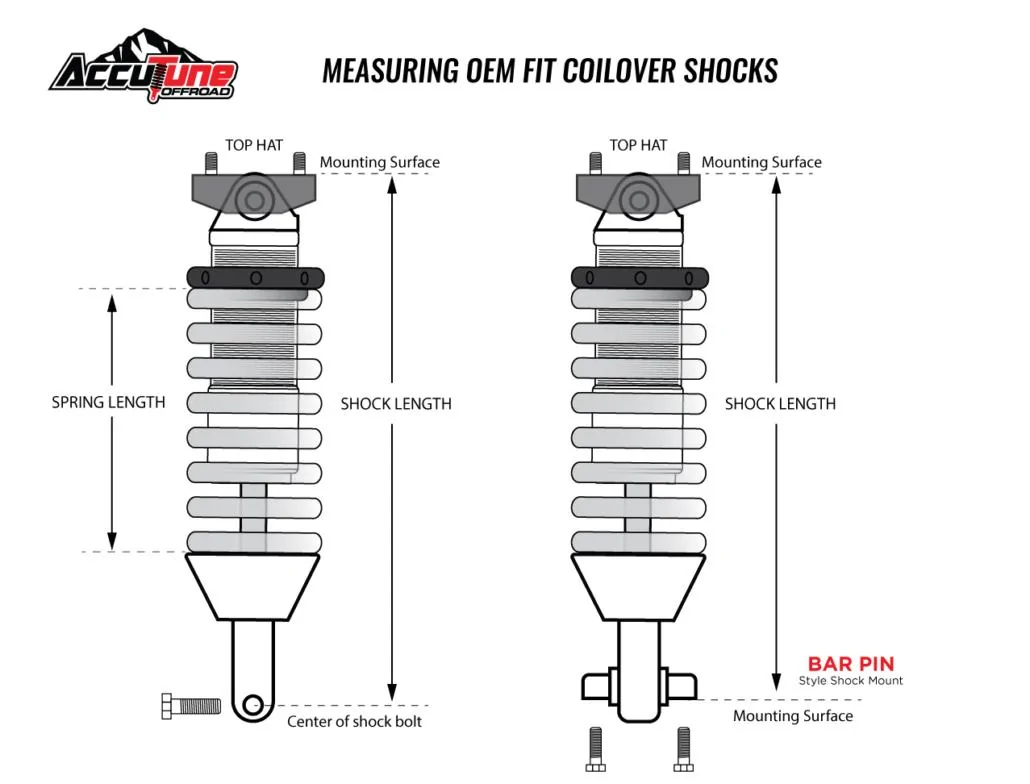
I'll toss in this diagram I made again just for fun and likely update it to show compressed lengths.
Ford Bronco Some stock suspension calculations and measurements measuring-oem-coilover-shocks-1030x784
 

Sponsored

TeocaliMG

Badlands
Well-Known Member
Base Sponsor (Level 1)
Joined
Jun 3, 2019
Threads
24
Messages
999
Reaction score
3,289
Location
Plymouth Michigan
Vehicle(s)
2021 Bronco Badlands non-sas 4 door manual
Your Bronco Model
Badlands
Clubs
 
Thanks @Merc4x4 and @AccuTune Offroad

I don't want myself or anyone else to be "sold" or otherwise mislead by any of the brands. Still suspicious of how much Fox reduces the stroke length over stock, and what is probably still an overly conservative jounce limit even considering different measuring conventions.

Would be nice to create a master Matrix for all shocks where we can definitively see stroke length, compressed length etc. and exactly how they are measured (with some conversion between methods) like the drawing AccuTune provided. Not just to declare any one brand the best or worst on paper but to let everyone have an accurate source for what they can use for their own build.

If you have a Diff Drop, you can run one with extended length greater than the currently posted CV limit, if you have aftermarket fenders you could run one with a lower compressed length, or larger tires, or a bit of both. Running 40's on stock fenders, then you'll know to grab a set with greatly reduced jounce. All this in addition to the damping performance/preferences.

Bonus points if we can add to that matrix the expected wheel travel/jounce/rebound with accurate kinematics both on stock suspension as well as popular control arms like BajaKits that could have big implications for all the things above. If someone can provide me accurate specs, i'll gladly throw it together.
 
OP
OP

87-Z28

Outer Banks
Well-Known Member
First Name
Andy
Joined
Sep 1, 2022
Threads
3
Messages
1,308
Reaction score
3,227
Location
Texas
Vehicle(s)
BMW
Your Bronco Model
Outer Banks
Clubs
 
If someone can provide me accurate specs, i'll gladly throw it together.
It would be great to have exact numbers with consistent measurement references.That may be hard to get unless we ask forum members to take measurements before install. Thanks to @AccuTune Offroad we have good numbers from fox and king. And @Merc4x4 has compiled the other available data.

however, I do believe there are clear trends in the current data even though absolute numbers my not be exactly comparable. For example, as @TeocaliMG pointed out, fox and king have fairly long fully compressed lengths compared to SAS and are likely better for clearing larger tires. Also, shock travel numbers should be accurate. As long as compressed and extended length from same manufacturer use the same reference. Which is reasonable to assume.

I believe it is most important for folks to understand what the numbers mean so they can evaluate differences for themselves.
 

Snacktime

Black Diamond
Well-Known Member
First Name
Nate
Joined
Jul 14, 2020
Threads
74
Messages
4,002
Reaction score
10,009
Location
Sac-a-tomatoes
Vehicle(s)
Bronco, F150
Your Bronco Model
Black Diamond
Clubs
 
I have tried 3-4 different combinations of the same shocks and springs at different ride heights trying to figure out what works best. What I find to be interesting is that the Bronco handles the best with 5-6" of up travel in the rear. Which doesn't allow much droop. Front seems to be a mute point as the rear always starts to become unstable way before the front. I am at the point that I just don't see 8" of rear travel being enough to cover the weight if you need 3/4 of the travel to handle mild impacts. I don't even baja run my Bronco this is just snow wheeling at 15-20mph in the straight sections.

I know that bigger shocks help but no way they can make up for the physical need of motion.
 

Sponsored
OP
OP

87-Z28

Outer Banks
Well-Known Member
First Name
Andy
Joined
Sep 1, 2022
Threads
3
Messages
1,308
Reaction score
3,227
Location
Texas
Vehicle(s)
BMW
Your Bronco Model
Outer Banks
Clubs
 
Yeah, there is a 1-2” imperfection in a road near my place. About a 60 degree turn just coming off off a light. When I hit that at 30-40 mph the back end gets real squirrelly but front is fine.

My rear springs are light (stock SAS) and I am on the lowest preload setting with 6100s bils. I am sitting near the middle of shock travel at ride height with maybe 1” of preload. In fact my preload is so light I even adjusted clip setting while on vehicle (not a good idea).

Independent of the lift from preload, I think the rear really needs decent preload forces to maintain some traction at full drop. Either my soft springs with more compression (which will reduce available droop) or stiffer springs. The preload forces, wrt traction not lift, don’t seem optimal (to low). With zero preload, at full droop there will be no normal force to allow for tire/road friction forces to develop.

Of course if you need to travel past full droop there won’t be any friction forces anyway Since tire is off the ground. So rear travel can quickly become an issue especially if you don’t have much available droop to begin with.

Ford Bronco Some stock suspension calculations and measurements 3E2E1361-69CE-4E24-B39A-DE242994C9C3
 
OP
OP

87-Z28

Outer Banks
Well-Known Member
First Name
Andy
Joined
Sep 1, 2022
Threads
3
Messages
1,308
Reaction score
3,227
Location
Texas
Vehicle(s)
BMW
Your Bronco Model
Outer Banks
Clubs
 
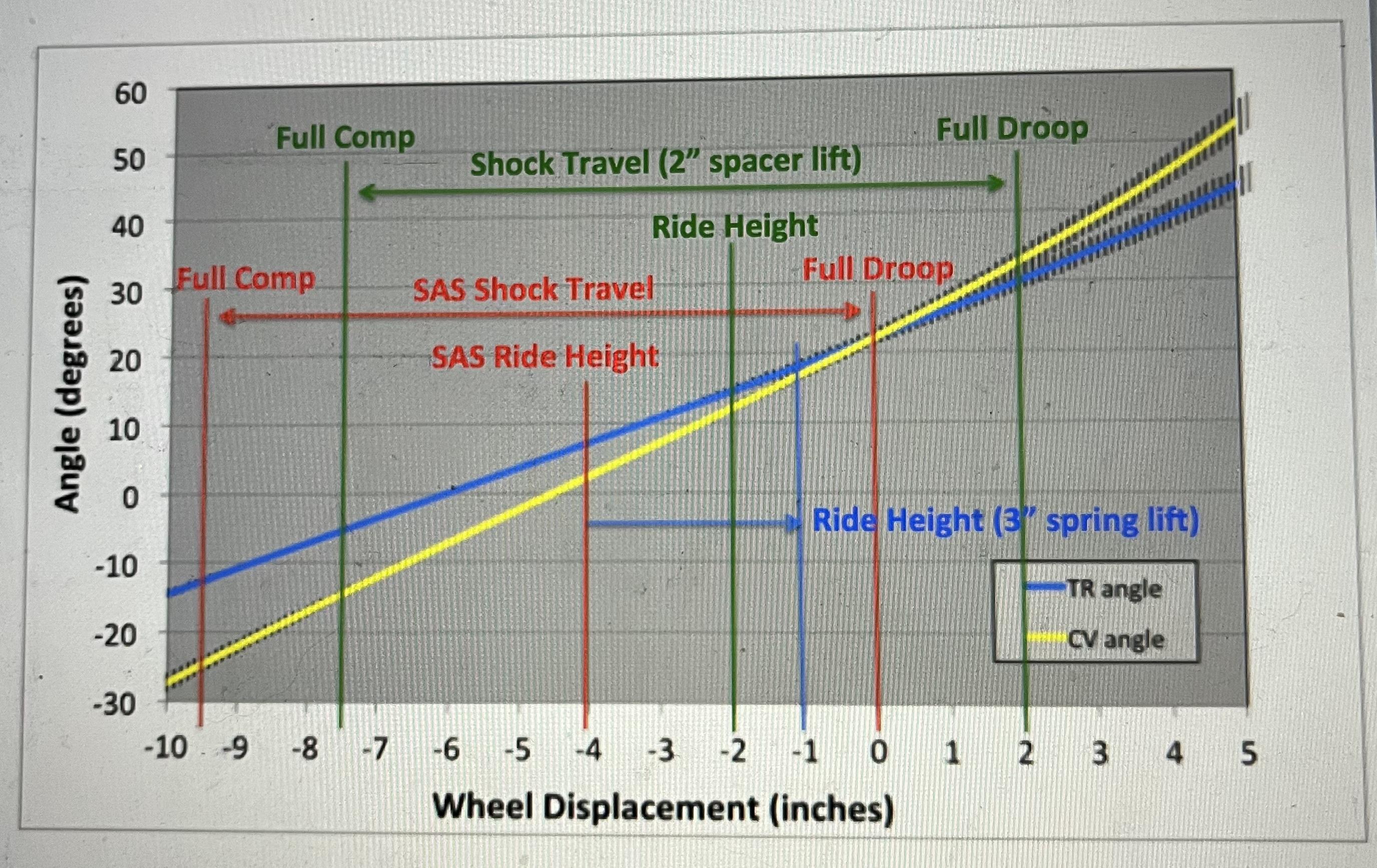
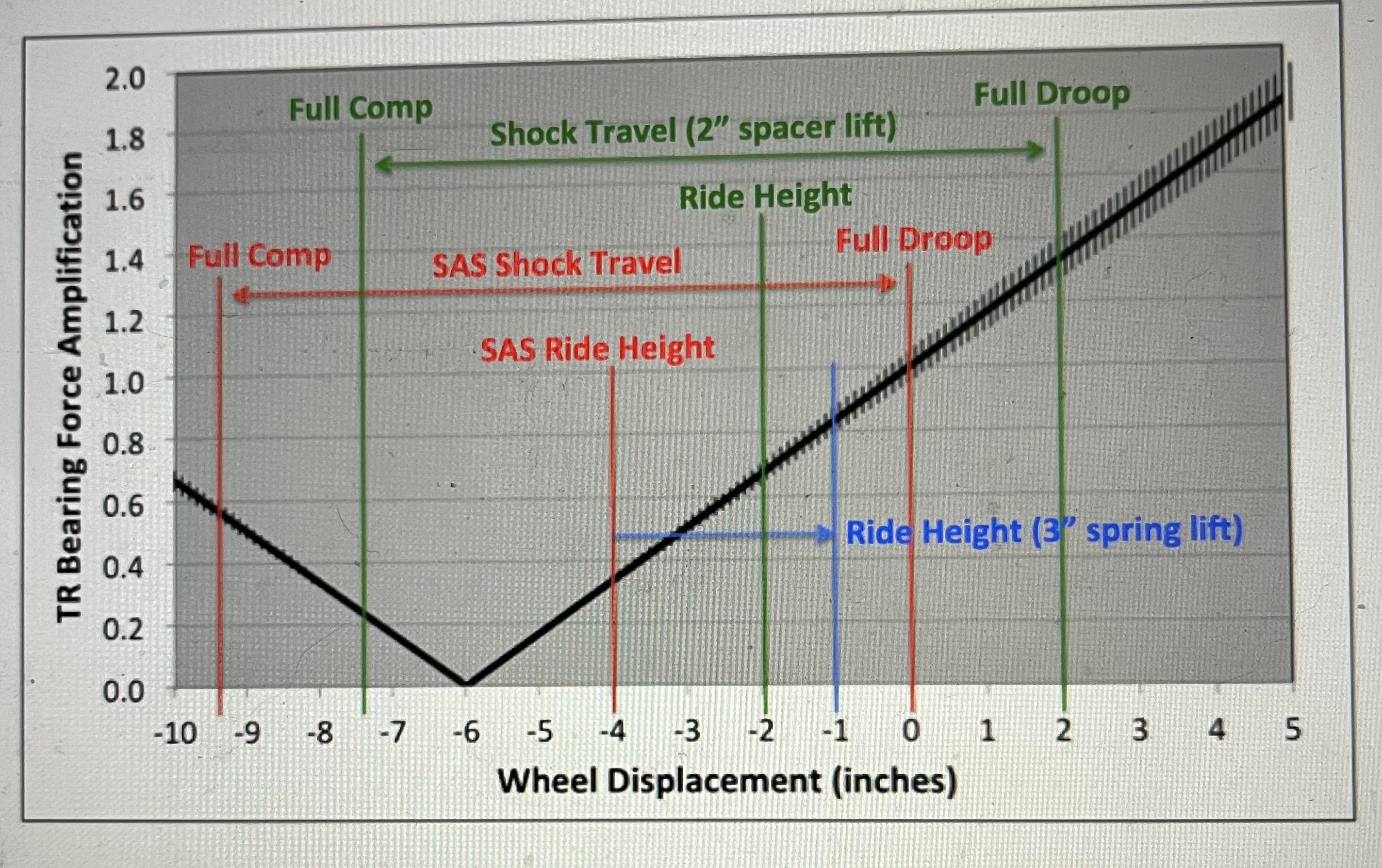
Tie rod and CV angles with bearing forces updated for kinematics wrt full shock travel. This is for my rig which is at “near” SAS ride height with 6.3” of shock travel and 9.5” of wheel travel.

The zero (origin) of wheel travel represents full droop for OEM SAS shock length. Notice angles go negative as wheel gets fully stuffed in compression. Bearing forces are normalized to worst case OEM SAS geometry at full drop.

notice angles and bearing loads are very small at OEM SAS ride height. A 3” spring lift increases ride height and thus normal operating loads and angles. A spacer lift increases both ride height (normal operation loads) as well as maximum possible loads due to increased full droop travel (from effective shock length increases).

Ford Bronco Some stock suspension calculations and measurements 8AB65B70-B685-475C-A3D7-AD7FB6D845B9


Ford Bronco Some stock suspension calculations and measurements F73E8C84-F0B5-4D6A-8C01-02FD1F64400A
 
OP
OP

87-Z28

Outer Banks
Well-Known Member
First Name
Andy
Joined
Sep 1, 2022
Threads
3
Messages
1,308
Reaction score
3,227
Location
Texas
Vehicle(s)
BMW
Your Bronco Model
Outer Banks
Clubs
 
From the workshop manual.
Halfshaft
Special Tool(s) / General Equipment

Tire Lever
Removal

NOTICE: Do not hold the halfshaft by the CV joint.

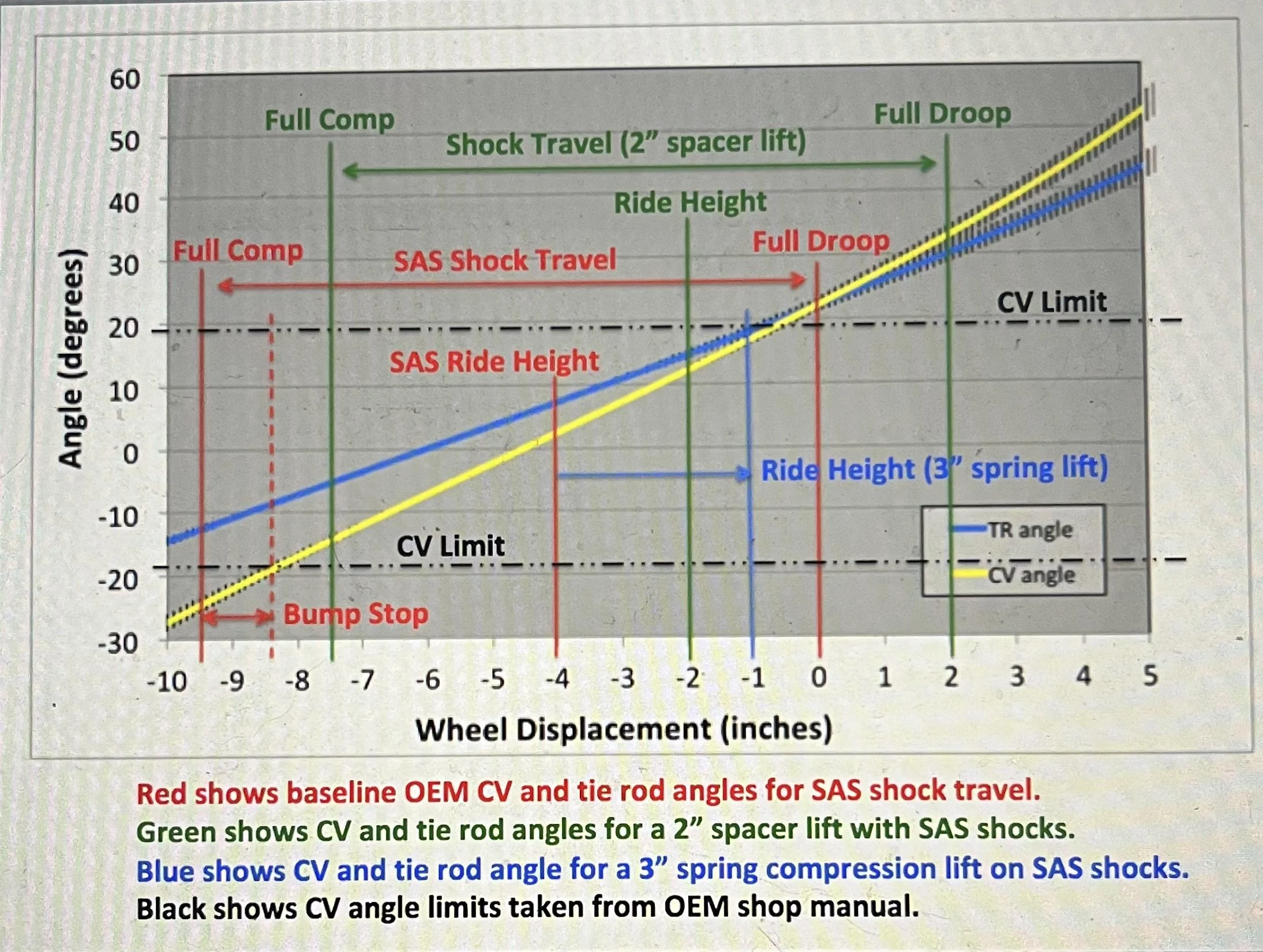
NOTICE: The inner CV joint must not be bent more than 18°.
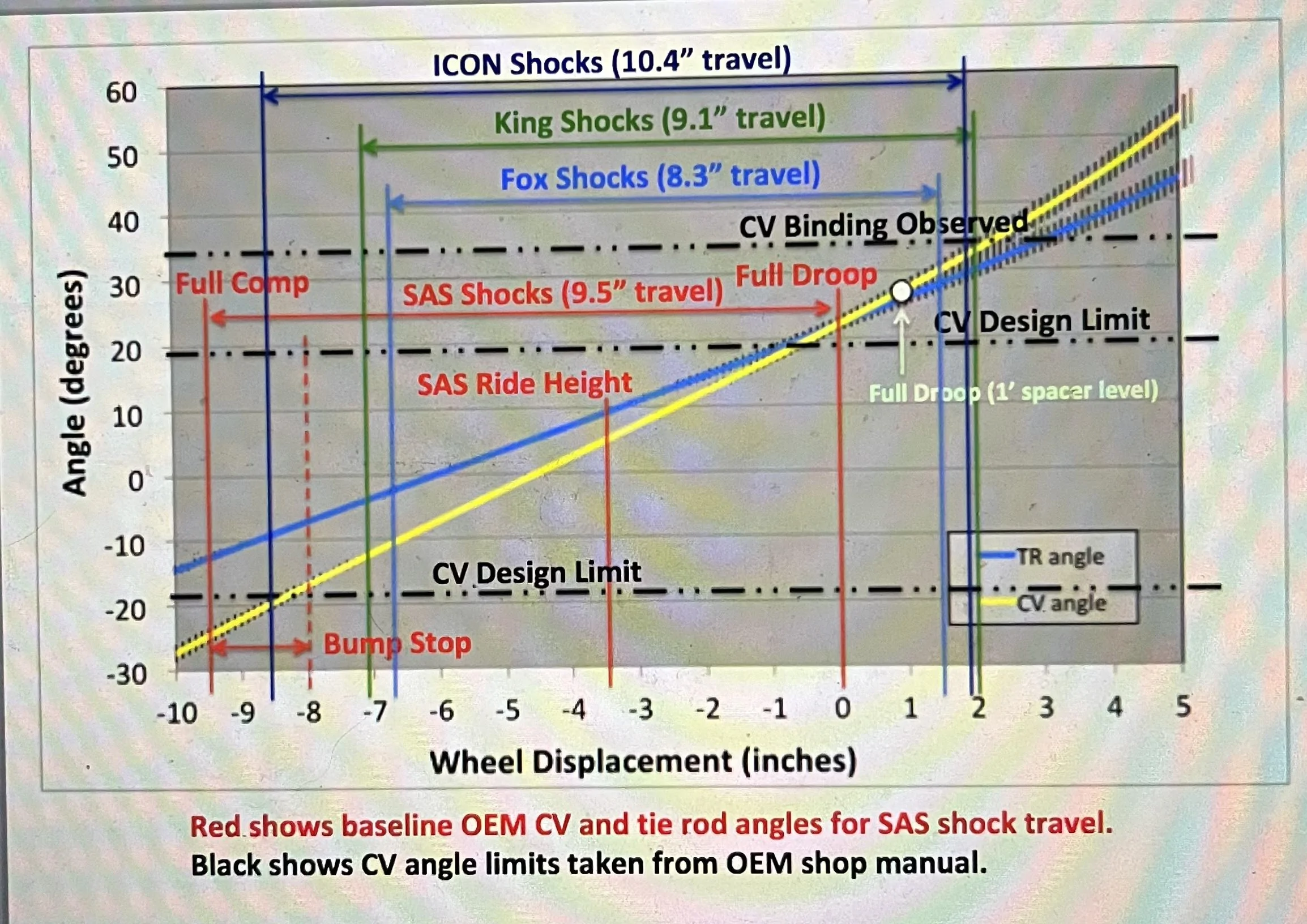
Plot of CV angles during OEM shock travel have been updated to include limits taken from the shop manual. Notice range of CV angles for SAS geometry fits reasonably well into the design limits, +/- 18 degrees. Also notice that at SAS ride height CV angles are small, <5 degrees.

Ford Bronco Some stock suspension calculations and measurements 378B0D7E-5BDF-4002-8341-D16B99258145
 

Snacktime

Black Diamond
Well-Known Member
First Name
Nate
Joined
Jul 14, 2020
Threads
74
Messages
4,002
Reaction score
10,009
Location
Sac-a-tomatoes
Vehicle(s)
Bronco, F150
Your Bronco Model
Black Diamond
Clubs
 
@87-Z28 You are basically showing that running a lift will wear your CV axles out substantial faster. Each rotation the range of motion is 4 to 5 times greater than stock. This will cause the grease inside the CV to wear out substantial sooner. Most people will say you will wear out the boots but the boot failure is just the external visual wear.

This is common knowledge but the fact you put hard numbers on the angles you could speculate a service life of 150k miles divided by 5 times the wear to an actual life of 30k miles. This is just a random guess, as the more angle on CV the more stress and less engagement of the internal balls would exaggerate the wear probably exponentially.

Lot of what companies are selling people on safe is not really if you look at the long term effects. I can say 1.4" of spacer lift will exceed the safe operating range of a CV axle when a 37 is attached.
 
OP
OP

87-Z28

Outer Banks
Well-Known Member
First Name
Andy
Joined
Sep 1, 2022
Threads
3
Messages
1,308
Reaction score
3,227
Location
Texas
Vehicle(s)
BMW
Your Bronco Model
Outer Banks
Clubs
 
There is really nothing here that is not already known by many of you with abundant experience. It is nonetheless interesting to plot all of this data on a single chart with increasingly accurate numbers and calculations. This helps others to understand and think about the data.

I have taken the data compiled by @Merc4x4 and added to the chart showing wheel motion wrt shock travel and CV angles. Ride heights are not included since that depends on springs chosen and vehicle weights. SAS, fox, and king data are accurate and all use the same reference points for measurements. Thanks to acutune. The ICON data is just notional until measurements can be verified. Thanks to all the info and input from others.

@Snacktime, @V1Rotate, @GreyZ, @TeocaliMG, @Tex and any others with interest. I would like to further refine this to increase accuracy so please take a critical look and provide feedback. I believe the geometry calculations for the CV and tie rod angles are accurate. errors are likely introduced from the length measurements, CV halfshaft and tie rod lengths from “knuckle to knuckle”. Those were measured on my truck. Within 1/4” at best, so possibly 10-15% errors. Those errors can get compounded so if someone has exact lengths, or parts on the bench to measure, this can be updated and improved.

I do believe the chart is fairly reasonable, especially since the +/- 18 degree CV angle limits from the OEM shop manual plot nicely with SAS shock travel. That is surely how ford would have designed it.

the SAS bump stop is also a guess and only notional. No idea how much that will compress so just assumed 2” from full compression as the limit case.

@TeocaliMG it is easy to see how much space there is at full compression between SAS OEM and the fox/king aftermarket shocks. It seems they were designed to keep the big wheels from the fenders during high speed severe shock compression, at the sacrifice of CV angles and tie rod angles (which affect steering rack).

just a note wrt bilstein 5100 and 6100/6112 shocks. They are same length as SAS with very similar shock travel. So they will plot similar to SAS shocks. Ride height will of course vary depending on springs/preload used and vehicle weight.

Ford Bronco Some stock suspension calculations and measurements 4798DE5C-ED47-4E24-99FD-3FA06BB468D5
Sponsored


Top