
Sponsored
Loading

OP
OP


- First Name
- Jonathan
- Joined
- Dec 7, 2021
- Threads
- 8
- Messages
- 374
- Reaction score
- 509
- Location
- Tucson, AZ
- Vehicle(s)
- FJ Cruiser [sold]
- Your Bronco Model
- Badlands
- Thread starter
- #47
Sorry about the delay. I wired it to 5. It's just controlling a relay so you don't have to worry about the draw--any switch will do.Did you guys wire this to your upfitter switches? If so, any particular one to be used here?


- First Name
- Brandon
- Joined
- Oct 14, 2020
- Threads
- 4
- Messages
- 95
- Reaction score
- 106
- Location
- Washington
- Vehicle(s)
- 2023 Bronco Wildtrak
- Your Bronco Model
- Wildtrak
Did you guys wire this to your upfitter switches? If so, any particular one to be used here?
Probably worth noting that any switch will do, but probably want to save AUX1 & AUX2 for power drawing accessories. They’re 30A and 15A respectively, with the remaining AUX3-6 being 10A.Sorry about the delay. I wired it to 5. It's just controlling a relay so you don't have to worry about the draw--any switch will do.
Also, @Jo8n, what circuit breakers did you go with?

Can you define “power drawing accessory”?Probably worth noting that any switch will do, but probably want to save AUX1 & AUX2 for power drawing accessories. They’re 30A and 15A respectively, with the remaining AUX3-6 being 10A.
Also, @Jo8n, what circuit breakers did you go with?
I’m just planning to hook up my winch, compressor, and GMRS to the switches. Maybe ditch lights down the road.
- First Name
- Brandon
- Joined
- Oct 14, 2020
- Threads
- 4
- Messages
- 95
- Reaction score
- 106
- Location
- Washington
- Vehicle(s)
- 2023 Bronco Wildtrak
- Your Bronco Model
- Wildtrak
In the context of this thread, we’re talking about an ARB compressor install, which draws its power directly from the battery (via 2 x 40A connections directly to accessory terminals on the battery), instead of through the AUX switches.Can you define “power drawing accessory”?
I’m just planning to hook up my winch, compressor, and GMRS to the switches. Maybe ditch lights down the road.
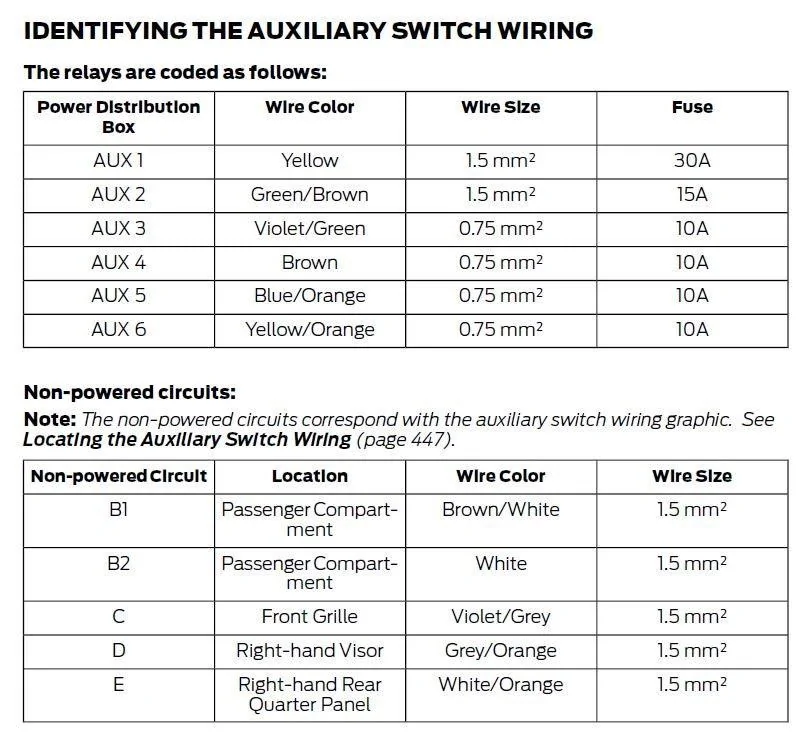
The AUX switches themselves ARE powered, so you are able to actually power devices through them directly by connecting the power line of your accessory to the switch’s respective wire. You just have to be mindful of the device’s amperage to make sure it doesn’t draw more amperage than the particular switch supports. See list below:
Sponsored
Got it. This is very helpful. So the idea for using the compressor with the switches would be to power directly off the battery and then is there a compressor switch wire that’s run to the upfitter switches to turn it on/off?In the context of this thread, we’re talking about an ARB compressor install, which draws its power directly from the battery (via 2 x 40A connections directly to accessory terminals on the battery), instead of through the AUX switches.
The AUX switches themselves ARE powered, so you are able to actually power devices through them directly by connecting the power line of your accessory to the switch’s respective wire. You just have to be mindful of the device’s amperage to make sure it doesn’t draw more amperage than the particular switch supports. See list below:

- First Name
- Brandon
- Joined
- Oct 14, 2020
- Threads
- 4
- Messages
- 95
- Reaction score
- 106
- Location
- Washington
- Vehicle(s)
- 2023 Bronco Wildtrak
- Your Bronco Model
- Wildtrak
Correct.Got it. This is very helpful. So the idea for using the compressor with the switches would be to power directly off the battery and then is there a compressor switch wire that’s run to the upfitter switches to turn it on/off?
Lights and possibly radio (not sure the peak amperage for GMRS) could probably run directly off AUX connections. Being GMRS has its own on/off switch, that may be redundant, though. Winch, I’m pretty sure, draws way more than 30A (like up to nearly 300A under heavy load - someone correct me if I’m wrong) would be powered directly from battery and may/may not have on/off switch that can be wired through an AUX switch. Not sure, as I’ve not personally installed/run a winch yet.
Edited: to state that winch WOULD be powered directly from battery.
Last edited:
Tyvm!Correct.
Lights and possibly radio (not sure the peak amperage for GMRS) could probably run directly off AUX connections. Being GMRS has its own on/off switch, that may be redundant, though. Winch, I’m pretty sure, draws way more than 30A (like up to nearly 300A under heavy load - someone correct me if I’m wrong) would not be powered directly from battery and may/may not have on/off switch that can be wired through an AUX switch. Not sure, as I’ve not personally installed/run a winch yet.
OP
OP
- First Name
- Jonathan
- Joined
- Dec 7, 2021
- Threads
- 8
- Messages
- 374
- Reaction score
- 509
- Location
- Tucson, AZ
- Vehicle(s)
- FJ Cruiser [sold]
- Your Bronco Model
- Badlands
- Thread starter
- #54
This is why I was working backward through my switches, saving the "first" two for things that might actually draw more current through the switches. However, I recently installed the DD pocket lights leaving with me only Aux 1 left.In the context of this thread, we’re talking about an ARB compressor install, which draws its power directly from the battery (via 2 x 40A connections directly to accessory terminals on the battery), instead of through the AUX switches.
The AUX switches themselves ARE powered, so you are able to actually power devices through them directly by connecting the power line of your accessory to the switch’s respective wire. You just have to be mindful of the device’s amperage to make sure it doesn’t draw more amperage than the particular switch supports....
OP
OP
- First Name
- Jonathan
- Joined
- Dec 7, 2021
- Threads
- 8
- Messages
- 374
- Reaction score
- 509
- Location
- Tucson, AZ
- Vehicle(s)
- FJ Cruiser [sold]
- Your Bronco Model
- Badlands
- Thread starter
- #55
These are the ones we're using but they don't really fit in the ARB fuse harness without pushing down on the reset buttons. We still haven't satisfactorily dealt with this--just wrapped the housing with tape for now. I can't say I'm really worried about it functionally but don't like the mess.
https://www.amazon.com/gp/product/B08FSXY1Q4
Either need a better housing, mounted breaker(s), or a better DIY solution. So many of the more mountable breaker solutions have reviews stating they don't work right or fall apart.
Sponsored
- First Name
- Brandon
- Joined
- Oct 14, 2020
- Threads
- 4
- Messages
- 95
- Reaction score
- 106
- Location
- Washington
- Vehicle(s)
- 2023 Bronco Wildtrak
- Your Bronco Model
- Wildtrak
Gotcha. Yeah, I saw those, and thought they would be a nice & easy solution using the existing fuse block. What you’re experiencing was my actual concern with them. Thanks for the heads up!These are the ones we're using but they don't really fit in the ARB fuse harness without pushing down on the reset buttons. We still haven't satisfactorily dealt with this--just wrapped the housing with tape for now. I can't say I'm really worried about it functionally but don't like the mess.
https://www.amazon.com/gp/product/B08FSXY1Q4
Either need a better housing, mounted breaker(s), or a better DIY solution. So many of the more mountable breaker solutions have reviews stating they don't work right or fall apart.
Thinking I’ll probably cut out the fuse blocks and just add an inline 40A CB, like this one:
40A Inline Circuit Breaker Reset Fuse, 12V-24V DC Reset Fuse Holder 40 amp with Manual Reset for Car Audio Stereo Switch and Solar Inverter System (2 Pack) https://a.co/d/gAl2g6r
Would be better if it was waterproof, so I could mount them in the engine bay with confidence, but thinking behind the FW would be fine. Just need to find a good spot to mount them with 3M tape or some good ole RCV.
- First Name
- Brandon
- Joined
- Oct 14, 2020
- Threads
- 4
- Messages
- 95
- Reaction score
- 106
- Location
- Washington
- Vehicle(s)
- 2023 Bronco Wildtrak
- Your Bronco Model
- Wildtrak
Running out of AUX switches seems like a good problem to have!This is why I was working backward through my switches, saving the "first" two for things that might actually draw more current through the switches. However, I recently installed the DD pocket lights leaving with me only Aux 1 left.
OP
OP
- First Name
- Jonathan
- Joined
- Dec 7, 2021
- Threads
- 8
- Messages
- 374
- Reaction score
- 509
- Location
- Tucson, AZ
- Vehicle(s)
- FJ Cruiser [sold]
- Your Bronco Model
- Badlands
- Thread starter
- #58
So this is the style I was interested in too but it seemed like they all had so many scary one star reviews. Please let me know what you think if you go that route. ...really whatever route you go actually....
Thinking I’ll probably cut out the fuse blocks and just add an inline 40A CB, like this one:
40A Inline Circuit Breaker Reset Fuse, 12V-24V DC Reset Fuse Holder 40 amp with Manual Reset for Car Audio Stereo Switch and Solar Inverter System (2 Pack) https://a.co/d/gAl2g6r
Would be better if it was waterproof, so I could mount them in the engine bay with confidence, but thinking behind the FW would be fine. Just need to find a good spot to mount them with 3M tape or some good ole RCV.
EDIT: I'm no expert but, FWIW, I'd be concerned with mounting circuit protection that far from the battery but, again, not an expert so just saying/asking.
- First Name
- Brandon
- Joined
- Oct 14, 2020
- Threads
- 4
- Messages
- 95
- Reaction score
- 106
- Location
- Washington
- Vehicle(s)
- 2023 Bronco Wildtrak
- Your Bronco Model
- Wildtrak
Yeah, it’s like anything sold cheap on Amazon. Always a chance you get a dud, I suppose.So this is the style I was interested in too but it seemed like they all had so many scary one star reviews. Please let me know what you think if you go that route. ...really whatever route you go actually.
EDIT: I'm no expert but, FWIW, I'd be concerned with mounting circuit protection that far from the battery but, again, not an expert so just saying/asking.
And, good point about proximity of CB to battery. Was thinking difference of a couple feet from battery would be negligible. I’ve heard you should keep your line < 18in where possible.
For fun, asked ChatGPT what it thought and it gave the following answer, FWIW…
 :
:Don’t trust the robots quite yet, so would love to hear from an actual mechanic, experienced car audio tech, or electrician who knows the what and why, if any are listening…The distance between a circuit breaker and a car battery for a 40-amp circuit will depend on several factors, including the gauge of the wire used and the type of insulation on the wire. Generally, it is recommended to place the circuit breaker as close to the battery as possible to reduce voltage drop and ensure proper circuit protection.
In automotive applications, it is common to use wire with a gauge of 10 or 8 AWG for a 40-amp circuit. If using 10 AWG wire, the distance from the circuit breaker to the battery should be no more than 6 feet, while for 8 AWG wire, the distance can be up to 10 feet.
However, it's important to note that this is a general guideline, and the specific requirements may vary depending on the specific circumstances and the manufacturer's recommendations. It's always best to consult the manufacturer's documentation or seek the advice of a qualified professional to ensure proper installation and safety.
OP
OP
- First Name
- Jonathan
- Joined
- Dec 7, 2021
- Threads
- 8
- Messages
- 374
- Reaction score
- 509
- Location
- Tucson, AZ
- Vehicle(s)
- FJ Cruiser [sold]
- Your Bronco Model
- Badlands
- Thread starter
- #60
Yeah. Chat GPT is nice for searching and getting a concise answer! Used it for wire size the other day when I couldn't remember the gauge of the aux wires.Yeah, it’s like anything sold cheap on Amazon. Always a chance you get a dud, I suppose.
And, good point about proximity of CB to battery. Was thinking difference of a couple feet from battery would be negligible. I’ve heard you should keep your line < 18in where possible.
For fun, asked ChatGPT what it thought and it gave the following answer, FWIW…
Don’t trust the robots quite yet, so would love to hear from an actual mechanic, experienced car audio tech, or electrician who knows the what and why, if any are listening…
I always thought, the longer the wire, the more that can go wrong whether it be getting close to something hot or moving or rubbing up against something sharp but I'm in software--not hardware.
Sponsored
Similar threads

- Replies
- 6
- Views
- 833


- Replies
- 4
- Views
- 4,462
- Replies
- 0
- Views
- 698

- Replies
- 15
- Views
- 8,345