
Sponsored

Tire Pressure Guide -- All Terrains, Chalk Testing and Towing

swamp2

Raptor
Well-Known Member
Joined
Dec 19, 2022
Threads
156
Messages
4,104
Reaction score
4,238
Location
San Diego
Vehicle(s)
911 Carrera S / 4Runner TRD Pro
Your Bronco Model
Raptor
Guidance from @Valhalla , @userdude and me. So many threads on "what tire pressure should I run". This should be accurate for a wide range of vehicles, tire sizes and conditions. Chalk testing, towing and large vehicle loads (cargo) in following posts. The following are for no to light loads:

High (36-42 psi): Better gas mileage on highway, stiffer (rougher) ride on road. Will exhibit non uniform "crowning" wear.

Medium-High (30-35 psi): Smoother ride on road, worse gas mileage (sometimes -3-5mpg depending on tire). Should exhibit even tire wear.

Medium (25-29 psi): Softer ride on fire/gravel roads. Also a good street pressure for large tires with higher load ratings that factory tires.

Medium-Low (18-24 psi): Softer ride on rocks. Not safe for sustained high speeds on road.

Low (13-17 psi): Softer on the rocks, watch out for your sidewalls if you're not on M/Ts.

Low (Sand) (11-14 psi): Good on fast/deeper sand like Glamis and where there are not rocks hiding. OK without bead locks.

Very Low (11 psi or lower): Harder use at these pressures should be with bead locks or bead grip wheels and only needed for maximum traction in technical rock crawling or mudding.

Super Low (5-10 psi): For wheeling in deep snow or very soft sand, bead locks advised.
Sponsored

 
Last edited:
OP
OP
swamp2

swamp2

Raptor
Well-Known Member
Joined
Dec 19, 2022
Threads
156
Messages
4,104
Reaction score
4,238
Location
San Diego
Vehicle(s)
911 Carrera S / 4Runner TRD Pro
Your Bronco Model
Raptor
Chalk Testing:

Simple, reliable and accurate method primarily to obtain street tire pressures for even tire wear but will also improve traction.

It will not lead to a match with factory recommended pressures as those are largely optimized for fuel efficiency and are higher (often a lot) than what you'll get via chalk testing.
  1. Find 150' or so of smooth, clean, flat asphalt.
  2. Begin with cool tires after parked for some time. Rub a stick of regular kids sidewalk chalk across the entire width of a tire in a rectangle about 5" wide (fore-aft). Make few passes to build up the chalk.
  3. Drive very slowly for 100' or so. Stop where the chalk patch is visible on the tire and example it for lateral uniformity. More chalk missing from the center means the tire is bulging in the center and is wearing faster there. The pressure is too high. More chalk missing on the edges means the pressure is too low.
  4. Adjust pressure, typically +/- 2-5 psi and repeat until chalk patch shows uniform wear.
 
Last edited:
OP
OP
swamp2

swamp2

Raptor
Well-Known Member
Joined
Dec 19, 2022
Threads
156
Messages
4,104
Reaction score
4,238
Location
San Diego
Vehicle(s)
911 Carrera S / 4Runner TRD Pro
Your Bronco Model
Raptor
Inflation for Cargo and Trailers:

Higher loads need increased pressure to insure the tires don't not deform too much which causes excessive heat buildup and wear. Here is how to get tires at the correct pressure.

1. Determine rear axle weight (no cargo or trailer). Unfortunately OEMs don't publish this. Use your curb weight spec and lookup the F:R weight distribution online and multiply the rear % by curb weight.

2. Determine rear axle added weights.

Trailer:

Rear Axle Added Weight (trailer) = Tongue Weight x (1 + OH/WB)

OH = distance from rear axle to hitch ball center
WB = wheelbase

Cargo:

Use an estimate of where cargo is located to determine how much weight is added to the rear axle.

3. Add up curb rear axle weight, cargo weight and rear axle added weight (trailer) to determine total laden rear axle load. Divide this by 2 to determine total load per rear wheel. Alternatively load everything up and hit a scale with only the rear wheels.

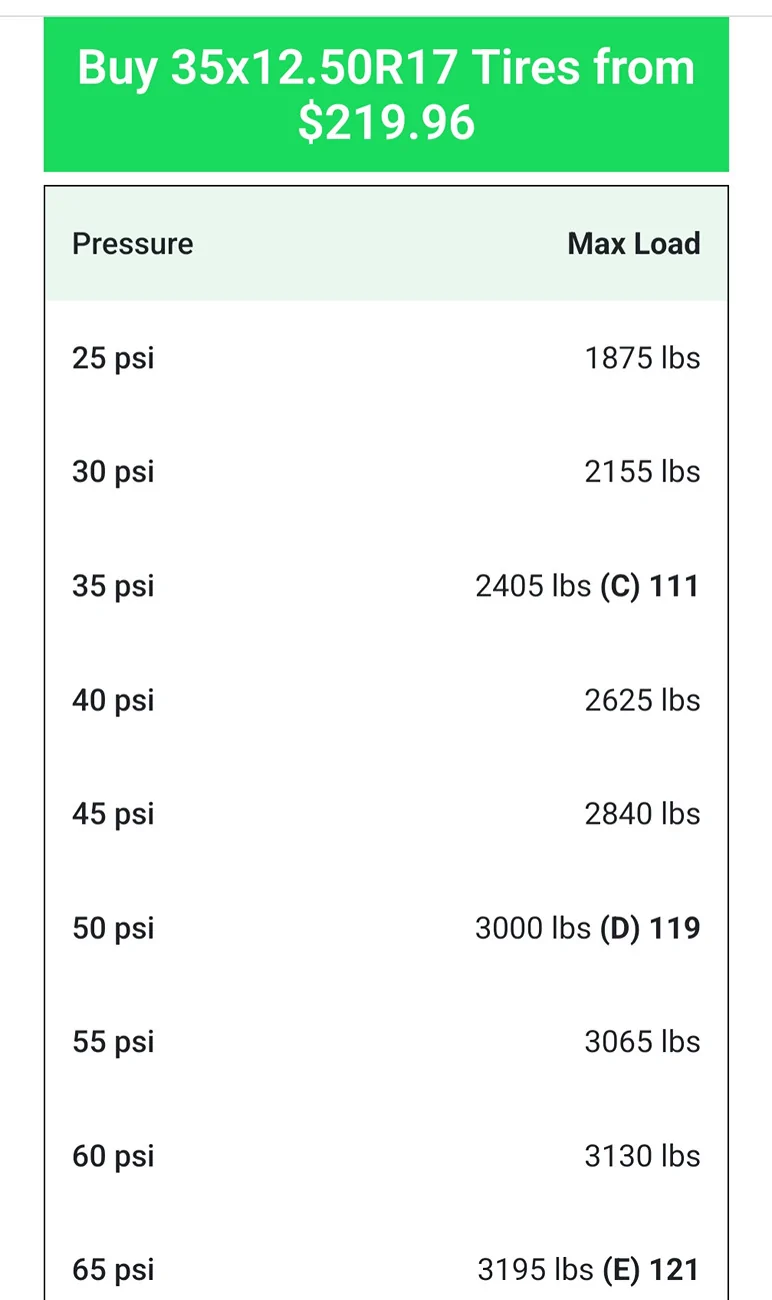
4. Find your load vs. pressure chart for your exact tire (and it's load rating). I've not been able to find these for some tires... It is my understanding that results are standardized across manufacturers by the Tire and Rim Association at a given size and load rating, thus if you can't find the chart for your tire, the attached Goodyear one should suffice. Here is an example for a 35" BFG KO2:

Ford Bronco Tire Pressure Guide -- All Terrains, Chalk Testing and Towing Screenshot_20260711-151605


5. Inflate to specified pressure. Obviously, never exceed the maximum load, psi printed on the tire sidewall or official vehicle tow capacity.

That said my experience is that factory tow values are for curves and full highway speeds and in hilly terrain, I.e. they are always conservative.

Front tires will typically run fine at your normal unloaded pressure.
Sponsored


Attachments

Last edited:


Top