

Sponsored

Forscan/FDRS fuel tank size fix for 30.1 gal tank on 2025 Bronco Raptor - has anyone gotten DTE to read correctly?

swamp2

Raptor
Well-Known Member
Joined
Dec 19, 2022
Threads
156
Messages
4,132
Reaction score
4,262
Location
San Diego
Vehicle(s)
911 Carrera S / 4Runner TRD Pro
Your Bronco Model
Raptor
Swamp

Who cares if we cant update the tank size. that is the first step, once we can update the tank size we can verify how far off we are on the second step. there is an order of operations and you are worried about step 3 or 4

This is the formula for the DTE


Distance to Empty = Usable Fuel Remaining × Running Average Fuel Economy (RAFE)

the usable fuel remaining is the first variable
We remain not on the same page.

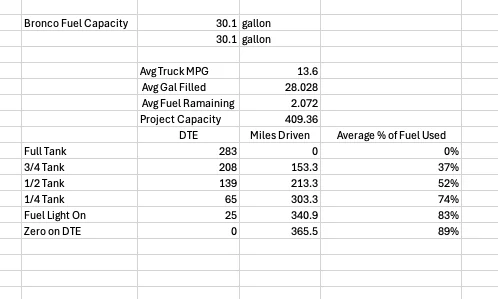
I don't think you can say whether slope (tank size) or intercepts are the cause of the greater error. Likely, the greater error % depends on how full the tank is. Both errors/effects are large and significant. Empirically, from the other thread, the offset errors are quite large at both full and near empty, and DTE simply can't be corrected fully using only slope.

Again, in short, I don't think we will see a solution that even gets 20% accuracy on DTE, near full, nor near empty.
Sponsored
 
OP
OP
Erod007

Erod007

Raptor
Active Member
First Name
Eric
Joined
Jan 5, 2026
Threads
1
Messages
29
Reaction score
21
Location
NTX
Vehicle(s)
2025 Bronco
Your Bronco Model
Raptor
We remain not on the same page.

I don't think you can say whether slope (tank size) or intercepts are the cause of the greater error. Likely, the greater error % depends on how full the tank is. Both errors/effects are large and significant. Empirically, from the other thread, the offset errors are quite large at both full and near empty, and DTE simply can't be corrected fully using only slope.

Again, in short, I don't think we will see a solution that even gets 20% accuracy on DTE, near full, nor near empty.
you are right, we are not on the same page. In fact, we are not even reading the same book.


The first issue is actually very simple. If the truck believes it only has a 20-gallon fuel tank, the DTE will never be correct, regardless of where the float sits or how it is calibrated.


The first objective is to get the truck to recognize that it has 30 gallons of usable fuel. Once we accomplish that, we can accurately measure how far off the gauge is due to the float position and then determine what adjustment, if any, is needed to compensate for the deeper tank.


Skipping the first step and jumping straight to float calibration makes no sense because we would be trying to correct a symptom before fixing the underlying problem.


If you don’t know the answer or don’t have a way to help solve it, that’s perfectly fine. But simply telling me that I’m wrong doesn’t move either of us any closer to finding a solution.
 

swamp2

Raptor
Well-Known Member
Joined
Dec 19, 2022
Threads
156
Messages
4,132
Reaction score
4,262
Location
San Diego
Vehicle(s)
911 Carrera S / 4Runner TRD Pro
Your Bronco Model
Raptor
you are right, we are not on the same page. In fact, we are not even reading the same book.


The first issue is actually very simple. If the truck believes it only has a 20-gallon fuel tank, the DTE will never be correct, regardless of where the float sits or how it is calibrated.


The first objective is to get the truck to recognize that it has 30 gallons of usable fuel. Once we accomplish that, we can accurately measure how far off the gauge is due to the float position and then determine what adjustment, if any, is needed to compensate for the deeper tank.


Skipping the first step and jumping straight to float calibration makes no sense because we would be trying to correct a symptom before fixing the underlying problem.


If you don’t know the answer or don’t have a way to help solve it, that’s perfectly fine. But simply telling me that I’m wrong doesn’t move either of us any closer to finding a solution.
Indeed, not on the same page.

It's not a process that has a defined/required order to fix. You may believe that to be so, but it doesn't mean it is.

Again, assuming you could fix the overall volume issue, you could still have a more significant issue/error due to offset (the improper early top out or bottom out of the float). All that would be corrected would be roughly the change in reported fuel level vs. the change in DTE. Absolutes, which are obviously what any one wants/needs are going to still be way off. Agree or disagree, simple direct question?

Have you read the other entire thread? Sounds like not. There were reports there about how far off and got how many miles the level didn't change near full and empty. If the float stops moving, reported consumption will go to zero and DTE would start going up!

You could dial in tank volume with a custom lookup table or detailed curve fit and STILL have a terrible DTE. What part of that don't you get? It seems like you keep discounting or ignoring the float improperly topping out and improperly bottoming out (which it DOES!). If course if it did both perfectly, then yes, simply recalibrate via a rank volume and you would be quite close.

Just because I don't have a practical solution doesn't mean that I don't understand the entire issue much better than you do.
 

Spchgexo

Wildtrak
Active Member
First Name
Rick
Joined
Jan 6, 2021
Threads
6
Messages
33
Reaction score
14
Location
Michigan
Vehicle(s)
F150 and mustang
Your Bronco Model
Wildtrak
I personally would like an accurate representation of how much correct fuel is in the tank than a computer calculation telling me I only have 50 miles to empty. If an accurate fuel gauge is reading then I could make my own decision on when I need to refuel. People have been doing it since the beginning of the automobile a
Sponsored


Top