
Sponsored

swooshdave

Badlands
Well-Known Member
Joined
Dec 15, 2020
Threads
103
Messages
4,852
Reaction score
9,143
Location
Portland, Oregon
Vehicle(s)
Mustang
Your Bronco Model
Badlands
Clubs
 
Badland - Harbor Freight Tools

No kinetic rope in the Harbor Freight Badland line, but the strap & soft shackle I'd highly recommend. Also, the 10,000-snatch strap says it does have stretch for that added safety net.
https://www.harborfreight.com/brand...3-in-x-30-ft-recovery-snatch-strap-58139.html
This purpose-built recovery strap allows 20% stretch for easier vehicle recovery
Interestingly Yankum doesn't seem to list their stretch rating.

Voodoo says 38%.


Also on their shackles are:
  • 9500 lb. rated load, 47,500 lb. breaking strength
5:1
Sponsored

 
Last edited:

mike8675309

Base
Well-Known Member
First Name
Mike
Joined
Nov 24, 2021
Threads
35
Messages
1,175
Reaction score
1,731
Location
Minnesota
Vehicle(s)
2022 Ford Bronco ManSquatch, 2023 Chevy Silverado
Your Bronco Model
Base
I question the strength at many of the welded-on bumper "recovery" points on the various aftermarket bumpers. I also wouldn't trust the factory loops as recovery points. You might winch against them, but I wouldn't try a kinetic recovery against them.
 

SROC3

Big Bend
Well-Known Member
First Name
Pat
Joined
Aug 23, 2022
Threads
75
Messages
975
Reaction score
1,172
Location
Las Vegas, NV
Vehicle(s)
Ford Bronco 2022
Your Bronco Model
Big Bend
Clubs
 
As more people keep posting about recovery gear I figure we should have a technical discussion.

1)First is making sure you control your failure point! You really want the strap or kinetic rope to be the yield point. People put to much emphasis on getting a big strap, you want to have the strap fail before anything else. This sounds dangerous, but a whipping rope is safer than a fly hitch or shackle.

2)Most receiver hitches are in the 40,000lb break strength, this is not deform and yield area. So at 40,000lbs a hitch can break, so if your new to recovery stepping down to smaller straps is highly recommend.

3)Shackles, you don't need the biggest ones ever made. You want to be under the 40,000lb breaking strength so that the shackle fails before the mount. At this time a 7/16 soft shackle is around 40,000lb breaking point and as big as you want to go for a Bronco(they lose strength as they are used so typical safe to assume they will fail before 40,000lbs). Goal here is to stay under the hitch or mounts strength. A 3/8 soft shackle is around 30,000lbs breaking point and also a good option if paired with the right size rope/strap. Same theory applies to d ring metal shackles, watch the rating(they are all different). I always carry a metal shackle because they don't cut on sharp edges. For a metal shackle you want to stay in the 40,000lb and above area. Metal shackles are rated on working load so a 40,000lb shackle has a factor of safety before failure and safe to use with 40,000lb soft shackle (usually rated to failure strength). I would stay large on metal shackles as if the mounting point fails I rather have hopefully a whole bumper attached to the shackle than the shackle(something to think about when hooking up to pull someone).

4)Strap / Kinetic Rope should have a lower yield than shackles. You are controlling the failure zone to the strap. 1" Kinetic rope is rated to 30,000lbs as large as you want to go. Do not think you need a bigger rope/strap, bigger is not better it just moves the failure. 7/8" Kinetic rope is 25,000lbs followed by a 3/4" Kinetic rope at 20,000lbs. Same with straps a 3" wide strap is good for 30,000lbs and 2" wide strap is good for 20,000lbs.

5) Putting it all together! You want a step down in strength at each connection. You are controlling your failure point (yes the most costly item is the failure point).
7/16" soft shackle (40,000lbs) => 1" or 7/8" or 3/4" kinetic rope (30,000lbs to 20,000lbs)
7/16" soft shackle (40,000lbs) => 3" or 2" wide strap (30,000lbs to 20,000lbs)
3/8" soft shackle (30,000lbs) => 3/4" kinetic rope (20,000lbs)
3/8" soft shackle (30,000lbs) => 2" wide strap (20,000lbs)

Take away,
If you are new to offroading a 3/4" kinetic rope and 2" wide strap are what you want. Its perfectly fine to break a strap/rope, that just tells you need to rethink how your pulling and that something is not right. I wouldn't buy a 3/8" soft shackle, 7/16" is pretty much the standard and do not buy bigger soft shackles as you don't want to exceed the mounting point (that is how you get flying metal). I always recommend matching straps to kinetic ropes in case you need to use both at the same time try and have them equal strength.

Bigger kinetic ropes are becoming a hot item, don't be pulled in. You want the rope to fail before you rip the frame or mounts!

I always buy 30ft straps/ropes you want some distance between 5000lb vehicles buy the extra 10ft!
Great info!!! :) I'm part of SNORR (Southern Nevada Off Road Recovery). This is what I carry in my Bronco All the time.....


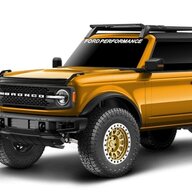
- Rough Country Winch (1200)
- DV8 Traction Boards
- 4 soft Shackles
- 4 hard shackles
- 1 Recovery Ring
- 20ft Kinetic Rope (should have gotten a longer one)
- 20FT Recovery Tow Strap
- 10 FT Tree Hugger Strap
- Tool Kit
- 1 Winch Dampener Cover
 

MnLakeBum

Outer Banks
Well-Known Member
First Name
Eric
Joined
Sep 21, 2021
Threads
5
Messages
1,131
Reaction score
1,913
Location
MN and FL
Vehicle(s)
‘18 Range Rover Diesel
Your Bronco Model
Outer Banks
Thanks to all for providing such in-depth information here for a newbie like me. I’ve been on Jeeping trips in the Sierra Nevadas with buddies who have a lot of knowledge but my Bronco is my first venture into off roading as an owner. As always, the devil is in the details and I have a lot to learn.
 

the poacher

Badlands
Well-Known Member
First Name
john
Joined
May 27, 2021
Threads
11
Messages
1,392
Reaction score
2,440
Location
Whistler
Vehicle(s)
2010 ford ranger
Your Bronco Model
Badlands
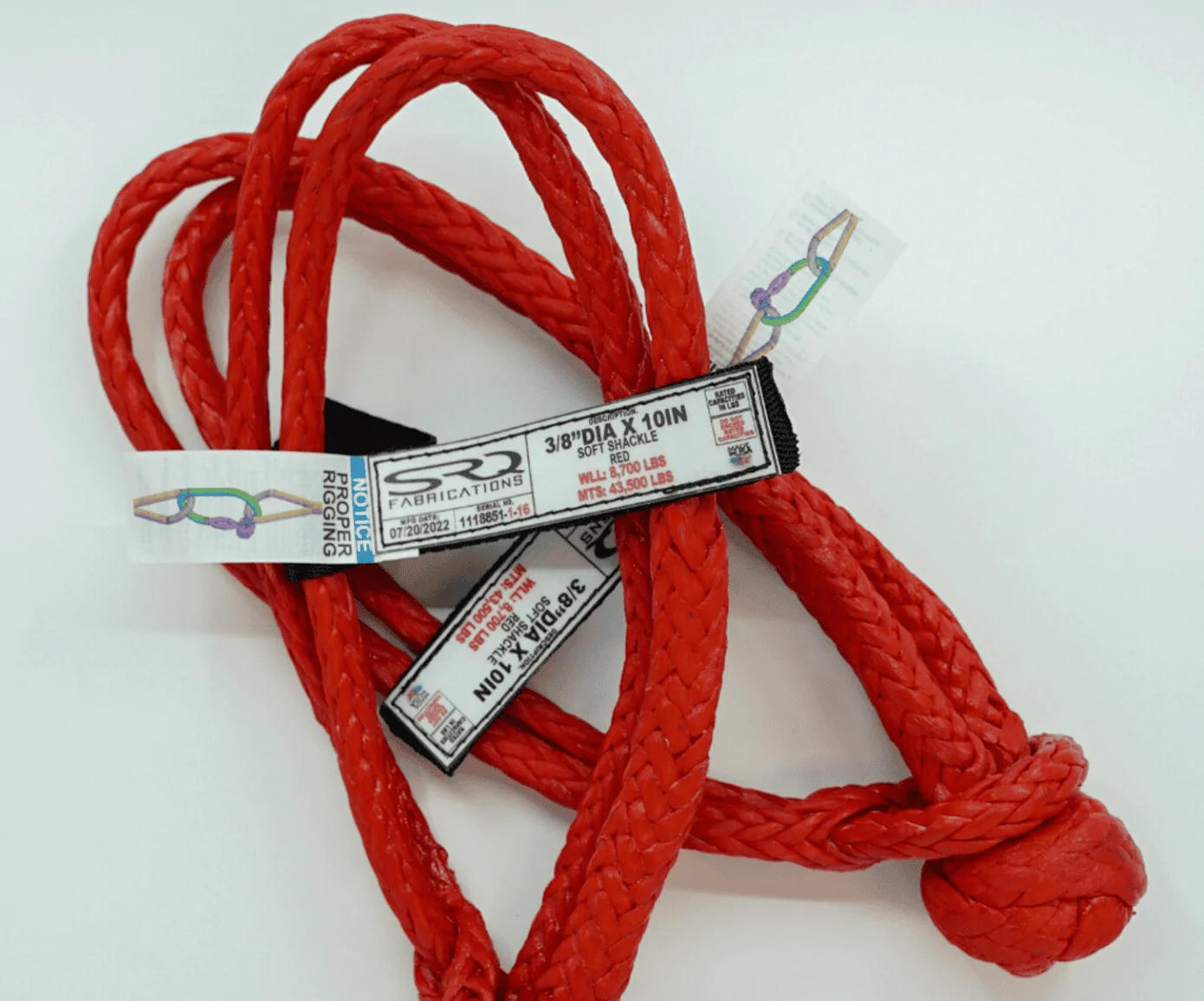
A big thing to look for on soft shackles, kinetic ropes, and bridles are the tags shown below. These tags display the minimum tensile strength and the working load limit of the gear you are using. You need both of these numbers to use your recovery gear properly and safely recover a vehicle. Props to the OP for putting this information together but this is a lot of key information that is missing which is vital to a proper and safe vehicle recovery.

Screenshot 2023-02-07 at 4.02.16 PM.png


There is a big difference between MTS (Minimum Tensile Strength) and WLL (Working Load Limit). You do not want to use only the MTS in your calculations during recovery unless you know the safety factor the recovery gear is designed around. If you use a soft shackle based on just its MTS, you are in for a very bad day. It can not handle 40,000 lbs of force being pulled on it in an everyday scenario. This is just the minimum tensile strength found in the shackle material during testing prior to it getting spliced and knotted. THIS IS VERY IMPORTANT as the shackle material is often not the failure point, the knot, and splice are. I can go into more detail on the quality of splices/knots if you guys are interested but it's probably better for a different thread. Every knot/splice is not the same and there are key design flaws to look out for in your recovery gear, mainly overseas tied recovery gear. This plays a huge role in the safety factor of the product.

Our soft shackles have a 5:1 factor accounted in them for safety. This is on the extreme safe side in terms of recovery gear and allows for error by the end-user in regards to rigging and maintenance of their gear. This also accounts for the strength of the knot and splice. Most gear you find has a 3:1 safety factor. If you find something with a 2:1 ratio, I would stay away from it as they are most likely not providing true numbers. If you divide the MTS of the product by the WLL of the product you will find the safety factor of the gear. This is why it is so important to know both numbers.

You will want to use the WLL of your recovery gear not the MTS of your gear for proper recovery calculations. If your 6000lb vehicle is tire-height deep in mud, one soft shackle with an 8,000lb working load is probably not going to be enough. There are some great apps out there that let you enter your current recovery situation and the gear you have on hand. It will then show you exactly how you need to rig your recovery setup using the gear you have available to you. It also brings the winch rating into the mix. Spoiler alert, a 10,000lb winch can't pull 10,000 pounds in a normal operation. This is a whole different topic though and get's interesting fast.

I highly recommend that everyone takes a recovery course class taught by a licensed and insured instructor. There is a lot of misinformation in the recovery world that can easily cost someone their life if not careful.

For those in FL, we have a recovery course for Broncos specifically at the end of April.

https://www.srqfabrications.com/store/FL6G-Bronco-Recovery-Course-April-29-30th-p528835967

Our Soft Shackles: https://www.srqfabrications.com/store/3-8-Soft-Shackle-p482025164

Our Kinetic Ropes: https://www.srqfabrications.com/store/7-8-x-30-Kinetic-Rope-p482060276

I highly recommend you order from a company that is upfront about the MTS and WLL of their products. You should also purchase USA-made gear as overseas gear often doesn't abide by the same stringent load testing. These aren't items you want to skimp out on.

P.S. I'm not a licensed and insured recovery course teacher, just providing information that we have come to learn from taking classes.
Thank you for your great insights into MTS and WLL. You mention apps that that assist you in determining what gear to use based on your situation. Is there one app that you would recommend?
I look forward to your response.
 

Sponsored
OP
OP
Snacktime

Snacktime

Black Diamond
Well-Known Member
First Name
Nate
Joined
Jul 14, 2020
Threads
71
Messages
3,877
Reaction score
9,721
Location
Sac-a-tomatoes
Vehicle(s)
Bronco, F150
Your Bronco Model
Black Diamond
Clubs
 
Thank you for your great insights into MTS and WLL. You mention apps that that assist you in determining what gear to use based on your situation. Is there one app that you would recommend?
I look forward to your response.
The tags are proof tests and are required by law if using the straps for commercial use. Basically all employers need to provide proof of certified load testing of all hoisting equipment.

Private person is not required to use certified straps for personal use.
 

JetMech

Badlands
Active Member
First Name
Robert
Joined
Dec 2, 2021
Threads
3
Messages
26
Reaction score
181
Location
Arizona
Vehicle(s)
F150, Badlands Sasquatch (2), Base Sasquatch
Your Bronco Model
Badlands
Clubs
 
Great writeup! Thanks for the time and research the OP and follow-up contributors have done. We have the ARB RK12A Weekender Recovery kit in each of our Broncos. It comes with a snatch strap, two D-ring shackles, gloves and a carrying bag which is large enough to hold a couple of soft shackles as well. We also have a pair of soft shackles in each that we've added.
 

BulldogBear

Badlands
Well-Known Member
Joined
Oct 17, 2021
Threads
14
Messages
245
Reaction score
477
Location
Scottsdale
Vehicle(s)
2021 Ford Bronco Badlands, 2000 Mercedes-Benz G500
Your Bronco Model
Badlands
Clubs
 
Additional recovery/rigging info & tips:

1. WEAR GLOVES.
Always wear gloves when your performing a recovery, working w/your rigging equipment, stacking rocks, etc. Frayed wire ropes can rip your hands apart. Synthetic ropes that have been in the desert or through a briar patch can do the same.

2. Buy well-established, quality equipment from known and trusted manufacturers (for example, Crosby Screw Pin Anchor Shackles (what most people refer to as "D-rings")). Those fancy color-matched Chi-Com D-rings? I'd hike out of the desert before I let someone try to use those to recover me.

As srqfabrications said, know the MTS & WLL of your equipment.

3. It never hurts to carry a couple extra soft & metal shackles.

4.
UtahBrandon said:
Same question goes for the rear recovery points (factory hoops), although I'm not sure what they're rated for.
Those are factory tie-downs for shipping. Do not use those for recovery.

5.
Snacktime said:
I also think weather exposer factors in. Grit and grime wears down synthetics.
Grit, grime, heat, sun, water, ice, etc all wear down your 'soft' gear. Synthetic rope and recovery straps should always be cleaned after use, especially if they're in the mud & muck. Pass the rope/strap through a 5 gallon pail of soapy water, then another pail to rinse it out, a section of rope/strap at a time.

Depending on your climate, UV rays & heat can accelerate the decay of your synthetics and straps. You know those plastic grocery bags they say take decades to decompose? Leave one in the AZ sun and it will be completely disintegrated after two summers. If your synthetic rope on your winch is exposed to the sun all day every day, don't expect it to last more than a few seasons - a winch cover can give your rope a longer life.

6. Most recovery straps also have a 'recovery lifespan' that should be clearly stated on the packaging/tag. Most are only rated for 10 full-load pulls, after which they should be retired. I typically make a sharpie tic mark on my strap each time it's used to keep track.

7. When you have to walk across the rope/winch line/strap connected to two vehicles (not under load), always step *ON* the rope/line/wire/strap. If it's under load, always walk the LONG way around.

8. Tow straps and synthetic ropes are designed to work much more like wire winch cable - slow pulls under constant load. Do not use them to do "yanking" type recoveries - they should be pulled taught before starting to pull.

9. Never trust your rigging to anyone but yourself, unless you know & trust the person and their equipment to do it - and this is in regards to the rigging on BOTH vehicles.
 

[DELETED MEMBER 27901]

Well-Known Member
Joined
Oct 25, 2021
Threads
7
Messages
1,375
Reaction score
3,764
Location
[DELETED MEMBER 27901]
Vehicle(s)
[DELETED MEMBER 27901]
Your Bronco Model
Undecided

Fordmanfrombirth

Outer Banks
Well-Known Member
First Name
Gary
Joined
May 5, 2021
Threads
5
Messages
166
Reaction score
270
Location
Florida
Vehicle(s)
2022 Ford Bronco Outer Banks
Your Bronco Model
Outer Banks
Clubs
 
Badland - Harbor Freight Tools

No kinetic rope in the Harbor Freight Badland line, but the strap & soft shackle I'd highly recommend. Also, the 10,000-snatch strap says it does have stretch for that added safety net.
If you look for reviews on Badland recovery gear, they are mixed. I have the Apex 12000 winch, the tow strap, soft shackles, tree saver, and winch damper. They all seem well made. The winch was installed by my dealer’s performance shop and they were impressed by the quality, features and price. Yes I know the dig, they are made in China. But they have the virtue of availability, in stock at your local Harbor Freight and very good prices and discounts. I am a weekend warrior at best. If I went out more often or went on epic overland treks, then I could see spending up to 4X the price on the best of the best.
 

Sponsored

mcinfantry

Badlands
Well-Known Member
First Name
Lee
Joined
Jun 2, 2021
Threads
35
Messages
2,411
Reaction score
3,955
Location
Louisiana
Vehicle(s)
Badlands 2 door
Your Bronco Model
Badlands
Clubs
 
The tags are proof tests and are required by law if using the straps for commercial use. Basically all employers need to provide proof of certified load testing of all hoisting equipment.

Private person is not required to use certified straps for personal use.
I put myself through heavy duty towing and recovery school to learn concepts and recovery techniques

interestingly tip-loading booms and point loading recovery points was interesting

as well as blocks changing direction of force, increasing load on your attachment points etc.

a lot of things I didn’t factor induring private recovery’s

Now are understand a little better on how you can bend a boom, or rip an attachment point off when the load ‘seems’ to be less than rating
 

TXBrian

Wildtrak
Well-Known Member
First Name
Brian
Joined
Nov 30, 2022
Threads
4
Messages
103
Reaction score
163
Location
Dallas
Vehicle(s)
2022 Bronco
Your Bronco Model
Wildtrak
Curious what you are basing the recommendation on item #4 off of?


Additional recovery/rigging info & tips:

1. WEAR GLOVES.
Always wear gloves when your performing a recovery, working w/your rigging equipment, stacking rocks, etc. Frayed wire ropes can rip your hands apart. Synthetic ropes that have been in the desert or through a briar patch can do the same.

2. Buy well-established, quality equipment from known and trusted manufacturers (for example, Crosby Screw Pin Anchor Shackles (what most people refer to as "D-rings")). Those fancy color-matched Chi-Com D-rings? I'd hike out of the desert before I let someone try to use those to recover me.

As srqfabrications said, know the MTS & WLL of your equipment.

3. It never hurts to carry a couple extra soft & metal shackles.

4.
Those are factory tie-downs for shipping. Do not use those for recovery.

5.
Grit, grime, heat, sun, water, ice, etc all wear down your 'soft' gear. Synthetic rope and recovery straps should always be cleaned after use, especially if they're in the mud & muck. Pass the rope/strap through a 5 gallon pail of soapy water, then another pail to rinse it out, a section of rope/strap at a time.

Depending on your climate, UV rays & heat can accelerate the decay of your synthetics and straps. You know those plastic grocery bags they say take decades to decompose? Leave one in the AZ sun and it will be completely disintegrated after two summers. If your synthetic rope on your winch is exposed to the sun all day every day, don't expect it to last more than a few seasons - a winch cover can give your rope a longer life.

6. Most recovery straps also have a 'recovery lifespan' that should be clearly stated on the packaging/tag. Most are only rated for 10 full-load pulls, after which they should be retired. I typically make a sharpie tic mark on my strap each time it's used to keep track.

7. When you have to walk across the rope/winch line/strap connected to two vehicles (not under load), always step *ON* the rope/line/wire/strap. If it's under load, always walk the LONG way around.

8. Tow straps and synthetic ropes are designed to work much more like wire winch cable - slow pulls under constant load. Do not use them to do "yanking" type recoveries - they should be pulled taught before starting to pull.

9. Never trust your rigging to anyone but yourself, unless you know & trust the person and their equipment to do it - and this is in regards to the rigging on BOTH vehicles.
 

BulldogBear

Badlands
Well-Known Member
Joined
Oct 17, 2021
Threads
14
Messages
245
Reaction score
477
Location
Scottsdale
Vehicle(s)
2021 Ford Bronco Badlands, 2000 Mercedes-Benz G500
Your Bronco Model
Badlands
Clubs
 
Curious what you are basing the recommendation on item #4 off of?
Sorry, my mistake. I was basing that off my poor memory and from other off-road vehicles I've owned that had similar factory hoops that were solely intended for shipping.

The hoops on the Bronco are frame-mounted and appear to be robust enough for most recoveries.
 

Neverowneda4x4

Badlands
Well-Known Member
Joined
Jan 14, 2023
Threads
12
Messages
139
Reaction score
220
Location
California
Vehicle(s)
Bronco
Your Bronco Model
Badlands
Clubs
 
As more people keep posting about recovery gear I figure we should have a technical discussion.

1)First is making sure you control your failure point! You really want the strap or kinetic rope to be the yield point. People put to much emphasis on getting a big strap, you want to have the strap fail before anything else. This sounds dangerous, but a whipping rope is safer than a fly hitch or shackle.

2)Most receiver hitches are in the 40,000lb break strength, this is not deform and yield area. So at 40,000lbs a hitch can break, so if your new to recovery stepping down to smaller straps is highly recommend.

3)Shackles, you don't need the biggest ones ever made. You want to be under the 40,000lb breaking strength so that the shackle fails before the mount. At this time a 7/16 soft shackle is around 40,000lb breaking point and as big as you want to go for a Bronco(they lose strength as they are used so typical safe to assume they will fail before 40,000lbs). Goal here is to stay under the hitch or mounts strength. A 3/8 soft shackle is around 30,000lbs breaking point and also a good option if paired with the right size rope/strap. Same theory applies to d ring metal shackles, watch the rating(they are all different). I always carry a metal shackle because they don't cut on sharp edges. For a metal shackle you want to stay in the 40,000lb and above area. Metal shackles are rated on working load so a 40,000lb shackle has a factor of safety before failure and safe to use with 40,000lb soft shackle (usually rated to failure strength). I would stay large on metal shackles as if the mounting point fails I rather have hopefully a whole bumper attached to the shackle than the shackle(something to think about when hooking up to pull someone).

4)Strap / Kinetic Rope should have a lower yield than shackles. You are controlling the failure zone to the strap. 1" Kinetic rope is rated to 30,000lbs as large as you want to go. Do not think you need a bigger rope/strap, bigger is not better it just moves the failure. 7/8" Kinetic rope is 25,000lbs followed by a 3/4" Kinetic rope at 20,000lbs. Same with straps a 3" wide strap is good for 30,000lbs and 2" wide strap is good for 20,000lbs.

5) Putting it all together! You want a step down in strength at each connection. You are controlling your failure point (yes the most costly item is the failure point).
7/16" soft shackle (40,000lbs) => 1" or 7/8" or 3/4" kinetic rope (30,000lbs to 20,000lbs)
7/16" soft shackle (40,000lbs) => 3" or 2" wide strap (30,000lbs to 20,000lbs)
3/8" soft shackle (30,000lbs) => 3/4" kinetic rope (20,000lbs)
3/8" soft shackle (30,000lbs) => 2" wide strap (20,000lbs)

Take away,
If you are new to offroading a 3/4" kinetic rope and 2" wide strap are what you want. Its perfectly fine to break a strap/rope, that just tells you need to rethink how your pulling and that something is not right. I wouldn't buy a 3/8" soft shackle, 7/16" is pretty much the standard and do not buy bigger soft shackles as you don't want to exceed the mounting point (that is how you get flying metal). I always recommend matching straps to kinetic ropes in case you need to use both at the same time try and have them equal strength.

Bigger kinetic ropes are becoming a hot item, don't be pulled in. You want the rope to fail before you rip the frame or mounts!

I always buy 30ft straps/ropes you want some distance between 5000lb vehicles buy the extra 10ft!
Is a 3" 30 foot snatch strap with a 30000lb breaking strength ok? Also got 7/16 soft shackles but they say they have a 47500 lb break strength. Just hoping not to break anything.
 
OP
OP
Snacktime

Snacktime

Black Diamond
Well-Known Member
First Name
Nate
Joined
Jul 14, 2020
Threads
71
Messages
3,877
Reaction score
9,721
Location
Sac-a-tomatoes
Vehicle(s)
Bronco, F150
Your Bronco Model
Black Diamond
Clubs
 
Is a 3" 30 foot snatch strap with a 30000lb breaking strength ok? Also got 7/16 soft shackles but they say they have a 47500 lb break strength. Just hoping not to break anything.
Snatch strap is an interesting item as they are the in-between option. Depending on brand and actual construction I wouldn't use it as a kenetic rope but just as a strap.

Depending on what you bought you shouldn't damage anything if you don't hammer down when using it.
Sponsored


Top